
Our Favorite Things to Do in Porto: A Complete Guide
We really enjoy the contrasts between Lisbon and Porto, Portugal’s two biggest cities (and the friendly rivalry that exists between them).
While Lisbon feels more grand and upscale, Porto feels more approachable, younger, and more lived in.
Which is a little odd considering that from a physical perspective, Porto actually looks and feels significanlty older than most of Lisbon on account of the huge 18th Century earthquake that leveled Portugal’s capital and brought the Portuguese Golden Age to a screeching halt.
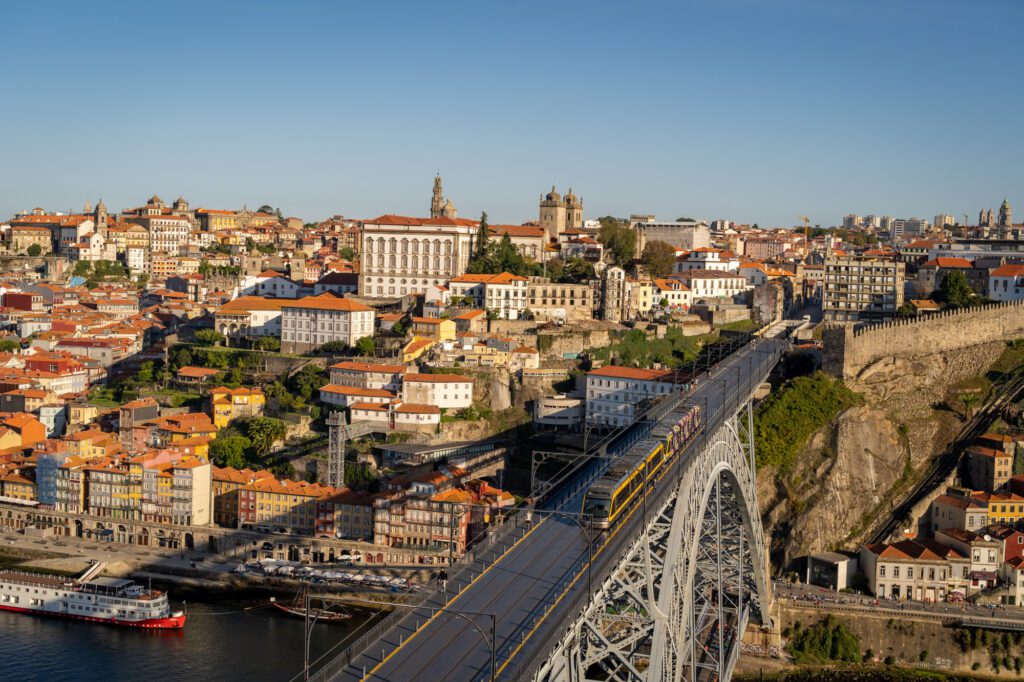
Sprawling down the slope of a hill overlooking the Douro River, Porto is a lovely city to spend a few days exploring.
It’s full of history, has a more progressive food and drink scene than you find elsewhere in Portugal, and features plenty of amazing views around every corner.
In this guide, we’re not going to give you a list of every single museum, park, and viewpoint that you could possibly see in Porto.
Instead, we’ll give you a blend of the main attractions in Porto – what they are, some brief (ish, I’m not known for brevity) historical context, and how to see them – but we’ll also give you some of our other favorite things to do in Porto that a lot of people just skip altogether.
Which, to be honest, is mostly walking, eating, and drinking, with a few magnificent views sprinkled in for good measure.
Armed with that (and our guide to planning your Porto itinerary), you’ll be ready to plan a trip that will go a level deeper than most and learn about the different aspects of Porto’s history and culture that have shaped the city as we know it today over the several centuries it has been in existence.
Learning is our favorite part of travel, which you’ll probably realize as you read this.
Sound good to you? Let’s get into it.
Disclaimer: Some of the links in this post, like hotel links, are affiliate links, meaning at no additional cost to you, we make a little bit of money if you click through and book. That being said, we would never recommend something to you that we don’t stand behind 100%.
Take a Walk Through Porto’s History
There are multiple reasons why we strongly recommend a walking tour as the very first thing you do in a new city.
First, it’ll help you get oriented to the new city and figure out where everything is and how it all fits together.
Second, you’ll get a quick history lesson with all the context you need to set yourself up for a much richer, deeper experience on the rest of your trip.
Last, and arguably most importantly, you’ll get to connect with a local who can help you figure out where to eat and drink (and what to see and what to skip) so that you can make the most of your trip.
We have done A LOT of walking tours around Europe over the past decade or so of building this corner of the internet, and we’ve come to the conclusion that the best walking tour guides have a combination of subject matter expertise and a certain flair for storytelling and drama to make it all fun and digestible.
We’ve done multiple walking tours in Porto now, and the clear winner is this history-focused walking tour with Carlota, which starts at the cathedral, makes a big loop down to the water and back up the other hill, and ends at São Bento station (the one in the center with all the azulejos).
It’s a journey through the city’s history that starts with the Kingdom of Portugal’s first kings, and makes its way through time to modern day.
Along the way, you’ll visit a couple of excellent viewpoints, walk through the oldest parts of Porto, and get some valuable tips for the rest of your trip (like where to eat and what to drink).
If you’re looking for something to do on your first day that will set the rest of your trip up for success, this is it!
Click here to check prices, availability, and book your tour with Carlota.
Get out on the Water at Sunset
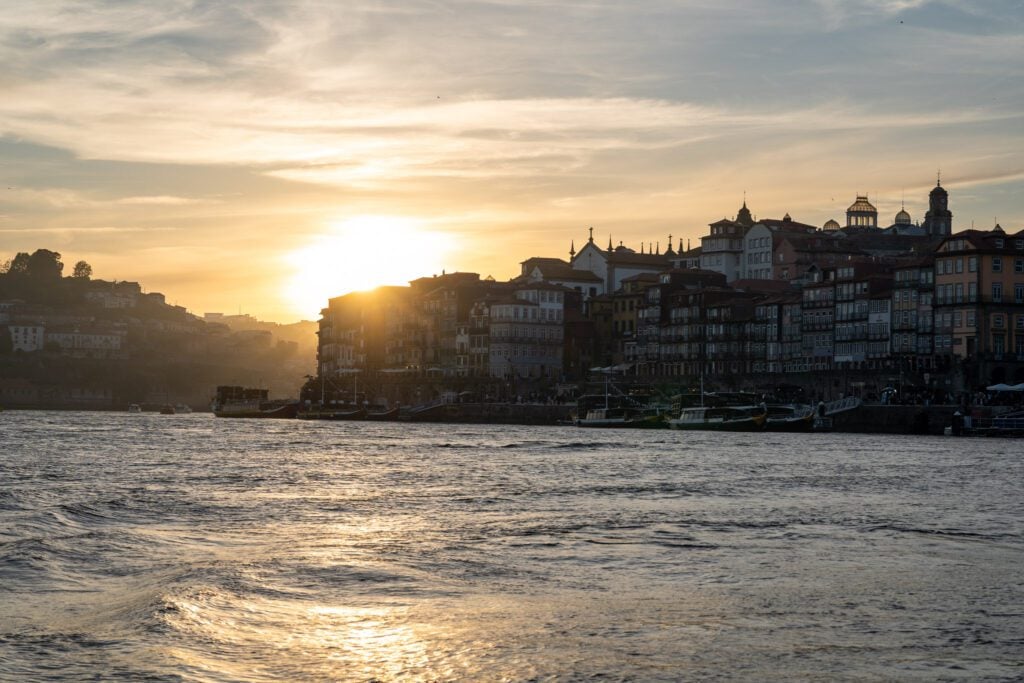
One of the best things we did on our last trip to Porto was something that was a spur of the moment, last second booking that turned into an incredible evening.
On previous trips to places in Europe, I’ve been very skeptical of any type of river or canal cruise because it feels like it’s too “touristy”, for lack of a better word.
Now, you should know that I hate the word “touristy” because, frankly, everything you’re reading in this guide is “touristy” in the sense that locals in Porto probably aren’t going to the cathedral, visiting the waterfront, or eating a pastel de nata at one of the famous spots all that often.
And that’s okay!
For example, I can count the number of times I walked across the Golden Gate Bridge when we lived in San Francisco for 10 years on one hand (really, on a single finger).
Does that mean you shouldn’t do that just because local residents don’t? Absolutely not. In fact, I’d strongly recommend that you do!
Anyway, back to the river cruise.
Over the past few years, I’ve come to realize that getting out on the water allows you to see the city from a completely different perspective, and it’s particularly impactful in cities like Amsterdam and Venice which are so clearly shaped by water.
Porto is another city shaped by water, between the wine industry bringing barrels up and down the Douro River, and the Portuguese Golden Age that was fueled by exploration via the Atlantic Ocean.
Now, there are dozens of different river cruises along the Douro branded as “Six Bridges” because they take you past, you guessed it, six different bridges en route to the mouth of the river where it meets the Atlantic.
We were looking for a smaller boat with a group of 10 or so, which is going to be a more intimate experience.
After searching through a bunch of different options, we found this river cruise with a sunset option that was on a small boat with snacks and three different wine tastings.
I went in not expecting too much from the captains, but I was truly impressed with the guides and their warmth and willingness to chat and engage in conversation along the cruise.
For example, it’s how we discovered the Jardins do Palácio de Cristal as a must-visit sunset spot that locals actually go to (more on that below).

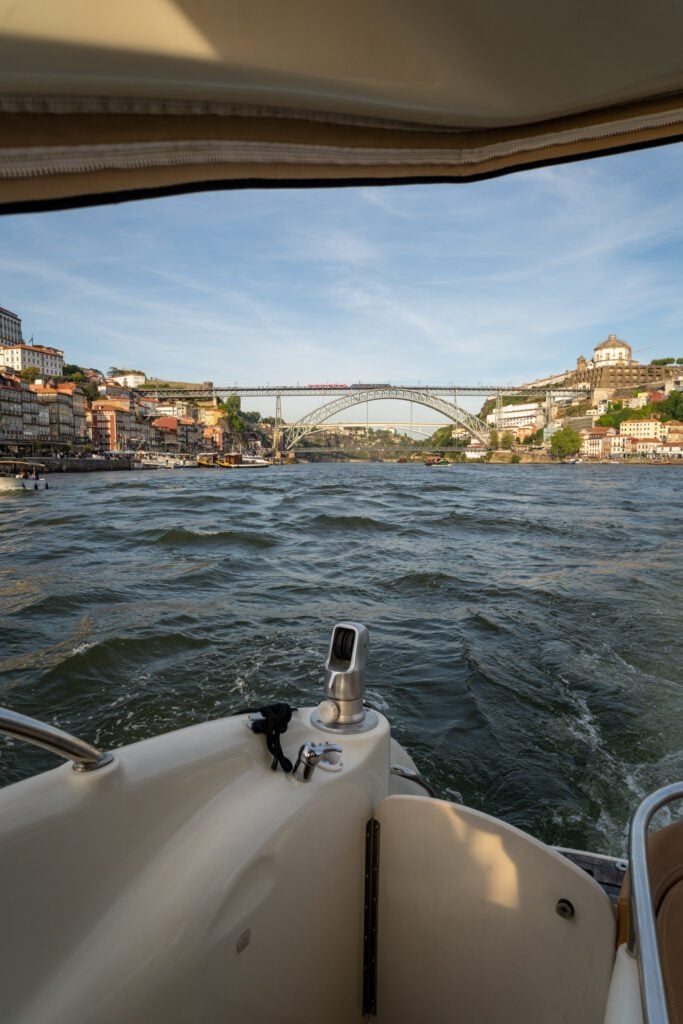
It’s also worth noting here that the best vinho verde we’ve ever had in Portugal was on this boat, which is kind of funny but speaks to the level of care that they put into the experience.
They have multiple sailings a day, including one in the late afternoon around sunset, which is the one we’d recommend if you can swing it.
Click here to check availability, pricing, and read reviews for your Douro River Cruise.
The meeting point is at a marina to the east of the city center (here on Google Maps), and you’ll have to either take a bus to get there, or call a rideshare or taxi.
For what it’s worth, we took the bus there, and took a rideshare on the way back.
Make sure to use the bathroom right before the cruise leaves, because there’s no bathroom on board the small boat.
Devour Pastéis de Nata by the Dozen
Depending on where you are in your foray into Portugal, you may or may not have already eaten a pastel de nata (or many, no judgment), the famous egg custard tart that we’ve seen popping up all over Europe.
If you’re not already familiar with the popularized origin story behind the pastel de nata, allow us a few paragraphs to introduce you to an example of business saviness.
The story goes that the monks at Jerónimos Monastery in Lisbon (west of the city center in a suburb called Belém, which is now part of the city) used a ton of egg whites to starch their robes, and they would use the leftover yolks to make tasty treats, which is why you see all sorts of different sweet egg yolk-based pastries in Spain and Portugal.
Combine that abundance of egg yolks with a never ending supply of sugar from Portugal’s overseas adventures, and you have yourself a recipe for a nice egg custard.
Stick it in a pastry shell and voila, a tasty treat!
In the early 19th Century, all religious orders in Portugal were ordered to be closed, and the monks started selling their sweet treats – an earlier version of the pastel de nata – to keep the proverbial lights on.
The monastery ceased operations a few years later, and the recipe for that tasty treat was sold to the sugar refinery nearby, which eventually opened up Fábrica de Pastéis de Belém a block or two from the location of the monastery, and the pastel de nata was born.
If you really want to get deep into the history and technique behind a pastel de nata, we’d recommend checking out this cooking class in Porto where you’ll make pastel de nata from scratch over the course of a few hours.
We love doing cooking classes and often come home with a recipe that sticks (for example, we make chicken cacciatore all the time that we first made in a cooking class in Tuscany), but a pastry class doesn’t make sense for us from a gluten perspective.
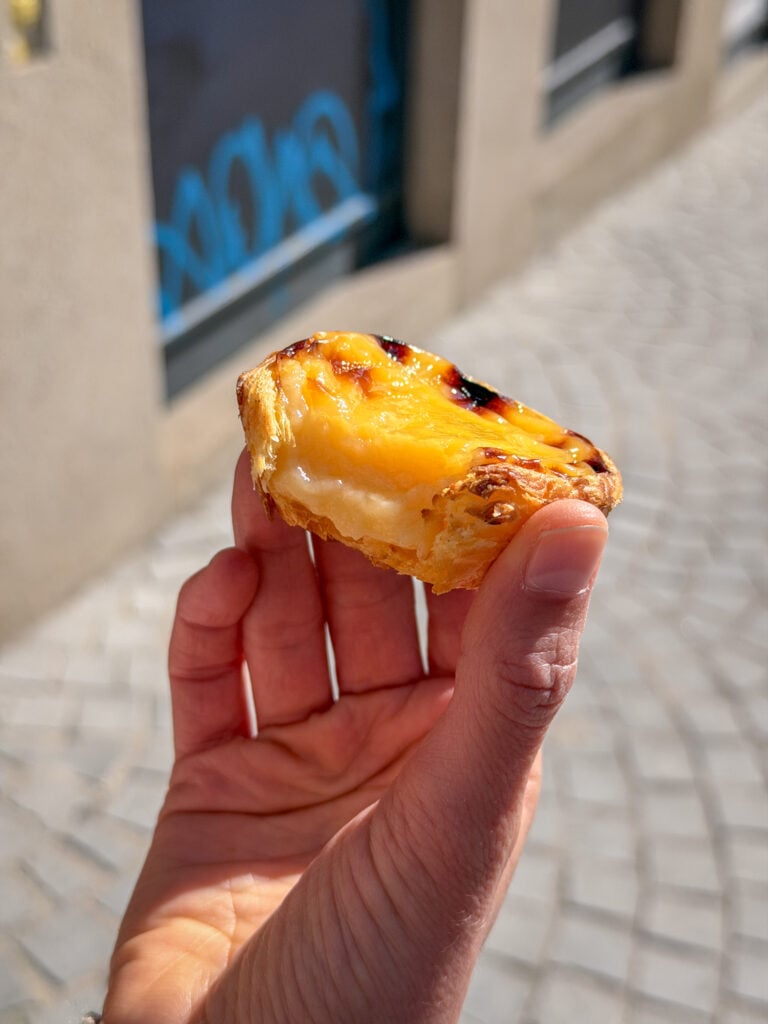
Now, you can get a pastel de nata at just about every bar and cafe in Portugal, but the real question is where can you find the best example of the pastel de nata, with a crispy pastry crust and ooey gooey egg custard (with the perfect dusting of cinnamon to top it all off)?
The answer is… it depends.
On our very first trip to Portugal, we were set on finding the best pastel de nata in both Lisbon and Porto.
I, Matt, the resident Celiac, did not get to participate, but Alysha and my two brothers ate their bodyweight in nata over the course of two weeks or so.
It turns out that the best pastel de nata is the one that is relatively fresh and warm, rather than being from a specific place.
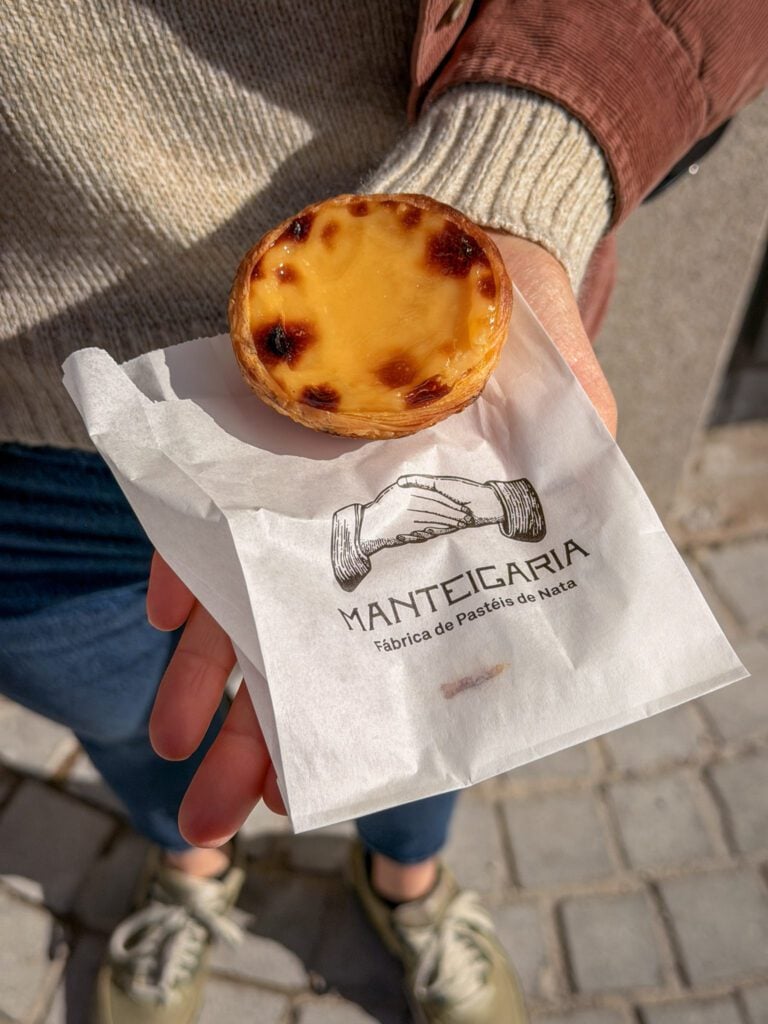
Though, I will say that we found that we got the freshest and warmest pastéis (that’s the plural version in Portuguese) most consistently at Manteigaria, which has locations in both cities.
In Porto, we have two recommendations for you.
First is Castro, a historic Fábrica down near the river (here on Google Maps), which is the place that multiple walking tour guides recommended. They started in Porto, and only recently expanded out to Lisbon and other parts of Portugal.
The second recommendation is Manteigaria, which has a couple of locations in Porto, including two near Mercado Bolhao (here and here on Google Maps), and one near the Torre dos Clérigos (here on Google Maps).
This was our favorite on our first trip, and Alysha went back this time just to confirm they were still delicious. You know, for science.
If, like me (Matt), happen to be eating gluten free, there are a couple of places to get a gluten free pastel de nata while you’re in Porto.
First is Com Cuore, which is right in the center of the city. It’s fine, but it wasn’t our favorite gluten free bakery in the world (it’s also cash only).
Second is Padaria CELÍCIAS, which is by far the best gluten free bakery in Porto, but it’s a longer journey to get there because it’s up on the hill in Vila Nova de Gaia (we took the bus from Ribeira, and it was easy).

Worth the journey for gluten free foodies, and they have a wide variety of gluten free pastries, sandwiches, and treats.
Try a Bifana and a Franchescina
Aside from the pastel de nata, the other food items that you shouldn’t miss while you’re in Porto are two sandwiches with vastly different philosophies on what makes a sandwich special.
The first sandwich is called a bifana, and it’s something you’ll find all over Portugal, though every region has its own slightly different spin on it (and claims they have the original, of course).
The bifana is a relatively simple and straightforward affair, with thin slices of pork boiled in a tomato-beer sauce until tender and then stuffed into a spongey roll before getting one last spritz of the sauce on top.
Get this one without cheese, which is the traditional way to eat it.


The francesinha, on the other hand, is anything but “simple.”
It’s a big, rich gut bomb that is kind of similar to a croque monsieur. This is the sandwich that Porto is specifically known for.
You start with two thick slices of bread, stuff a variety of meats (usually some combination of sausage, beef, and pork) in between them, top it with cheese, and pour a generous dose of a piping hot sauce made with tomatoes and beer over the top of it to melt the cheese and soak the bread.

For us, it’s the kind of sandwich that we want to try exactly once, and probably never again.
If you want to try both sandwiches, our recommendation (which came from a recommendation from a walking tour guide) is to head over to Conga (here on Google Maps).
They’re known for their bifana (you can see the meat stewing in the window as you walk by), but they also serve the francesinha. Two birds, one stone, but there are better versions of the francesinha to be found around Porto.
We made my brother (who has no issues with gluten) try a bifana here when we were in Porto together, and he enjoyed it. Eat at the counter with a beer or glass of wine.
If you want to try the places that are specifically known for their francesinha, there are two good options that have been recommended to us (I always ask even if I can’t personally partake).
The two places are O Afonso, which is the place to go for the most traditional experience, and Casanova is a place to go if you’re vegetarian and want to try a version of it without meat (though they also have regular versions).
If you’re gluten free and want to try a francesinha, go to Tasquinha do Bé down by the river, which has a gluten free option that gets good reviews. Make a reservation if you can, because it’s both small and popular.
Dive Deeper into Porto’s Food Culture on a Tour
Diving into the food culture in places we’re visiting is one of our favorite aspects of traveling, and we try to include a food tour, cooking class, or market tour in most places we visit.
The food of a place tells you so much about the culture, history, and influences that have shaped it, and exploring a city through its food scene is a unique perspective that a lot of people don’t even consider.
If you are really interested in going deeper on food culture in Porto, we would highly recommend booking a guided food tour while you’re in town.
Unfortunately for us, the reality is that because Matt has Celiac Disease and can’t have even a speck of gluten without being sick for days, a food tour or cooking class wasn’t in the cards for us in Porto.
HOWEVER. That does NOT mean it shouldn’t be for you!
We’d highly recommend it because it gives you a local’s perspective on the city’s food scene – what and where to eat and drink – and you get to connect with fellow travelers and try some amazing food.
In this case, the food tour we’d do is this food tour with Isa, a Porto local who will take you on a culinary journey into the city’s rich history through the lens of food.
The big benefit of doing a food tour is that the guide probably has more knowledge of exactly what to eat AND where to eat it, and Isa checks that box (you will visit places you never would have found on your own).
The reason we recommend it? My mom did that tour on her trip a few years ago and she LOVED it (and still raves about it to this day).
Click here to check prices, availability, and read reviews of Isa’s “Eat Like a Local” tour.
Dive into the World of Port Wine

Port is a type of fortified wine that comes specifically from the Douro Valley, just to the east of Porto.
It’s typically pretty sweet, and it comes in many forms including more fruit-forward ruby ports (which are aged for a shorter period of time), to the more prestigious tawny ports, which are aged to perfection.
There are a couple of different approaches to learning about port wine, and which you choose essentially comes down to how much time you have and how interested you are in the history and craft around port.
We’ll give you two options in the order in which we’d recommend them, starting with the most intensive (visiting a port house in Vila Nova de Gaia) and then giving you a lower commitment option.
Whatever you do, don’t miss ordering a “porto tonico” (a port tonic), a delightful combination of white port, tonic, and a slice of citrus. We make these at home for friends and family all the time because it’s so simple, refreshing, and delicious.
Here are the two options we’d consider.
#1: The Full Port House Experience in Gaia
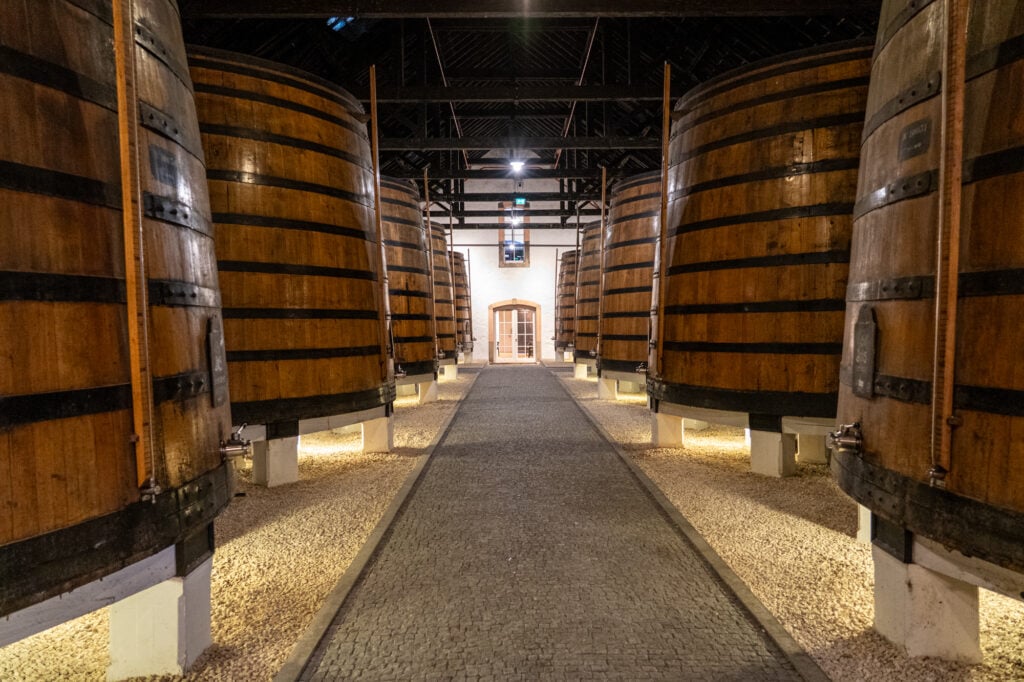
First is to do the full port house experience, which involves heading over to Vila Nova de Gaia for a guided tour of one of the places where port is made, followed by a guided tasting of a few of their ports.
If you follow the Douro River, the river that runs through the center of Porto, out to the east, you’ll quickly find yourself in a world of rolling hills and terraced vineyards.
If you haven’t already budgeted time to go out to the Douro Valley, you should.
It’s pretty spectacular – we did this excellent full day tour (with a local company based in Porto) and it was the highlight of our entire three month European adventure.
Since then, we have sent hundreds of friends, family (including Matt’s mom), and readers on the exact same tour.
Don’t worry, we have an entire section below on the day trip to the Douro Valley.
While the grapes are grown out in the Douro Valley, which is the oldest recorded denomination of origin in the world (like Champagne, it can only be called “port” if it’s made with grapes from the Douro and in a specific way), the aging process happens in the city of Vila Nova de Gaia.
Vila Nova de Gaia is a completely separate city from the city of Porto despite being just across the river.
If you look from Porto across the river, you’ll see countless signs marking the location of port houses dotting the hillside (though the city itself extends quite a bit beyond that hill, and is several times the size of Porto).
Port has to age quite a while in barrels before it can be sold (part of the reason why it’s so expensive), and port houses have these big, vast warehouses that are filled to the brim with barrels full of port.
The reason they’re over in Gaia (rather than in Porto) is simple: real estate is cheaper, and taxes were historically lower.
The other unique thing you may notice is that, for some reason, all of the port houses have British names like Taylor, Sandeman, and Graham.
The reason behind that is the fact that Britain and France fought a series of near-constant wars throughout the 1700s and 1800s, and importing wine from France to Britain became problematic.
Some British guys visited Portugal and came across port wine, and they decided to invest in the industry to fill the void that French wine had left.
Fast forward several hundred years and what you have is an industry rooted in Porto’s land and traditions, but almost entirely run by a bunch of Brits.
If you’re interested in visiting a port house that was established by a Portuguese family and has been in Portuguese hands since, Ferreira is the place to go.
They have a similar variety of tasting experiences, including cellar tours and higher end tastings if that’s what you’re looking for.
We personally visited Graham’s, which is perched high up on the hill with some excellent views out over the Douro River and Porto.
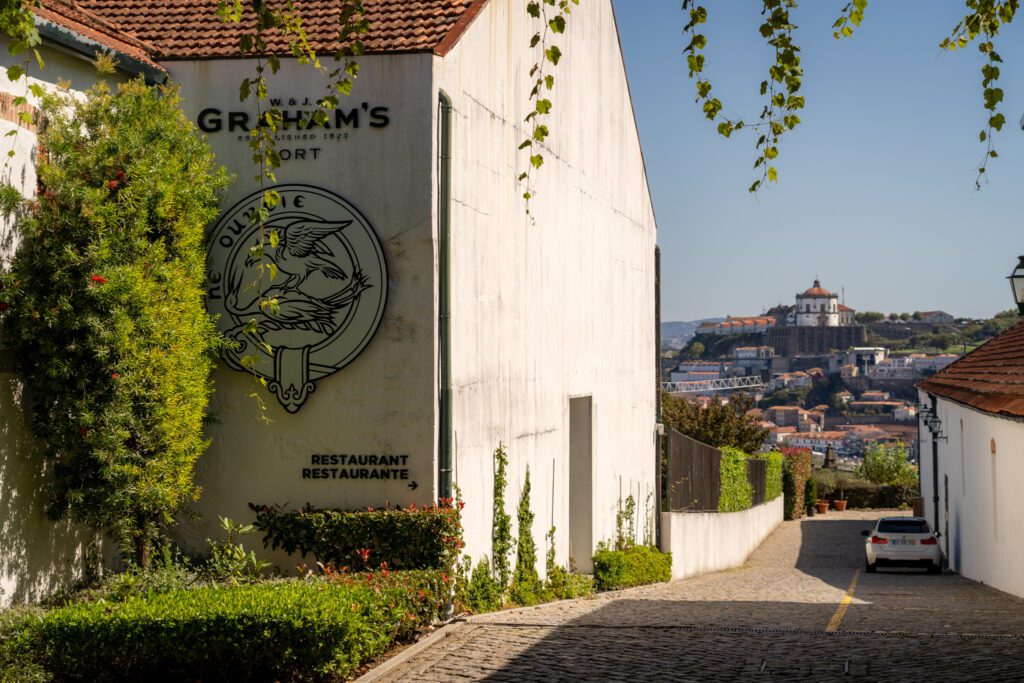

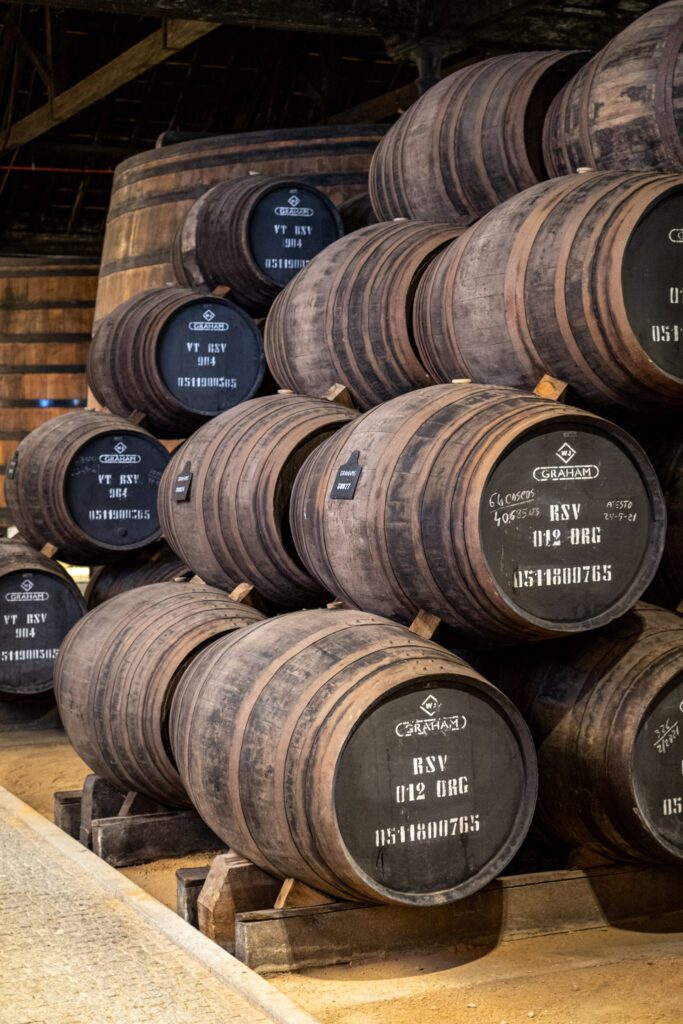
It’s one of the biggest names in the industry, and it’s the port we see most often here at home in the US.
You’ll want to book a tasting in advance because they do sell out during high season.
They have a couple of different options, some of which include tastings of more prestigious (read: more aged) bottles.
#2: A Port Tasting with an Expert
If you don’t have a half day to spend on heading over to Gaia and visiting a port lodge, a good compromise is this 90 minute guided tasting, which takes place in Porto down near the Palácio da Bolsa near the waterfront.
In some ways, we think this is a better way to actually learn about port than the port house tours because you’ll be focused on the history and craft of making it rather than the history of the family that owns the particular winery you’re at.
Plus, you’ll get to taste a selection of the best port across different producers, rather than ports from a single producer.
However, there is something to be said for being in “the room where it happened”, which is why our top recommendation would be doing the full cellar tour and tasting.
We almost did this class on our last trip to Porto, but we were both feeling a little under the weather after our trans-Atlantic flight and didn’t think it was a great idea.
You’ll taste five different types of port, learn about the way it’s made and the history and culture around it from a sommelier, and meet some like-minded travelers along the way.
Seek out the Best Miradouros around the City
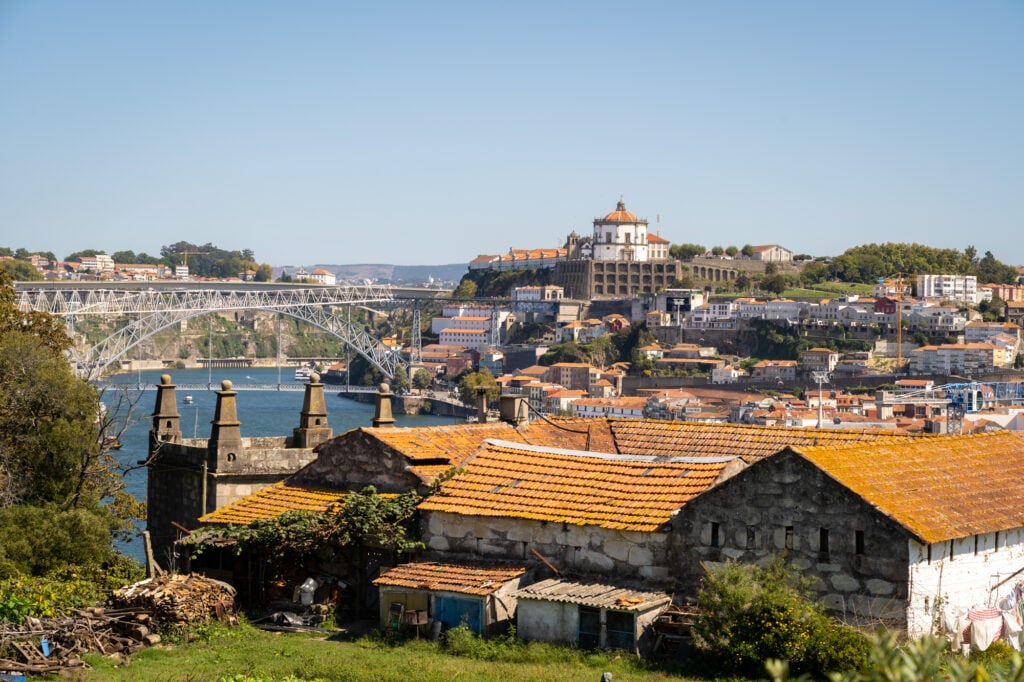
As two people who lived in San Francisco for nearly a decade know, a city built on a hill means two things: you should be prepared to sweat going up the hill, and there are excellent views waiting for you when you reach the top.
In this case, Porto is built on the northern bank of the Douro River and looks out across the valley to Vila Nova de Gaia, which is built on the hill on the opposite bank.
Between hills on the two sides of the river, there are some truly magnificent miradouros to be found (miradouro is the Portuguese word for “amazing view”, basically), and we’re going to tell you exactly where to find our favorites.
Unfortunately, we’ve heard from people that Miradouro da Vitória (here on Google Maps, in case it reopens) is closed, which is a shame because it’s a great view.
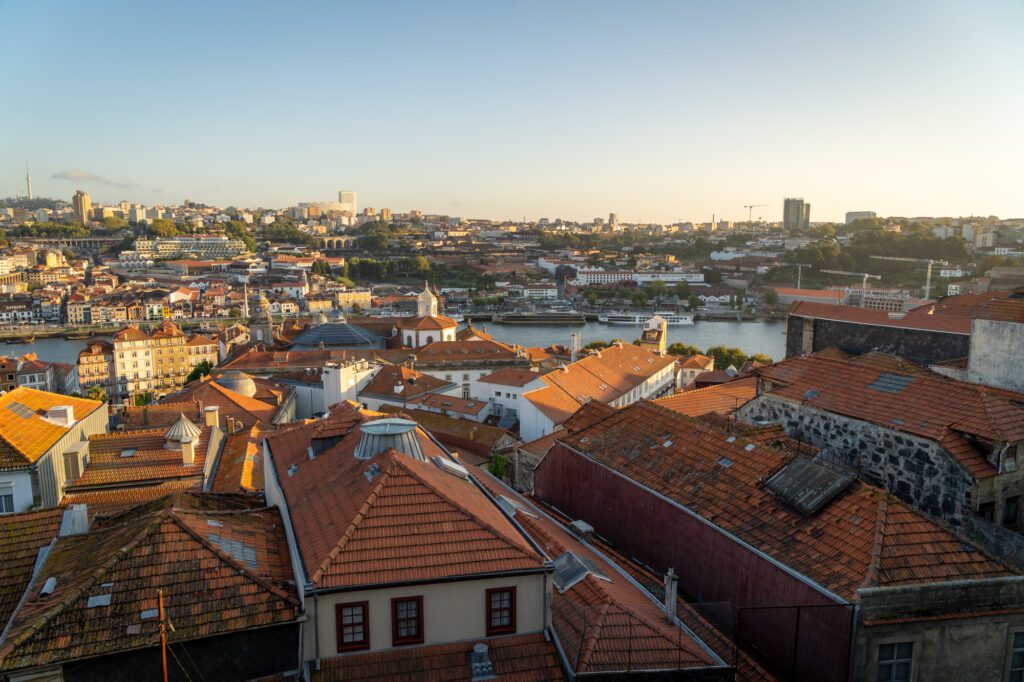
However, on every single one of our trips up there, we were sad to see a ton of trash (beer bottles, etc) at the viewpoint, so it kind of makes sense that they had to do something about it.
Don’t worry, there are plenty of other nice views of the city to be found.
Miradouro da Serra do Pilar
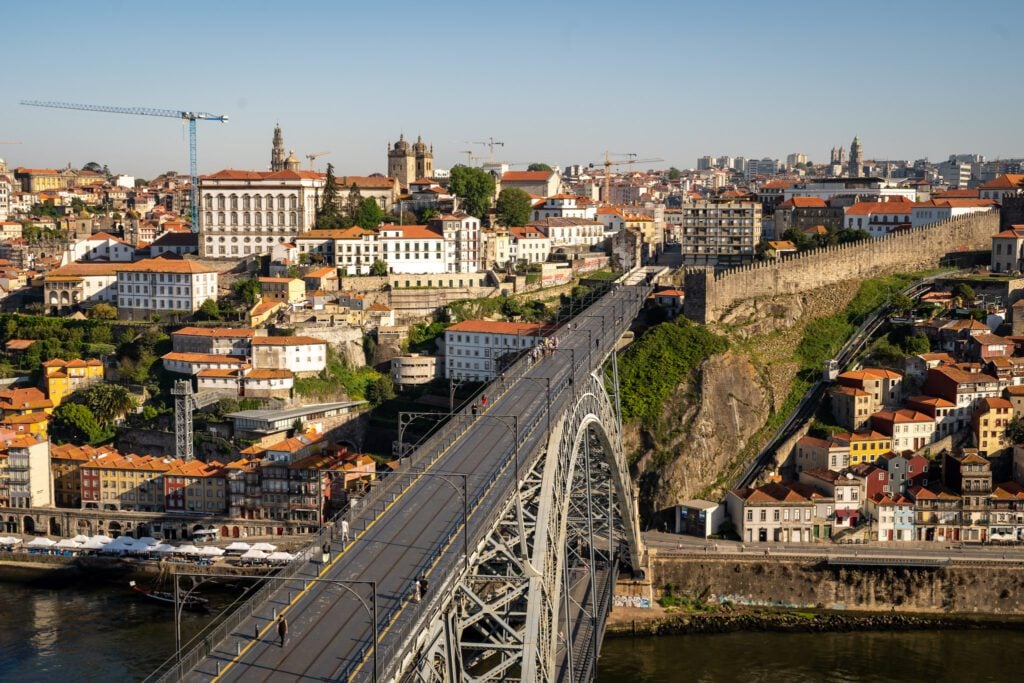
Our favorite viewpoint in the entire city, this miradouro is directly across the Dom Luís I Bridge (on the top deck)
To reach it, you have a couple of options.
You can walk from the Sé do Porto (on the Porto side of the river) across the top deck of the bridge (which also gives you some really nice views) and then up to the viewpoint.
You can also take Line D of the metro from the Porto side to Jardim do Morro, which drops you off at the base of the hill up to the viewpoint.
If you’re coming from the Gaia side, you either have to walk up from the waterfront, or you can take the Teleférico de Gaia (the cable car that connects the waterfront with the top of the hill) up, though that costs 7€.
Find it here on Google Maps. Worth noting that the view from the Jardim do Morro across the street is also really nice.
Torreão do Jardim do Palácio
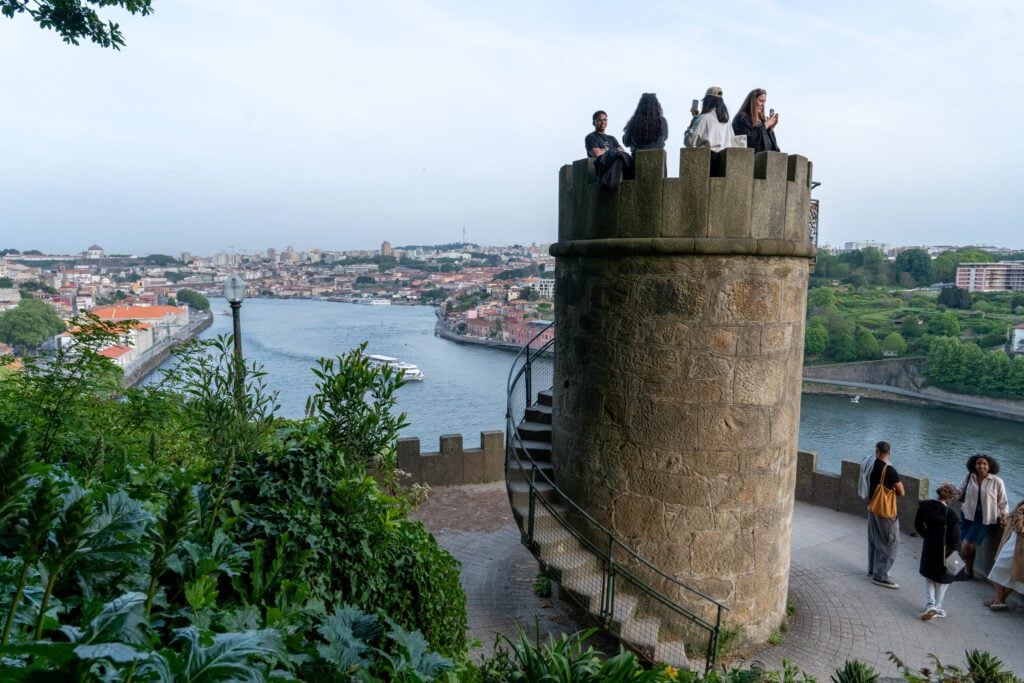
This viewpoint was pointed out from the water level on our sunset river cruise as we passed by it on our way out towards the Atlantic Ocean.
The captain of the boat said that this is where locals actually go to see the sunset (rather than going to the Jardim do Morro, which is absolutely packed with tourists around that time).
Sure enough, a few nights later when we made our way out here, there was basically nobody there except us, a couple of residents taking pictures in fancy attire, and a smattering of people enjoying a picnic in the park.
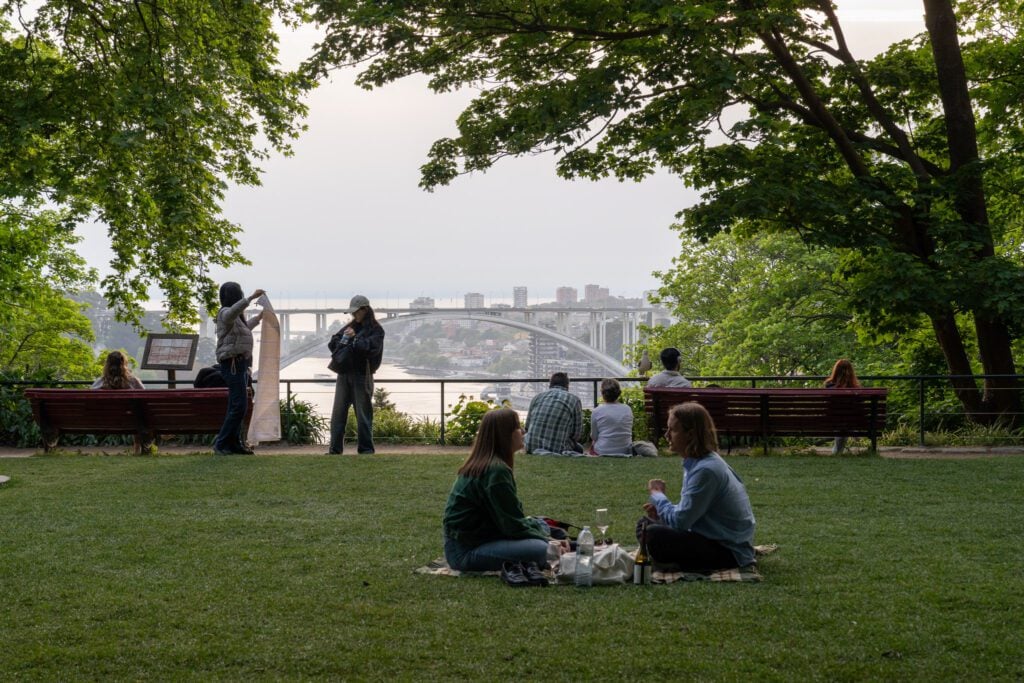
At the far end of the park, there’s a tower with a commanding view out over the river and Gaia, though you can’t see much on the Porto side.
To get there, it’s a short walk or bus ride west of Igreja do Carmo. There’s a really nice set of gardens – the Jardins do Palácio de Cristal and the Jardim dos Sentimentos – clustered around a (really ugly) arena – Super Bock Arena – that are filled with great views and peacocks.
Find the tower here on Google Maps.
Miradouro das Fontainhas
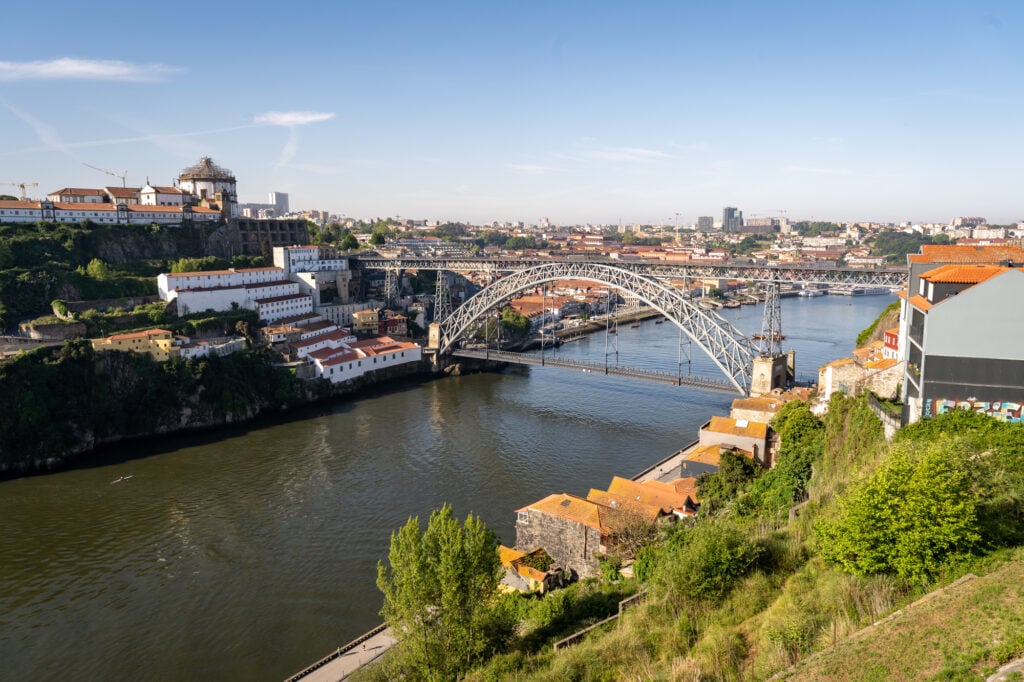
This is a viewpoint just west of the Dom Luís I Bridge that has a really nice view of the bridge itself, along with the former church (now military facility) up on the hill above where you find the first viewpoint we mentioned in this section.
To get there, it’s a short walk west of the Porto side of the bridge, and you’ll leave the main road to descend a short hill to a parking lot, which is where you’ll find the best view.
If you’re coming from elsewhere, you can take the metro to São Bento and walk from there, or take the bus (lines 400, 904, and 905 work) to L.go 1º Dezembro.
Find it here on Google Maps.
Check out Some Azulejos
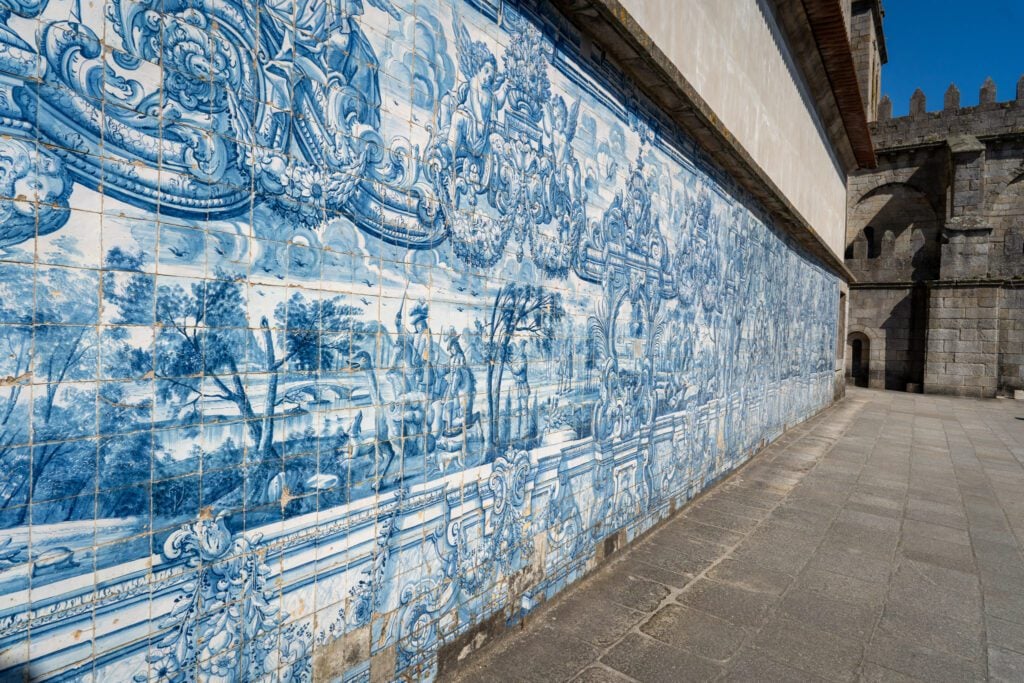
Even if you’ve never heard of an azulejo before you set foot on Portuguese soil, within a day or two of being here, you will almost certainly come across them.
Particularly in Porto, where they are more prominent in no small part due to Lisbon’s big earthquake a couple hundred years ago.
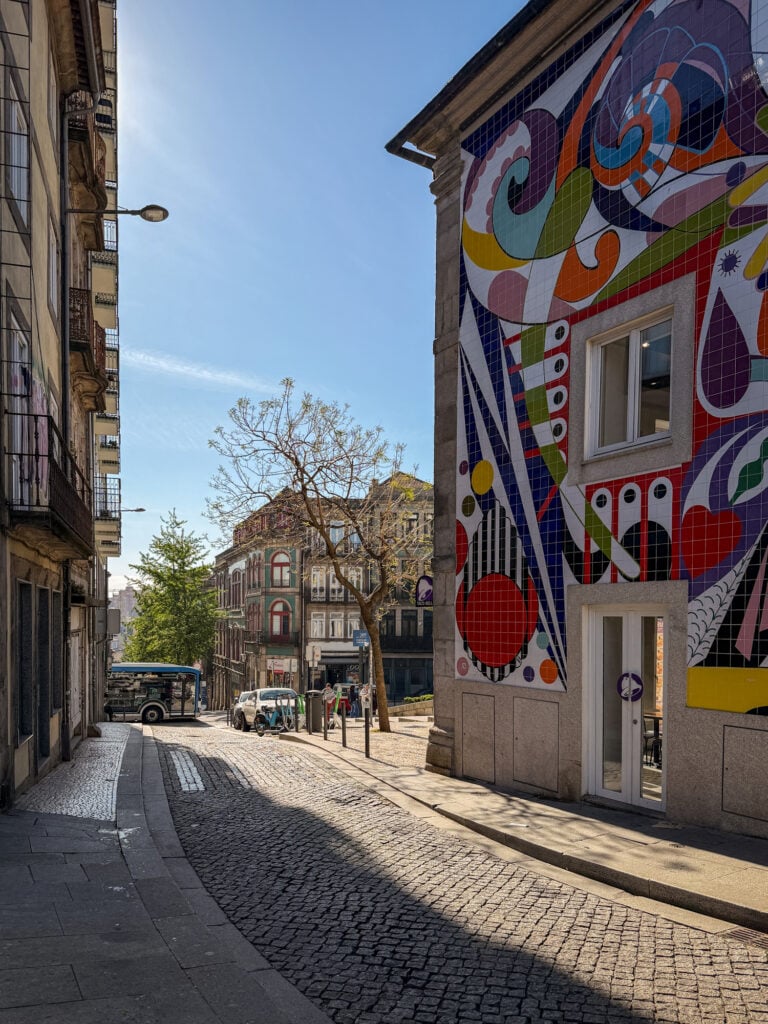
Azulejos are a blue and white (usually) painted tile that you’ll see adorning both interiors and exteriors of buildings around Porto.
It’s worth noting that they’re not just decorative (though they are beautiful and unique), they’re also useful for insulation of the buildings they’re on.
The production of tile on the Iberian Peninsula goes back hundreds of years, to when the Iberian Peninsula was controlled by a series of Muslim Caliphates from North Africa.
Like many things in Spain and Portugal, that history (which is often ignored) has influenced many of the most famous pieces of cultural heritage.
For a random example, you can take the word…azulejo. Which comes from the Arabic word al-zulayj, which roughly translates to “little stone.”
If you visit the Alhambra in Granada, you’ll see all sorts of painted tiles featuring geometric shapes in all sorts of colors and sizes.
The azulejos in Portugal have their own style and flair, and you often (but not always) see them in the famous blue and white colorway, organized into a mural that tells a specific story about the history of the place they’re in (often churches).
If you’re interested in painting your own tile as a souvenir (which I wish we had done), check out this tile painting class where you’ll have a tangible souvenir to take home with you to commemorate your trip to Portugal.
As you’re walking around Porto, you’re going to see beautiful tilework all over the place. Here are some of our favorite spots to see the blue and white, storytelling variety.
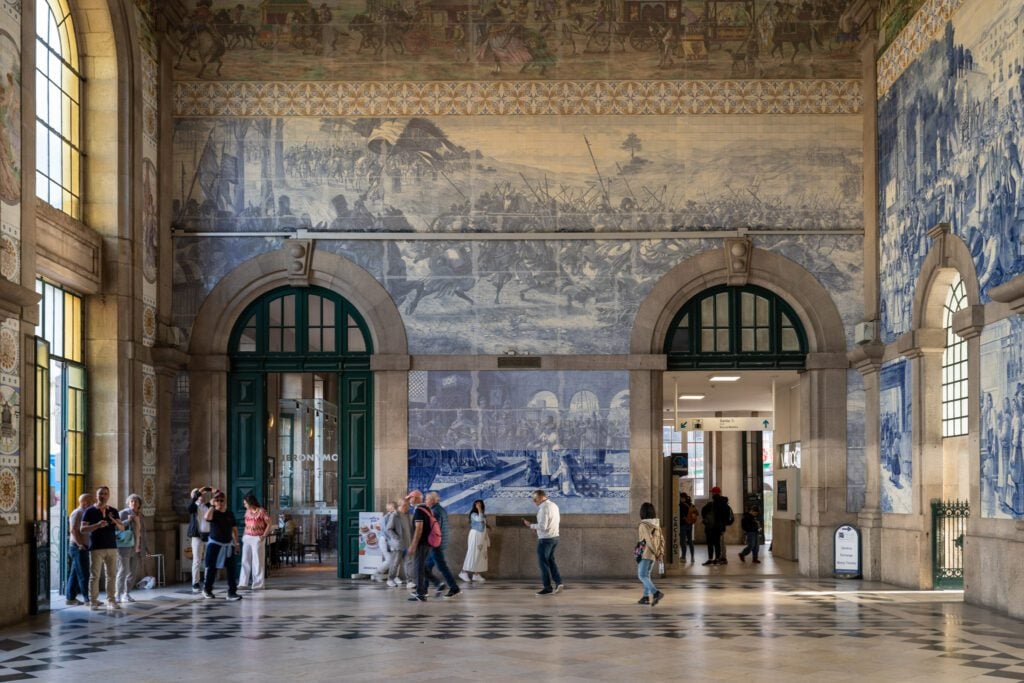
São Bento: The atrium of the train station in the center of the city is probably the single best place to get a feel for what azulejos are, with its floor to ceiling tiled murals in the classic blue and white colorway. It’s here on Google Maps.
Capela de Santa Catarina: The exterior tilework is relatively modern (it was installed in 1929), and features the stories of both Saint Francis of Assisi and Saint Catherine (who the chapel is named after). Find it here on Google Maps, just behind the Mercado do Bolhão.
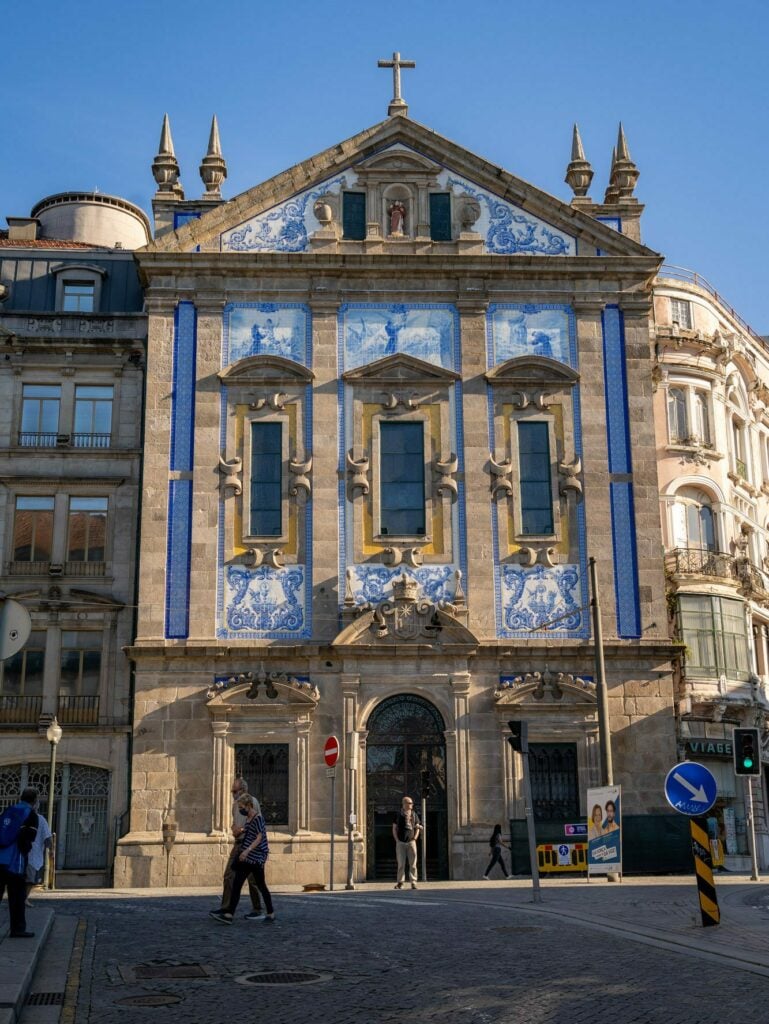
Igreja do Carmo: The side of this church is covered in the trademark blue and white tiles, and is probably the most impressive tile display of all the churches here. You can go inside for a fee, but the main attraction in terms of azulejos is right there on the outside of the building. Find it here on Google Maps, a few blocks from Livraria Lello and the Torre dos Clérigos.
Sé do Porto: We have a whole separate section below on the city’s main cathedral and how the display of azulejos in the cloister blew us away. Spoiler alert: you should visit, and you should try to go right when they open.
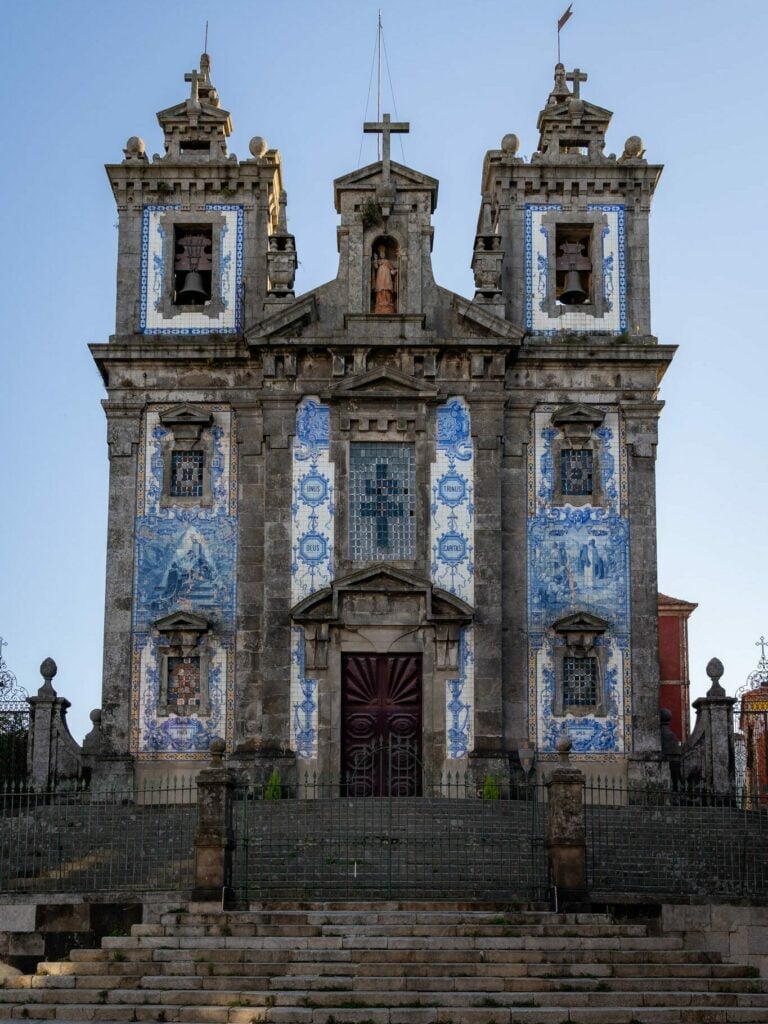
Igreja de Santo Ildefonso: This is another church with a tiled exterior, and it sits atop a small hill looking over a nice public square. The tiles on the exterior were completed in the 1930’s, telling the story of – you guessed it – Saint Ildefonso, while the church has been around since the 18th Century. Find it here on Google Maps, just behind São Bento Station.
Walk Across the Dom Luís I Bridge
If you’re looking for a nice walk that incorporates multiple incredible views of the city and the river, we’d strongly recommend a walk across the upper deck of the Dom Luís I Bridge from the Porto side to the Vila Nova de Gaia side.
You might have heard that there is a bridge in Porto that was designed by Gustave Eiffel, the same person who designed the Eiffel Tower.
Unfortunately, this isn’t it, and you can’t see it from this walk.
That would be the Maria Pia Bridge, which was built in 1877 to connect the railway to both sides of the river.
It’s no longer in use, but it’s still there and you’ll see it if you do a river cruise on the Douro.
Anyway, back to the Dom Luís I Bridge, which is honestly pretty similar to the Eiffel Bridge and was only built 10 years later.
There are two paths across the bridge – the lower deck at the water level and the upper deck, which is where the metro runs.
You want the upper deck for the views, which you can access from the Porto side by starting here, right next to the cathedral.
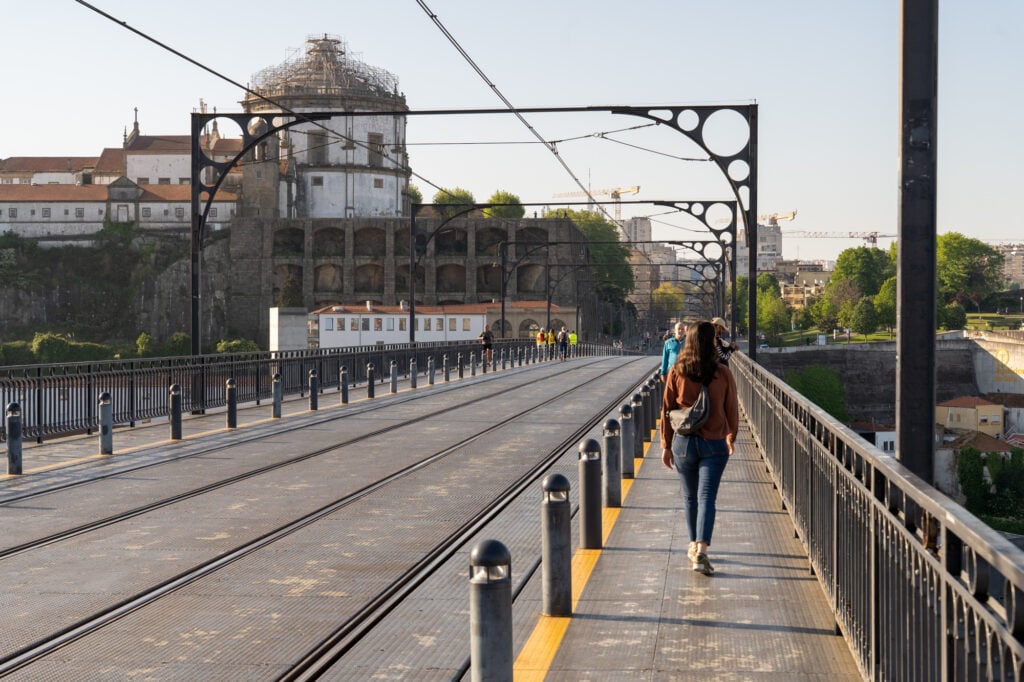
Walk on the western side (the right side if you’re heading across towards Gaia) for views of the river, and the two cities on either side. The view changes as you walk across, and there are some really nice views of both Porto and Gaia from up here.
Once you’re on the Gaia side, head up to the viewpoint next to the church on the left, Miradouro da Serra do Pilar (here on Google Maps), which you access by following the street for another block where you’ll find an uphill path that goes up the hill in the direction you came.
Another great view that includes both the city of Porto, but also the bridge in the foreground.
This is our favorite view in the city (though technically speaking it’s not actually in Porto).
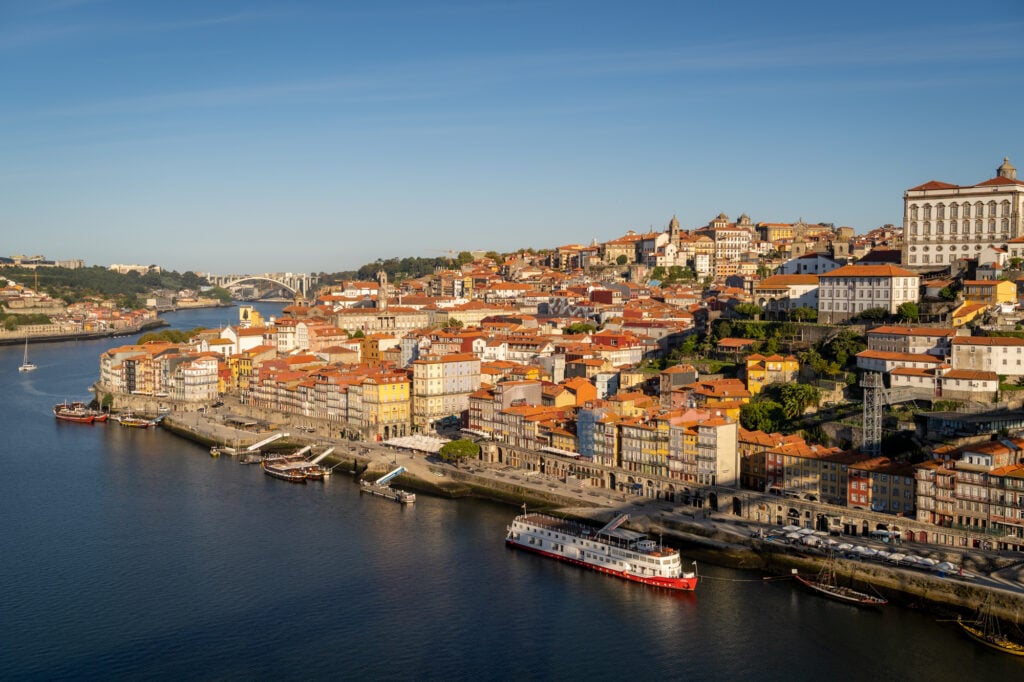
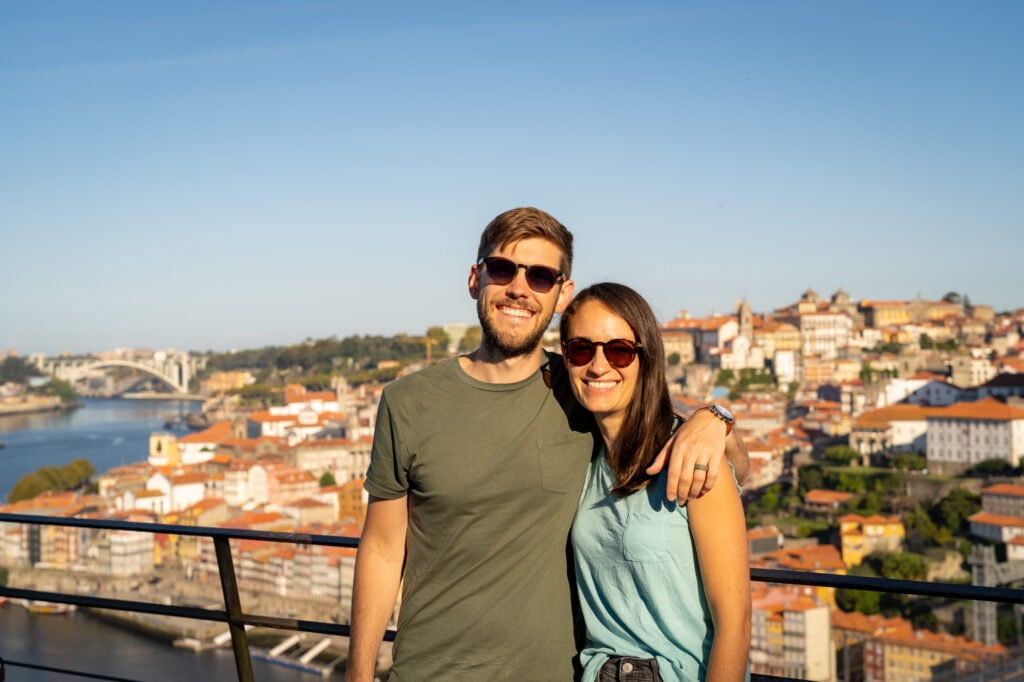
End with a walk across the street to the Jardim do Morro, a public green space with excellent views out to the west towards the ocean (that becomes a zoo around sunset time, when every tourist in Porto seems to make their way here to watch the sun set over the Atlantic).
From there, you can walk down the hill to the water level to visit the nice waterfront promenade on the Gaia side of the river, which has some excellent views back over to Porto.
There’s also a cable car – the Teleférico de Gaia – that you can take, but it makes a little less sense to pay for it going downhill, we think.
We like 7g Roaster, a local coffee roaster with a nice cafe a couple of blocks off of the water.
One important tip: we’d strongly recommend doing this in the early morning if you can, which is what we’ve done multiple times.
In the afternoon and evening, this is one of the most popular sunset spots in the city, and it is PACKED with people from the bridge up to the viewpoints.
In the morning, it’s you and some locals walking their dogs or out on a run. Much more pleasant!
Spend an Afternoon at the Mercado do Bolhão
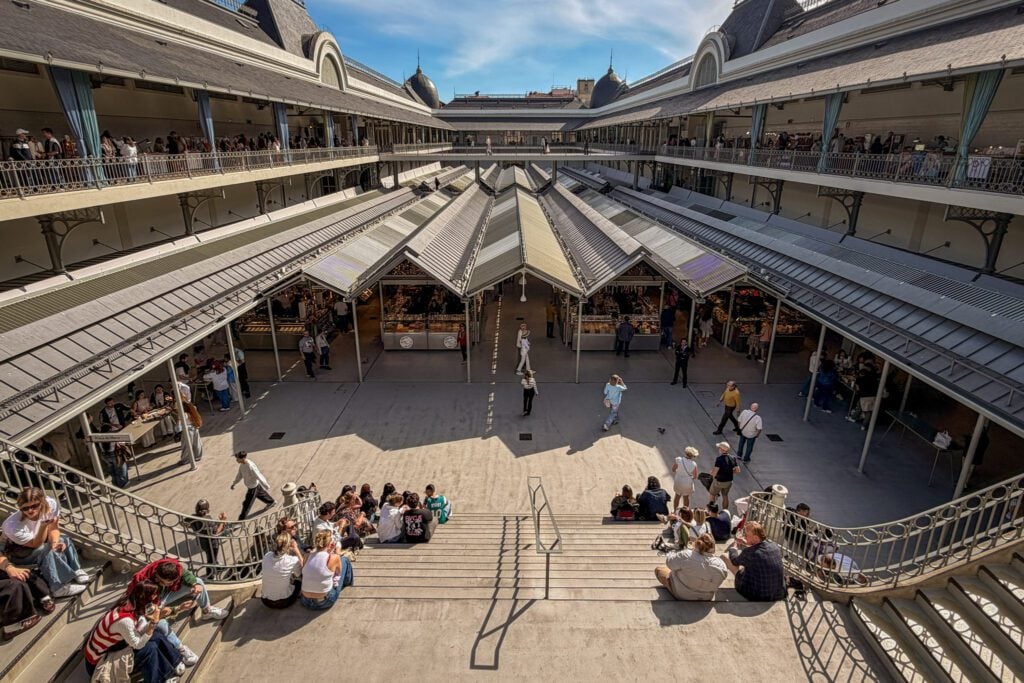
On our last trip to Porto, we stopped by our apartment to drop our bags on our first day and I asked the person at the front desk what we should do with our afternoon.
We had already chatted for a bit about our previous trip to Porto, so he knew that we had done most of the main attractions.
He thought for a second, and then he immediately lit up and said “have you been to Bolhão?”
The answer was no, and the reason we had not been to the city’s most famous covered market (to tourists, anyway) is the fact that it was closed for a years-long massive renovation.
When we were in Porto last, the renovation was underway, so we had to relegate it to our “next time” list.
Guess what? It was next time, and the beautifully renovated covered market was open!
He specifically mentioned the vibe in the afternoon, when people gather on the steps at the far end of the market with a glass of wine and some snacks (cheese, meats, crackers, oysters, etc etc) and soak up the sun before it dips below the roof.
We headed over, and he was absolutely right.
We love a good outdoor market (this one is mostly covered, but still counts), and the scene on the steps on that unseasonably warm sunny spring day was fantastic.
Our recommendation here is to do a little crawl, get some snacks and a drink, and set up on the steps at the north end of the market.
Crucially, from any given stall, we’d get the thing that stall specializes in (e.g. get a sandwich from the sandwich shop, cured meats from the meat stall, and a glass of wine or port from the wine stall).
Learn About Porto’s History at the Casa do Infante
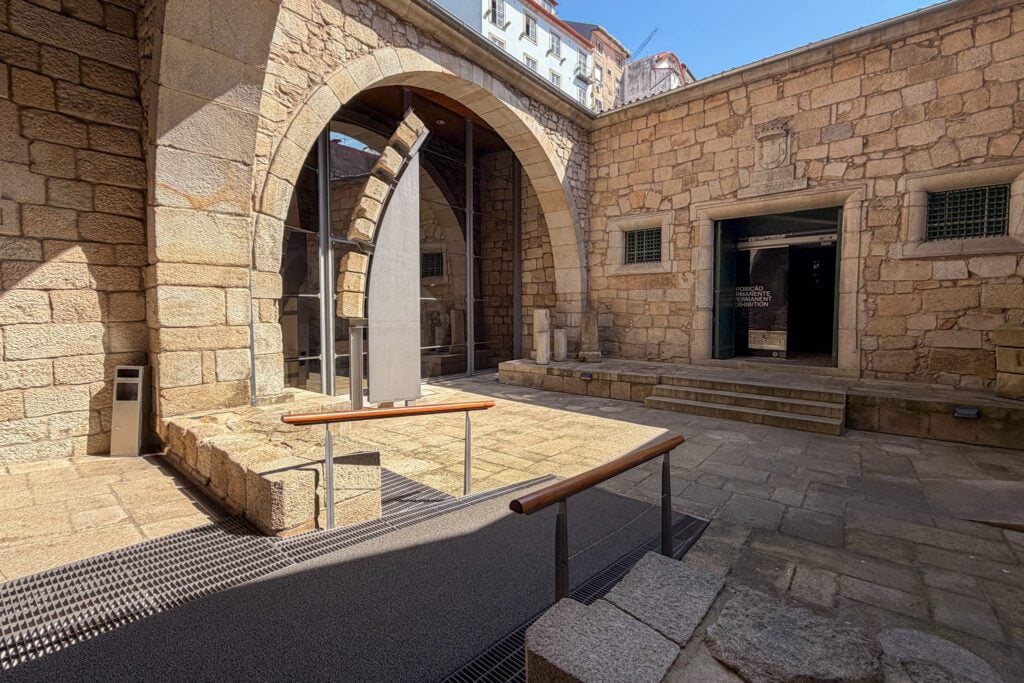
Look, this stop might not be for everyone, but Matt’s a history nerd and loves going to the small local history museum that you find in just about every city just to poke around and see what he can learn.
In Porto, that museum is the Casa Do Infante, which is in the old customs house from the 14th Century located half a block from the river in Ribeira.
This is, allegedly, the birthplace of Henry the Navigator (nobody knows if that’s actually true), and they have a nice exhibit on Henry that points out that he was not, in fact, much of a navigator, but he financed many of the expeditions that built Portugal’s colonial empire.
I guess “Henry the Financier” isn’t quite as cool of a nickname as “Henry the Navigator”.
The coolest part of this compact museum, however, is the interactive 3D model of the city’s expansion over time, which has a nifty little laser pointer tool and helpful narrations (in English) that you can use to delve into different topics that cover the city’s history.
It might be the single coolest thing I’ve ever seen in one of these local history museums, and I was thrilled to discover it and spent 20 minutes pushing all the buttons to hear about all of the different aspects and chapters in Porto’s history.
Step Inside the Sé do Porto (Porto Cathedral)
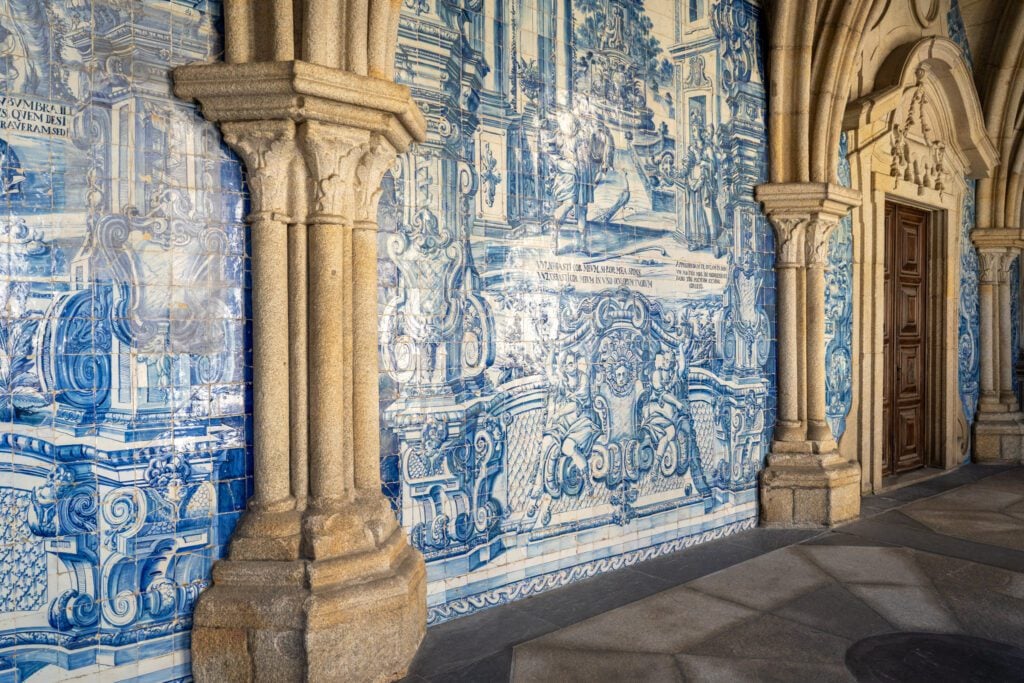
The Catedral do Porto was the unsung hero of our latest trip in terms of the things we did.
I went in with relatively low expectations, and the experience blew them out of the water and made the 4€ entrance fee well worth it.
I was skeptical mostly due to the fact that the area outside seems to be either the meeting point or a key element of every single tour in Porto, so it’s constantly packed with huge tour groups wandering around semi-aimlessly.
One note at the top here: we would go here as early as you can, because when we entered a little before 10am, there were a handful of people in line to get in, and it was relatively calm inside the complex.
By the time we left, maybe an hour later, there was a long line snaking around the building. Go early!
This is the most important religious building in Porto (the city’s main cathedral), but it kind of looks more like a castle from the outside.
Why do I think it’s worth the price? Two reasons.
First, the azulejos in the cloister are beautiful, and we can’t get enough of them.
Second, the view from the top floor of the cloister and the top of the tower, which you can climb to via a set of absurdly big stone steps, is really nice.
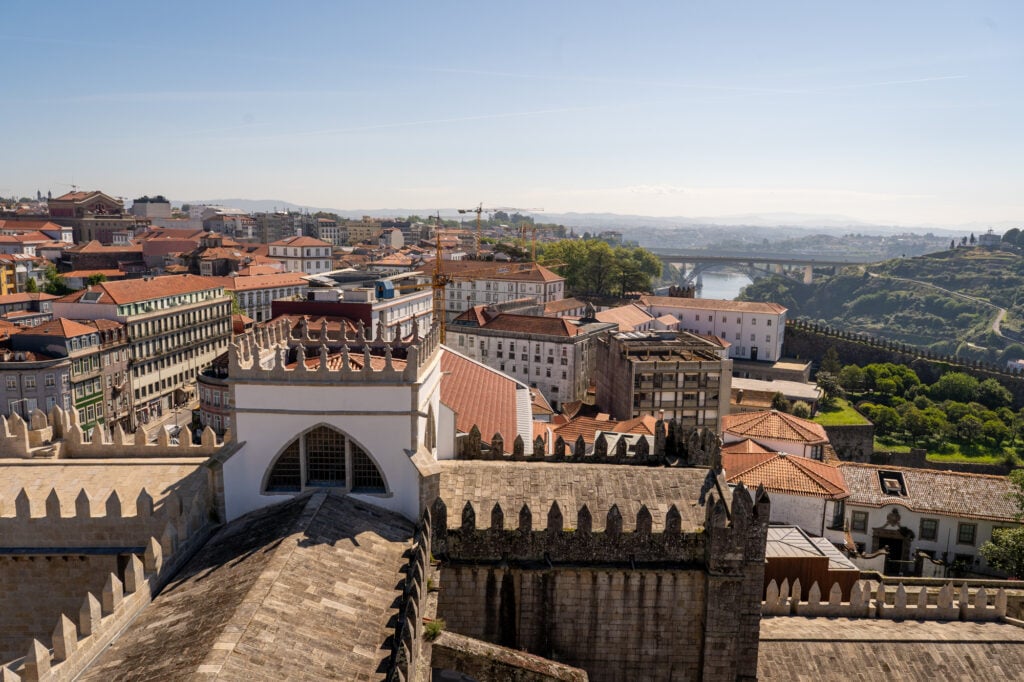
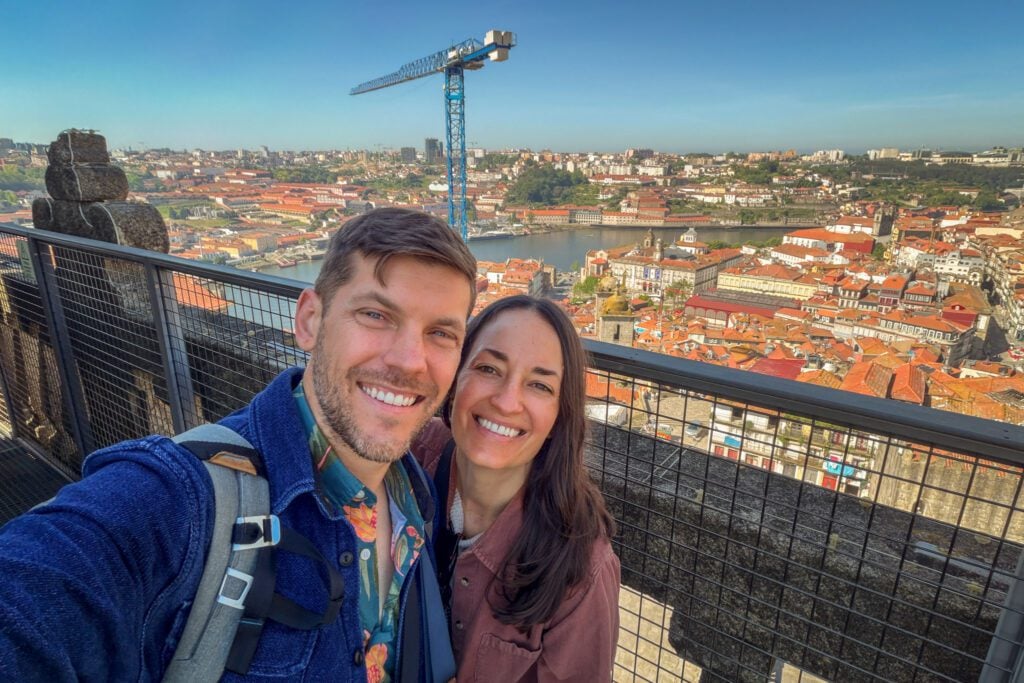
Are there better views in Porto? Definitely, and we’ll cover those various miradouros below in a separate section. But this one is nice, too!
The architecture of the cathedral is fairly interesting, too, thanks to the fact that it was consistently under construction from the late 12th Century (when Romanesque, heavily fortified churches were en vogue) through the 16th Century, when Gothic elements were all the rage.
Then numerous additions were made over the next couple of centuries, which is why you see some Baroque elements too.
Climb the Torre dos Clérigos
If you’re looking for a nice view out over the city, you’ve got plenty of options in Porto, which is a very hilly city.
Your first instinct is probably to look at the top of the hill, which is a good one.
At the top of the hill on the Porto side of the river, you’ll find a church with a 75 meter tall bell tower, which is an excellent vantage point.
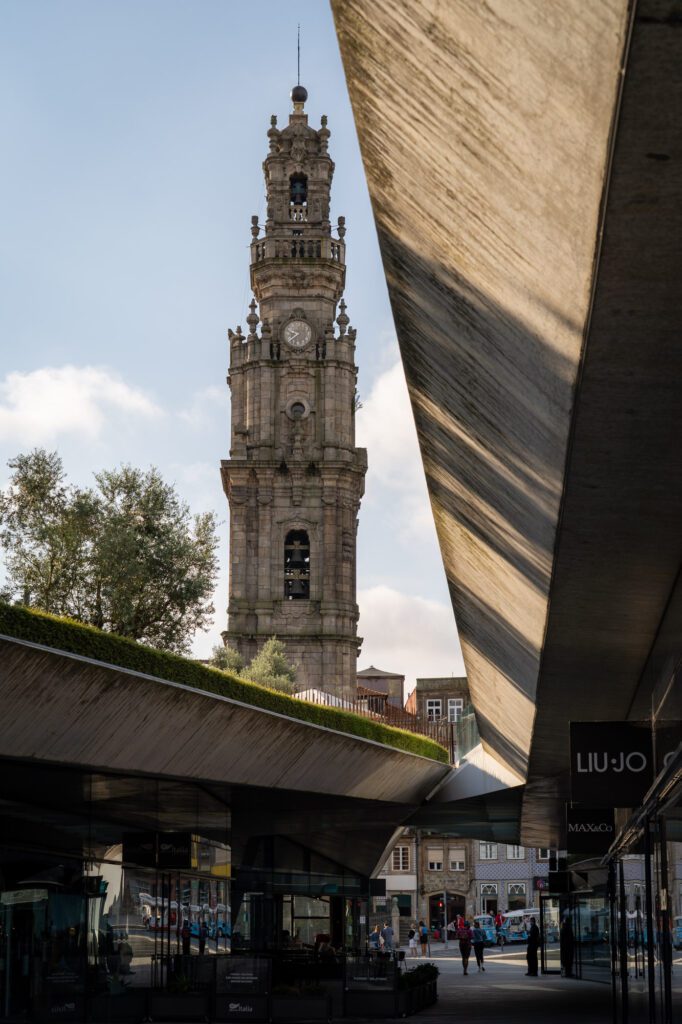
You can climb the 225 steps to the top of that bell tower where you will find a viewing platform with a 360-degree view out over the city, including views across the river to Vila Nova de Gaia and out to the west towards the Atlantic Ocean.
Full disclosure: we have not done this ourselves, mostly because we heard from a few people that the staircase to get up to the top gets very claustrophobic, which is simply not for us.
Tickets for the tower cost 10€ (for adults), and include a visit to the small museum inside the church.
We’d book tickets in advance, especially if you want to be up here early in the morning or around sunset, because it is one of the most popular attractions in Porto.
More information, including opening hours and the ticketing portal, on the official website.
Brave the Crowds at Livraria Lello
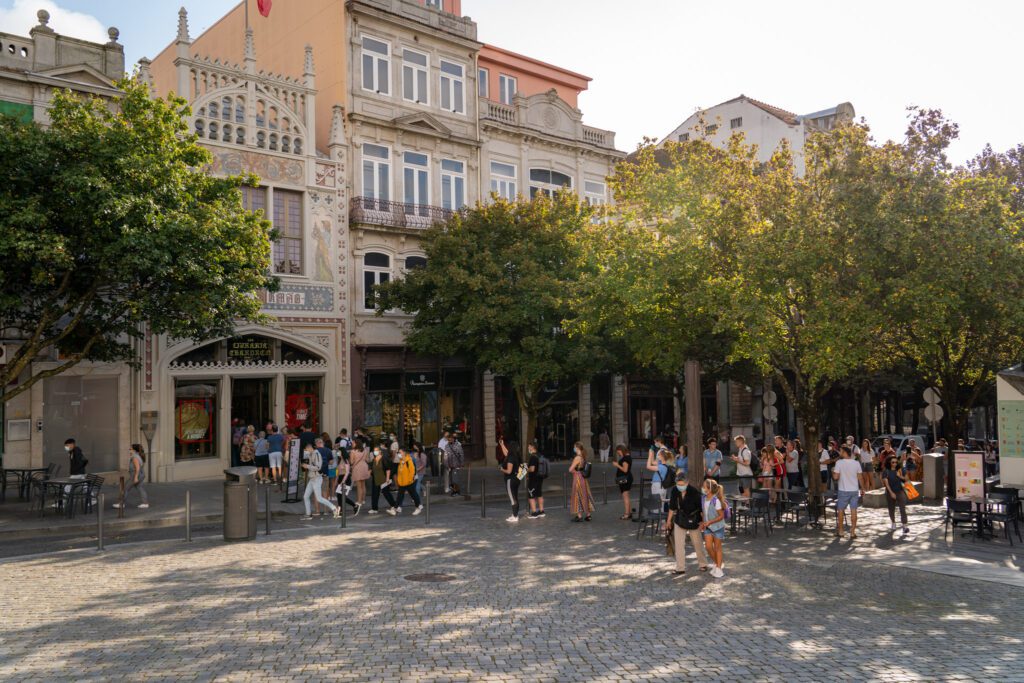
This is a bit of a controversial one because, on the one hand, it’s probably the most famous tourist attraction in Porto.
On the other hand, it’s also more marketing than substance considering even J.K. Rowling herself has dispelled the notion that she was in some way inspired by the bookstore during her time in Porto (she basically said that it’s beautiful, but had no impact on her writing of the Harry Potter series).
However, that didn’t stop the hype train from leaving the station (there’s a Hogwarts Express joke here somewhere), and today you’ll find long lines and timed entry stanchions on nearly every day of the year. Which is BONKERS to us.
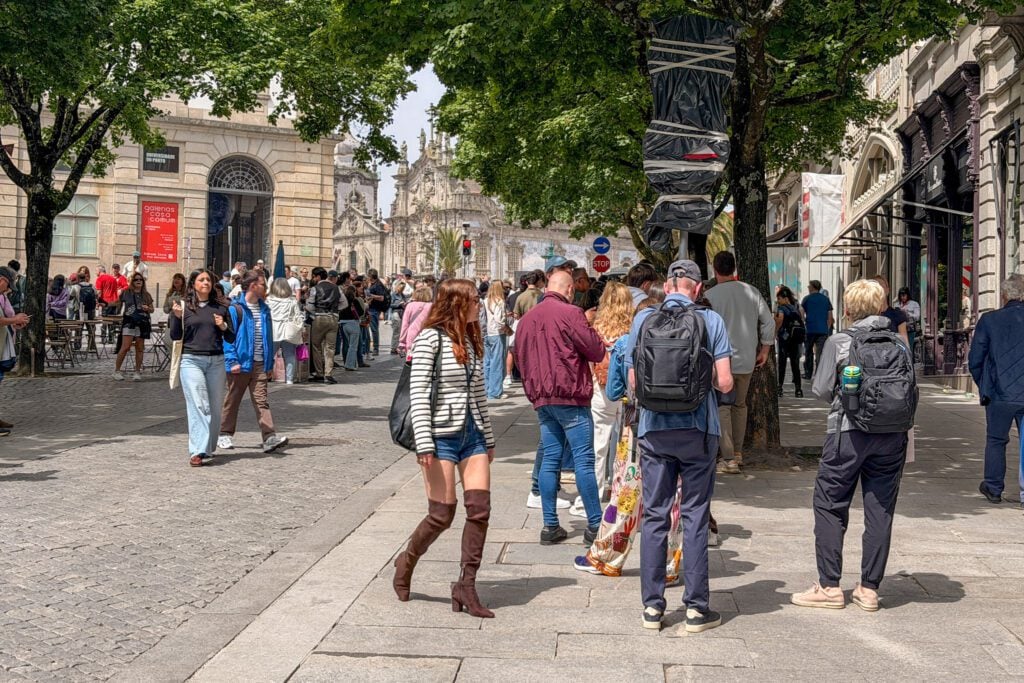
The Neo-Gothic building is gorgeous, and you can totally see why people get swept up in the story of it all.
It was built in the early 20th Century, and the dual staircases, stained glass windows, and tons of warm wood tones make it an idealized version of a bookstore.
It’s a fairly good example of the way that platforms like Instagram and Tik Tok have shaped travel in recent years. The main reason to come here these days seems to be to snap a picture on the beautiful staircase that runs through the middle of the store, which has been featured in countless Instagram stories and Tik Toks, adding to its popularity exponentially.
If you want that picture, you’re going to have to be willing to wait for it (and be ready to jostle for a position).
At the end of the day, it’s a bookstore in a beautiful building, and whether or not it’s worth spending a bunch of time standing in line to take a picture on the (admittedly beautiful) staircase is something only you can decide.
For transparency’s sake, we’ve never been inside because this really isn’t our vibe, but we do understand the impulse to see what all the hype is about.
If you want to go inside, you’ll need to buy a ticket in advance, which you can do on their official website. It will cost you €15.95 a person and you’ll need to select a timeslot (we’d do first thing in the morning, or in the late afternoon for marginally thinner crowds).
Catch an FC Porto Game
If you didn’t already know, Portugal is a fútbol country. Nearly everyone we meet in Portugal is crazy about fútbol, which is great news for Matt, who is a big nerd de fútbol.
There are multiple teams in Porto, but the big one is FC Porto, whose blue and white striped jerseys you’ll see all over the city.
They play in the Estádio do Dragão, which is a short metro ride from central Porto and makes for an easy trip if you, like me, are into soccer (or football).
You can check the schedule here, and we’ll talk about getting tickets in just a second.
The other big team in Porto is Boavista FC, which is based in a suburb northwest of the center and would be another good option (and tickets will be slightly easier to get your hands on).
However, they are going through some serious financial issues right now, so they aren’t an option.
Getting tickets for a game in Portugal is a little more complicated than just hopping on SeatGeek and buying them like you would in the US.
First of all, you’re going to want to avoid third party platforms because they’re often a scam (especially for a team like Porto). Instead, buy them straight from the club.
The challenge becomes the fact that the local fans have first crack at tickets before they ever reach the general public, so big games (like Benfica and Sporting) will sell out before you even have a chance to get tickets.
Lucky for you (and unlucky for normal supporters of the club), bigger clubs also generally have a selection of (very expensive) tickets for tourists that you can usually find.
To get tickets, you’re going to want to go to the ticketing portal directly on the club’s website.
Tickets go on sale in waves, with earlier access for supporters of the club, and tickets are released to the general public only after those phases are complete.
Generally speaking, tickets for matches hit the market about a week before the match, which can make planning a little bit difficult.
I will say that I have found that as you get closer to the day of the match, more tickets tend to become available, so keep checking even if you don’t have luck right off the bat.
If you’ve never been to a match in Europe, it’s quite the spectacle. Singing and chanting all game long, huge cheers, and more than a few shenanigans make it a very entertaining 90 minutes or so, even if you’re not into the sport itself (like Alysha).
If, like us, the dates don’t quite line up while you’re in Porto, then you can take a tour of the stadium to get a feel for what it’s like.
I, Matt, did this up in Bilbao, and it was a fun way to learn about the fan culture and see all the behind-the-scenes stuff like the media room, the locker room, and get to step on the field (really just the sideline, because they don’t want you ruining the real grass pitch).
Take a Day Trip Out to the Douro Valley
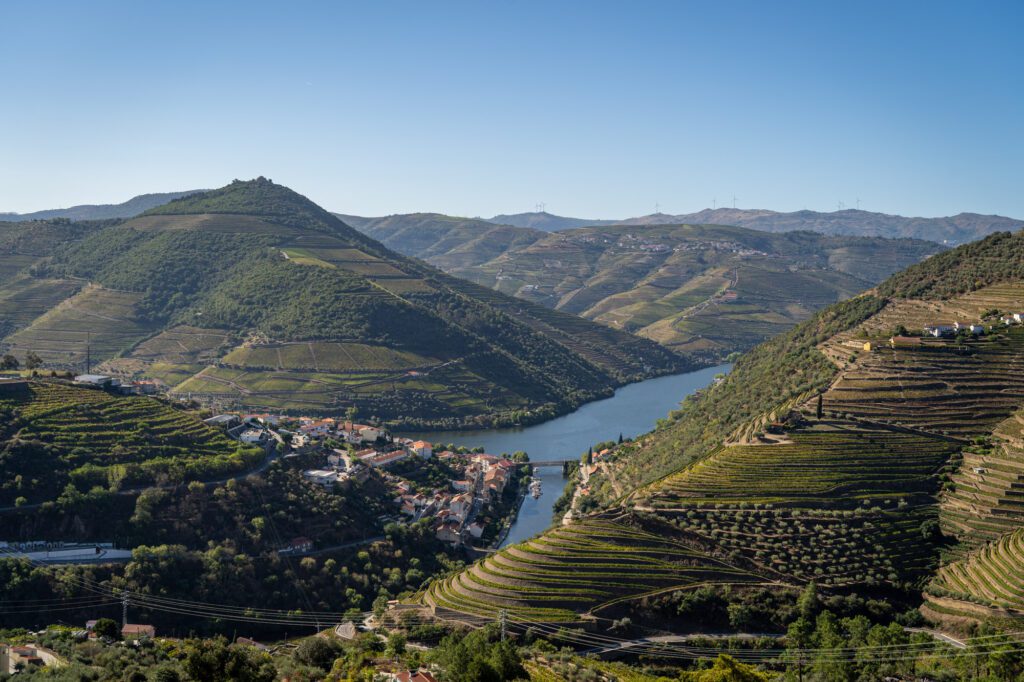
We say it in every guide that is about Porto or Portugal, but it bears repeating here: if you have an extra day, you should absolutely spend it on a day trip from Porto out to the Douro Valley.
The reason? We spent three months in Europe a few years ago when we were on the road full time, and our trip out to the Douro Valley was our single favorite experience from not only three weeks in Portugal, but on the entire three month adventure.
We did this full day tour with a local company and it was an incredible day of great views, tasty food, and, of course, great wine.
For what it’s worth, two of Alysha’s best friends AND Matt’s mom took this tour on their trips to Portugal over the past few years, and they loved it too!
We’ve also sent literally hundreds of readers on it and we’ve heard nothing but positive feedback.
As we mentioned in the section about port wine above, the Douro Valley is widely considered to be the first denomination of origin in the world.
Winemaking in the area goes all the way back to Roman times, and it was designated a demarcated wine region in 1756 to protect the now booming port wine industry (whose main customer was Brits).
We already covered the main points of port wine above, but here’s the quick summary: some Brits came to Porto during a period of strained relations with France and discovered port, then they invested in the industry and to this day Brits own most of the port wineries in Portugal.
The special thing about the Douro Valley, at least to us, is the topography. We’re very familiar with multiple wine regions having lived up and down the west coast of the United States, but we have never seen the terraced vineyards that you see in the Douro.
The closest thing we have seen is coffee farms in Colombia, which are terraced in a similar way to make the most of the water with limited infrastructure (which also seems useful for growing grapes).
Anyway, enough about the Douro Valley, let’s talk about the tour we recommend, and what it includes.
The tour starts with a drive out to the Douro Valley, stopping at a stunning viewpoint on the way to your first winery.
Here you’ll learn about the wine making process and sample some locally produced wines.
Next, you’ll head to lunch at an old estate, where there’s no shortage of delicious food and wine. Gluten free and vegetarian options are available too (let them know ahead of time).
After visiting a second winery in the afternoon, you’ll embark on an hour-long cruise along the Douro River with a charismatic captain and plenty of porto tonico (port and tonic) cocktails. The day trip ends with a leisurely ride back to Porto.
Click here to check prices, reviews, and availability for your tour of the Douro Valley.
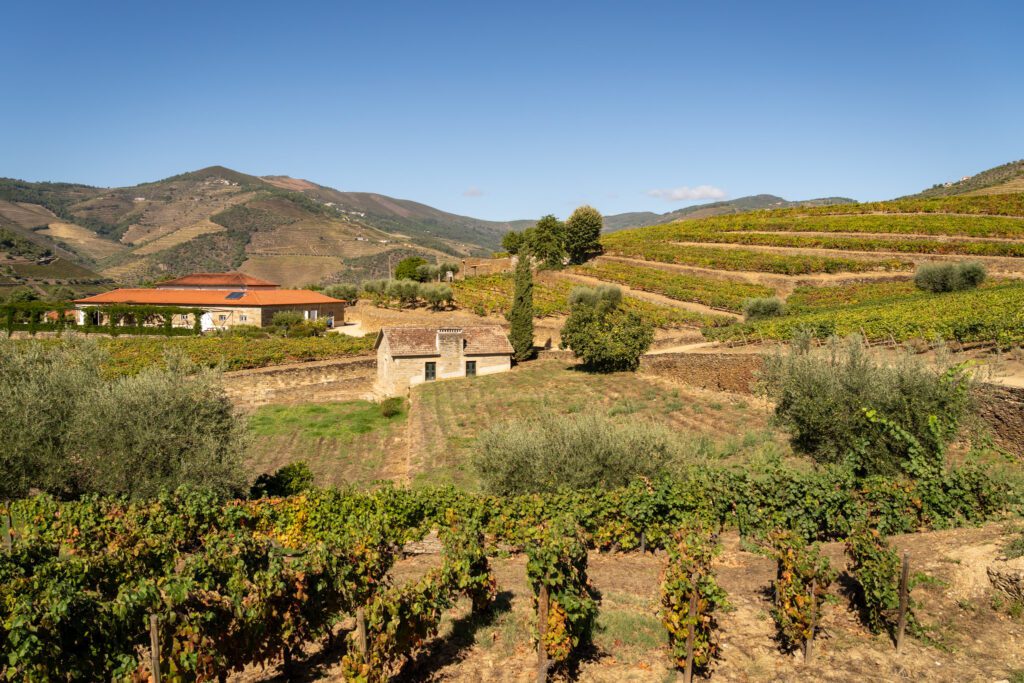

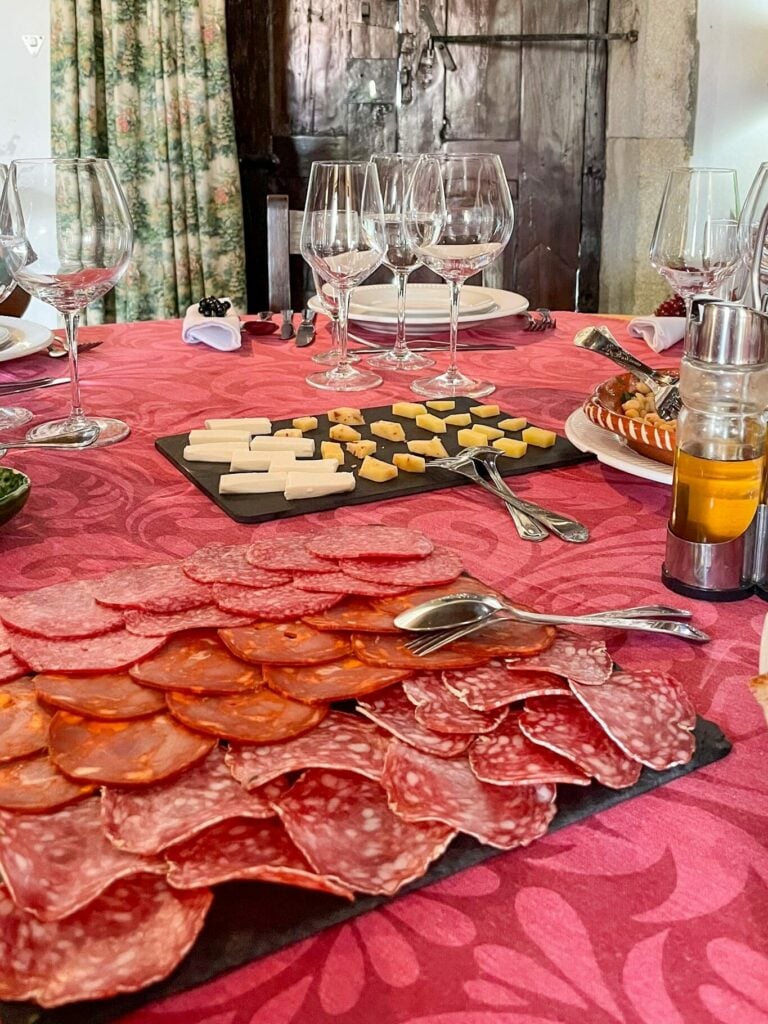
But why choose an organized tour over visiting the Douro Valley by yourself? Well, the region is not the easiest place to visit on your own, which is why we chose a tour in the first place.
It is possible to reach the Douro Valley from Porto by train. A direct line runs to Pocinho, with Peso da Régua and Pinhão being two of the most popular stops.
However, once you arrive in the Douro Valley, the area isn’t particularly well-served by public transportation.
Without a car to get around, you’ll only be able to explore the towns and limited surrounding areas.
The other option is renting a car and driving to the Douro Valley yourself.
The biggest downside of this method is that you’ll need a designated driver who won’t get to sample the local wine, and renting a car can be a bit of a hassle.
You’ll also be missing out on visiting the more off-the-beaten-path vineyards and scenic viewpoints that only local guides know about.
And you’ll miss connecting with both the guide, who has a wealth of knowledge about Porto and its port, and like-minded travelers who also love learning and trying new things.
Planning a trip to Portugal? We’d LOVE TO HELP!
Here are our other Portugal travel guides to help you plan an incredible trip (even if you have to eat gluten free!).
If there’s no link below, it means we’re still working on it – long, in-depth guides take time! We’re working on it, though, we promise.
Portugal:
- Exactly How to Spend One Week in Portugal (for First Timers)
- 10 Days in Portugal: Planning the Perfect Portugal Itinerary
- 2 Weeks in Portugal: A Perfect 14 Day Itinerary for First Timers
Lisbon
- 25 Incredible Things to Do in Lisbon: A Complete Guide
- 3 Days in Lisbon: Planning the Perfect Lisbon Itinerary
- One Day in Lisbon: The Best of Lisbon in 24 Hours
- Where to Stay in Lisbon: Our Guide to 4 Amazing Places to Stay
- Gluten Free Lisbon: A Complete Guide to Lisbon’s Best Gluten Free Restaurants
- The Best Coffee in Lisbon: 9 Amazing Lisbon Coffee Shops to Add to Your List
Porto:
- All of our Favorite Things to Do in Porto
- 3 Days in Porto: Planning the Perfect Porto Itinerary
- One Day in Porto: How to See the Best of Porto in a Day
- Where to Stay in Porto, Portugal: The 3 Best Places to Stay
The Algarve:
