
Our Favorite Things to Do in Seville: A Complete Guide
Seville (we prefer to call it Sevilla, because it sounds so much better than “Seville”), in many ways, is the most emblematic of the rich tapestry featuring a diverse cast of characters that is Spain’s history.
From the Phoenicians and Romans, who both settled in the area we now know as Seville, to the Muslim kingdoms that had a foothold in southern Spain for hundreds of years, to the eventual rise of the Spanish kingdom as we know it today, more or less.
For example, Hispania, the Roman Province in Spain which was centered around Seville, is where Julius Caesar made a name for himself and is where emperors Hadrian and Trajan were born.
Another great example is the fact that Seville was the epicenter of Spain’s Golden Age in the 16th and 17th Centuries, which coincided with the discovery of the Americas and the subsequent enormous wealth that made its way across the Atlantic back to Spain.
All of that trade went through exactly one city; Seville.
It shaped the modern history of both Spain and Europe, but also the world (and not always in a good way, which we’ll talk about in the guide below).
In this guide, you’re going to find a story of a city of layers (like, say, an onion, or an ogre) weaving through all of the things to do, see, eat, and drink that we’re going to cover.
We’re not going to sit here and give you every single church and viewpoint you could go to in Seville, but we are going to give you our favorite places that we’ve personally discovered in the city to help you make the most of your time.
Over the course of the guide, we’ll share all of our favorite discoveries on our own (multiple) visits to Seville to help you plan an incredible trip.
Sound good to you? Let’s get into it.
Important note: There are two attractions in Seville that we’d make sure to book well in advance, because they do sell out; the Royal Alcázar and the Catedral de Seville.
Disclaimer: Some of the links in this post, like hotel links, are affiliate links, meaning at no additional cost to you, we make a little bit of money if you click through and book. That being said, we would never recommend something to you that we don’t stand behind 100%.
Marvel at the Architecture at Seville’s Royal Alcázar
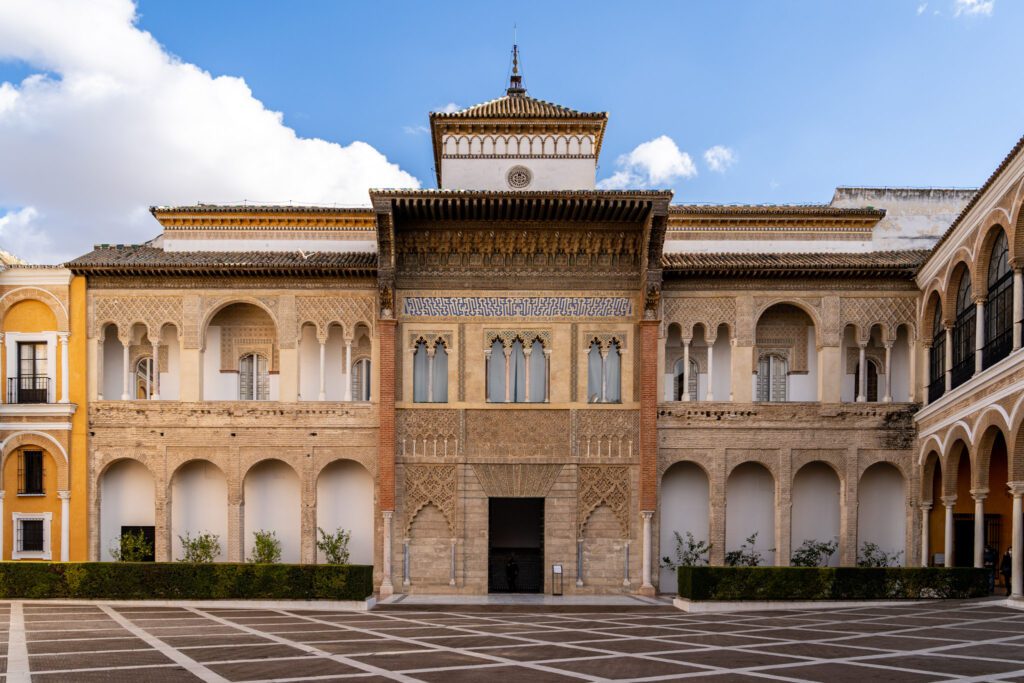
The Royal Alcázar, similar to the Cathedral (which we’ll cover in the next section), is a great example of the layers of history in this city
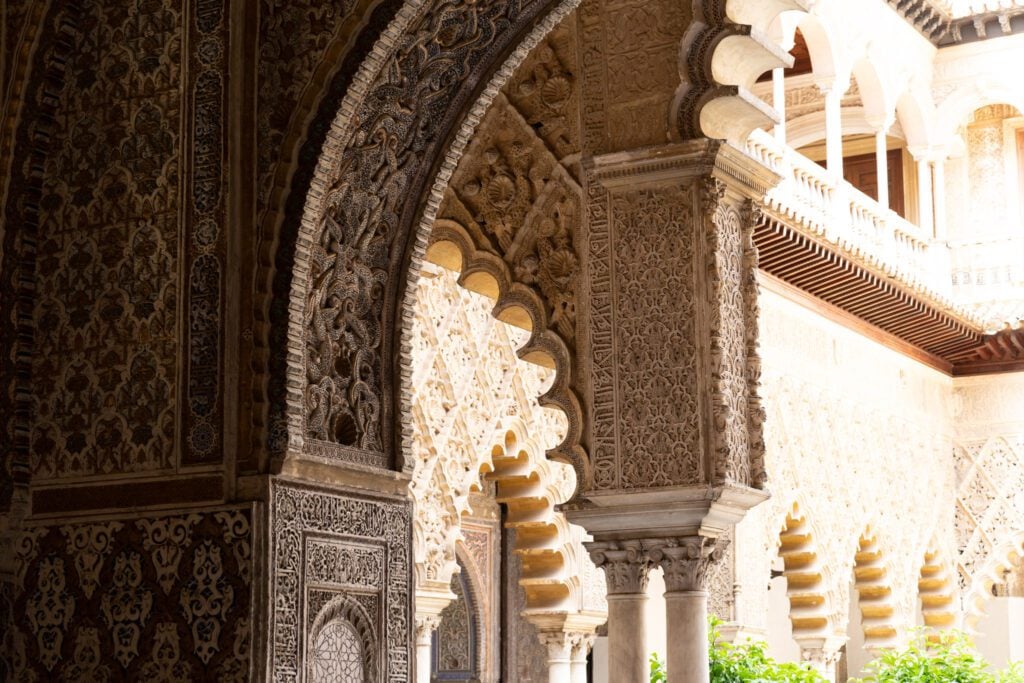
What you’re looking at here is a Muslim castle/fortress turned Spanish royal palace designed in the style of the Muslim kingdoms that ruled parts of southern Spain for several centuries between 711 C.E. and the late 15th Century.
It’s a UNESCO World Heritage Site, and it’s probably our single favorite tourist attraction in Seville.
This is actually a real operating royal palace, and when the Spanish royal family is in town (like they sometimes are for big football games, like the Copa del Rey Final), they stay here (which is why you need to give your passport information when you buy tickets – more on that below).
If you look at the palaces here, you might think that they were built during the Muslim reign in Seville, similar to the Alhambra in Granada.
And you’d be about half right.
There is a small portion of the Alcázar that was built during that period, but the majority of the palaces here were built by the Spanish royal family in the same style, which was en vogue at the time it was built, employing the famous Muslim architects who built places like the Alhambra in Granada.
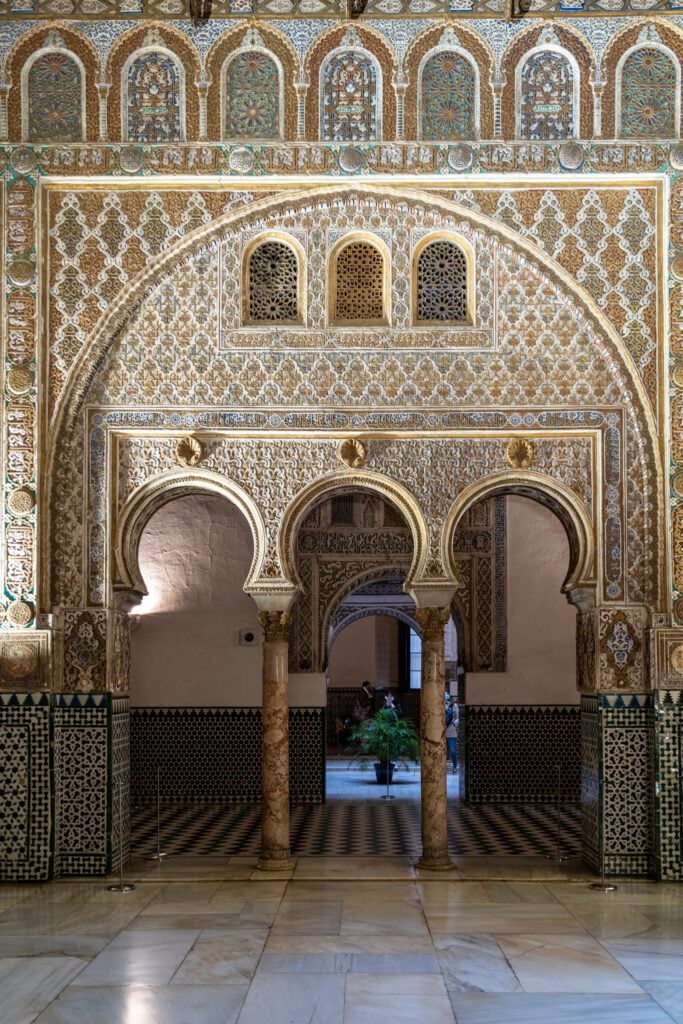
This architecture, known as “Mudéjar” (which just means in the style of the Muslim architecture, but commissioned by non-Muslims), is what you’ll find all over Seville.
The hallmark features are beautiful tile work and intricate wood carving in geometric patterns along with specific layout elements like open courtyards with greenery and water features to keep things as cool as possible.
It also features distinctly Spanish elements, like coats of arms with lions and castles representing the kingdoms of Castille and Leon, the two kingdoms that united with the marriage of Ferdinand and Isabella to create the Kingdom of Spain as we know it today (more or less).
There’s a lot to see here, and there are four specific elements we wouldn’t miss:
- Palacio de Pedro I: The most interesting expansion, at least in our eyes, and it’s the best example of Mudéjar architecture in the complex (and possibly the world). It was built by King Pedro I in the 14th Century, roughly 100 years after Seville had been conquered by the Christian kingdom that later became Spain as we know it today.
- The Casa de Contratación: This is where everything related to trade and the Americas was done until the 18th Century, and is where Columbus met with Isabel and Ferdinand to prepare those expeditions to the Americas.
- The Gothic Palace: Built later, this is much less interesting from an architectural perspective (no Mudéjar here), but it has some incredible tapestries, including a cool map of the Spanish Empire.
- The Gardens: They have one of the two water organs in operation in Europe (it plays every hour, on the hour).
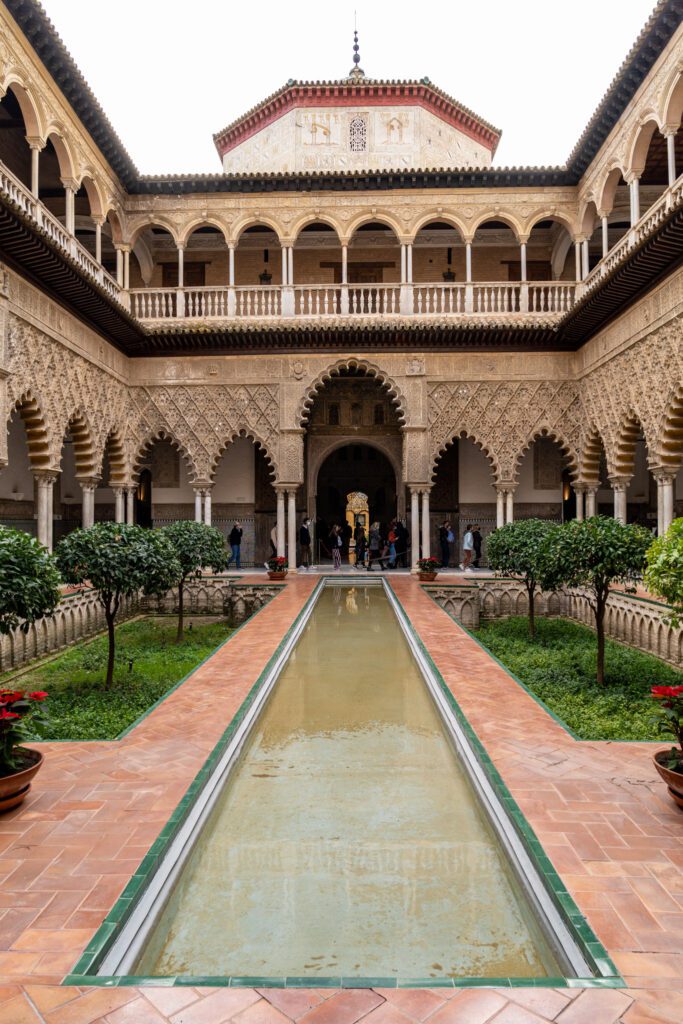
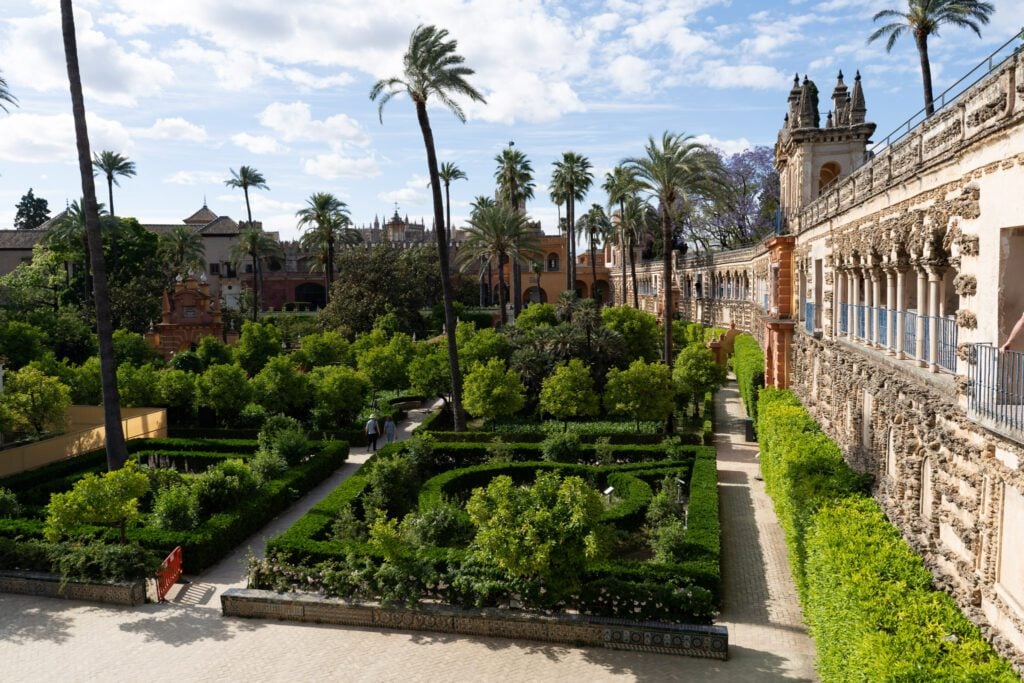
We have done this small group guided tour of the Alcázar twice, once on each of our two most recent trips to Seville several years apart, and walked away both times thinking it was one of the most informational and useful tours we’ve done in Spain (despite the fact that we had already done it once before!).
We’d highly recommend investing in a guided tour here, because you’re going to see a lot of architecture and iconography throughout the complex that would be nearly impossible to wrap your head around without a guide, we think.
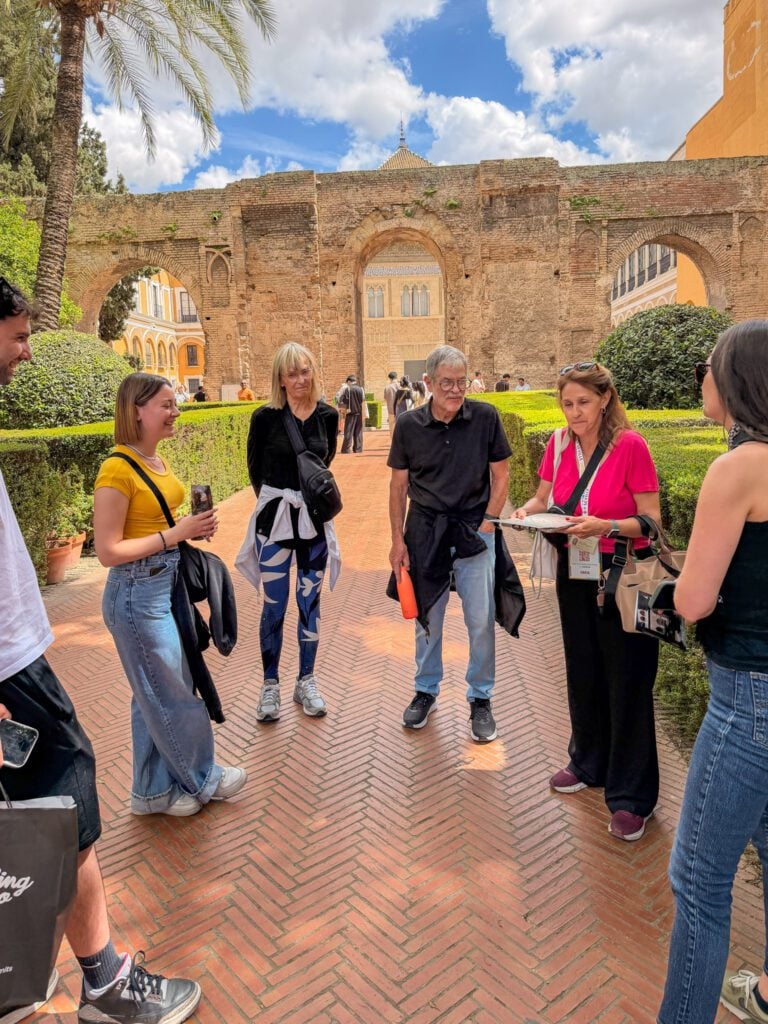
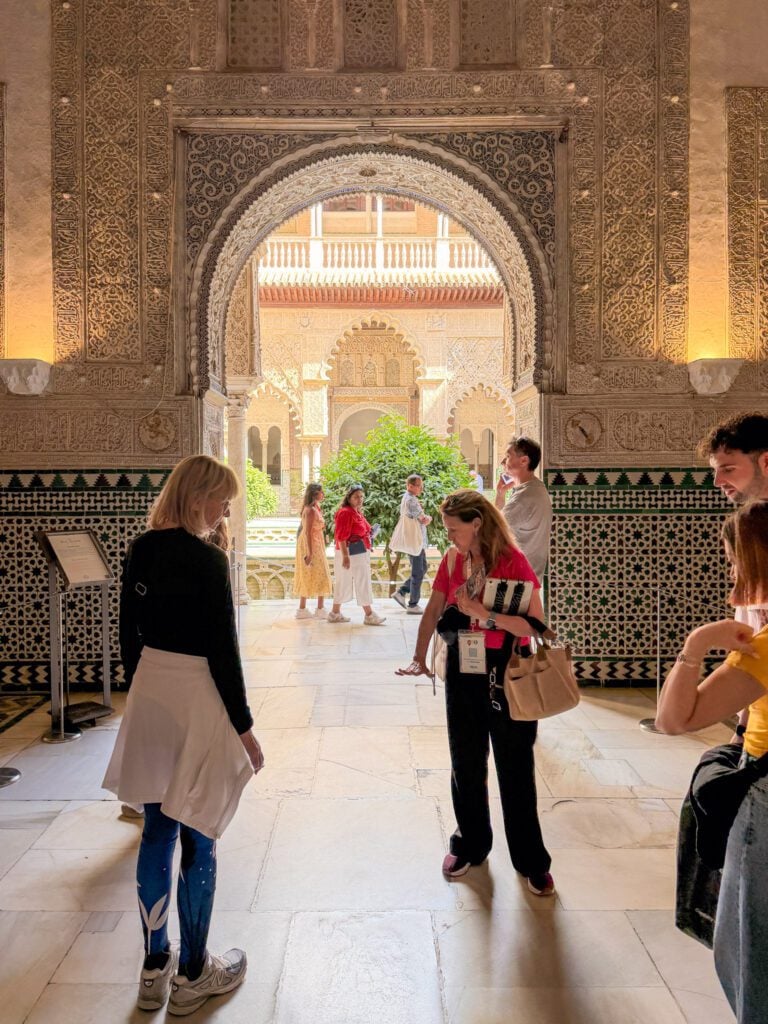
Of the attractions in Seville, this is the guided tour we’d prioritize if you only have time or budget for one tour.
Click here to check prices, reviews, and availability of that tour.
If you’re not doing a tour, buy tickets as soon as humanly possible to avoid waiting in line for multiple hours to buy them onsite.
On our last day in Seville on this past trip, we walked by the plaza outside the Alcázar on our way to Barrio Santa Cruz and saw a hilariously long line standing around waiting at 8:30am.
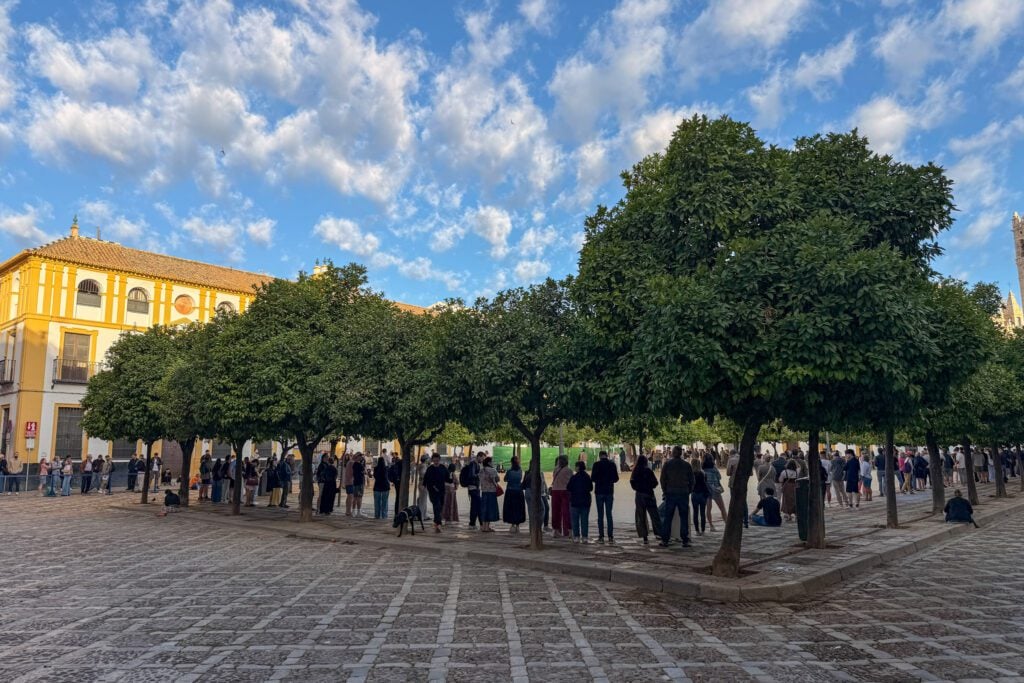
Turns out, that’s the line for buying tickets onsite. The ticket office opens at 9am, and people start lining up hours in advance.
The best way to avoid waiting in line for hours? Book your tickets well in advance (this is the first thing we’d book in Seville), and plan the rest of your trip around that visit.
You can book tickets through the official site of the Royal Alcázar, and they cost €15.50 for adults for the base ticket.
To buy tickets, you’ll go to the ticketing page (which is here – toggle to English in the top right), hit the button around “Visit the Royal Alcázar of Seville”, and select your date and timeslot.
It’s also worth noting that it’s free to visit late on Monday afternoon, which you have to book tickets for in advance here.
This would be an excellent way to go if it works with your itinerary.
The complex is open 9:30am to 5:45pm (last entry at 5:00pm) from October 1 to March 31, and from 9:30am to 7:45pm (last entry at 7:00pm) from April 1 to October 28.
We’d do an afternoon entry time, because the morning timeslots tend to be the busiest.
We’ve been twice after 4:00pm, and while there are still plenty of people, it’s much more doable than the huge crowds we’ve seen at 10:00am when it opens.
Because it’s an operational royal palace, you will need to input your passport information when you purchase tickets, and they WILL check your passport upon entry to make sure the information matches (do not forget to bring your passport when you visit).
If you happen to have missed out on buying tickets directly, the best option for visiting is going to be looking at guided tours that include tickets.
Oftentimes, tour operators have access to tickets that you as a regular person don’t, and a guided tour may be the best way to visit if you missed out on buying tickets yourself.
The Catedral de Seville
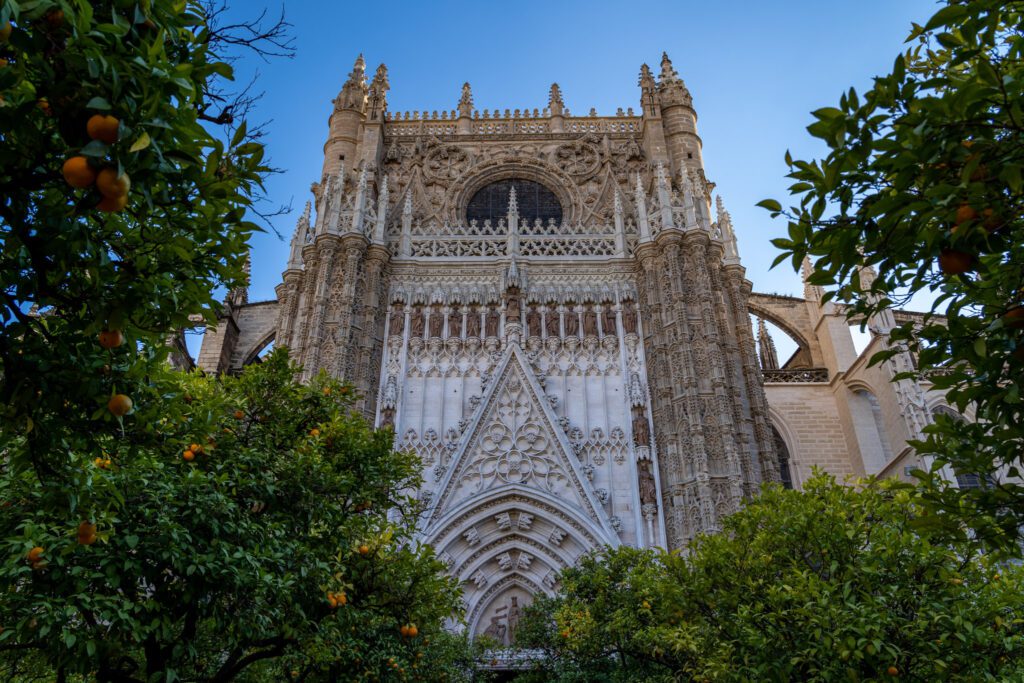
The Catedral de Seville, the city’s main cathedral is, perhaps, the most emblematic example of Seville’s different layers of history.
Today, it’s a UNESCO World Heritage Site, and is the third biggest Christian church in the world (and the biggest Gothic church).
However, if you peel back even just one layer of that proverbial onion, you’ll find the layers of Seville’s history hidden in plain sight.
Like many churches in southern Spain, this massive symbol of Christian power was originally…a mosque.
After the conquest of Seville in the 13th Century, the Christian kingdom that would later become Spain decided that they needed to change the narrative of the city FAST, and the way to do that was to, essentially, slap a cross on the existing mosque and call it a day.
Fast forward almost 1,000 years and the grand Gothic Cathedral you see today still retains three elements that came from that original mosque, though the original building crumbled during the 1755 earthquake that leveled Lisbon and did some relatively minor damage here in Seville.
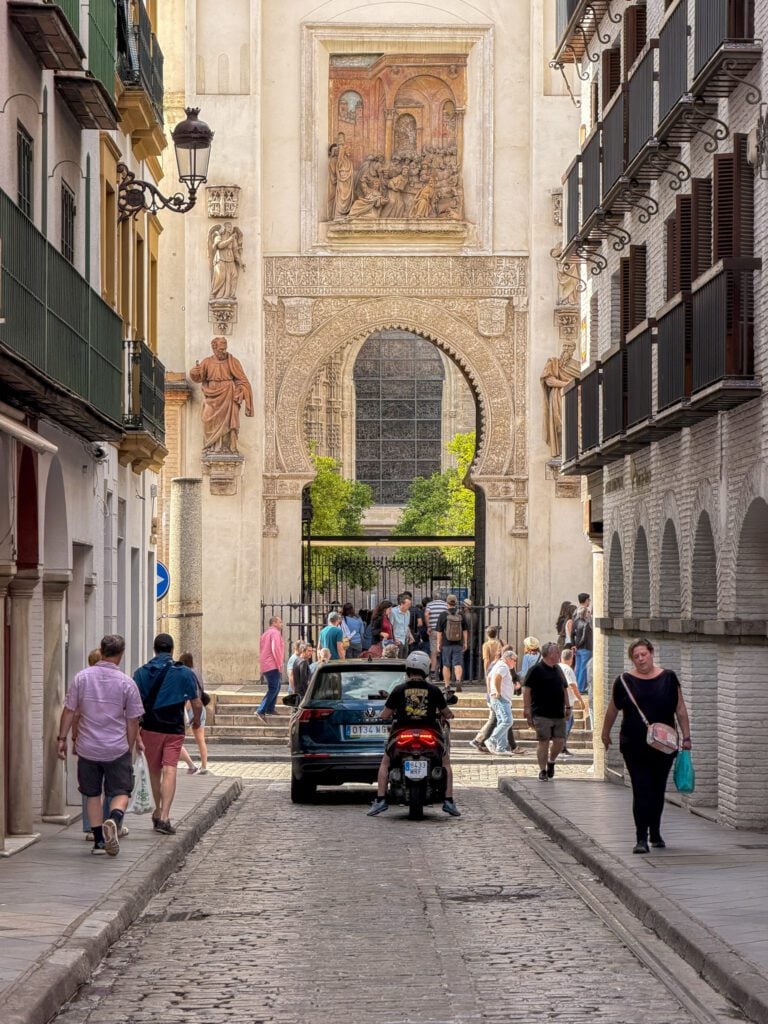
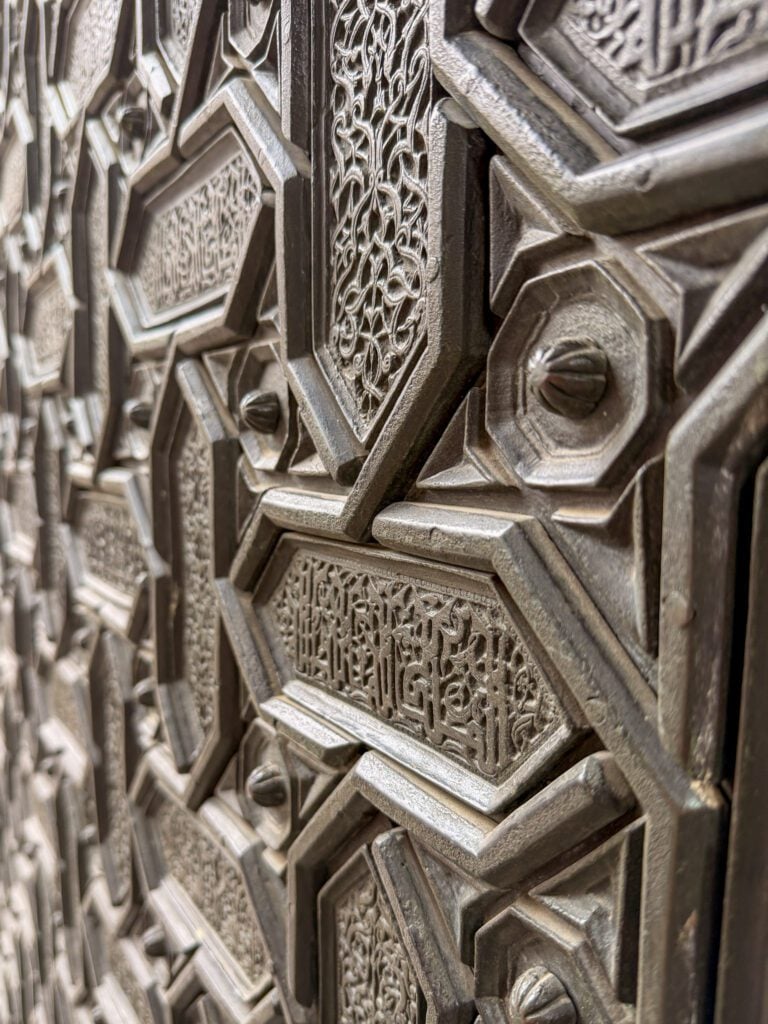
First, you have the Puerta del Perdón, a beautiful entryway on the northern side of the Cathedral that is unmistakably from the Islamic period with its horseshoe arch and grand doors (wood covered in bronze) with inscriptions from the Quran in Arabic covering the surface.
The second element is the Patio de Naranjas, the open patio just inside that arch that features numerous orange trees and the fountain where people would cleanse their hands and feet before entering the mosque.
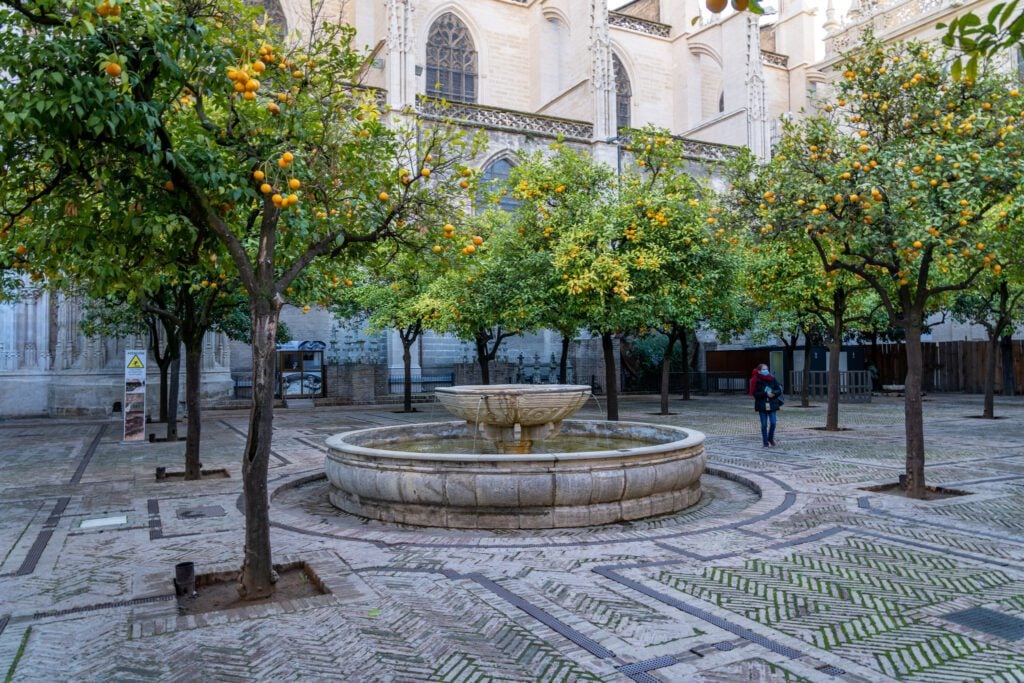
Peeling back a second layer, this fountain was actually repurposed from a Visigothic church that was found over by the Alcázar, which was built on the site of a Roman temple.
Like we said, layers upon layers of history here in Seville!
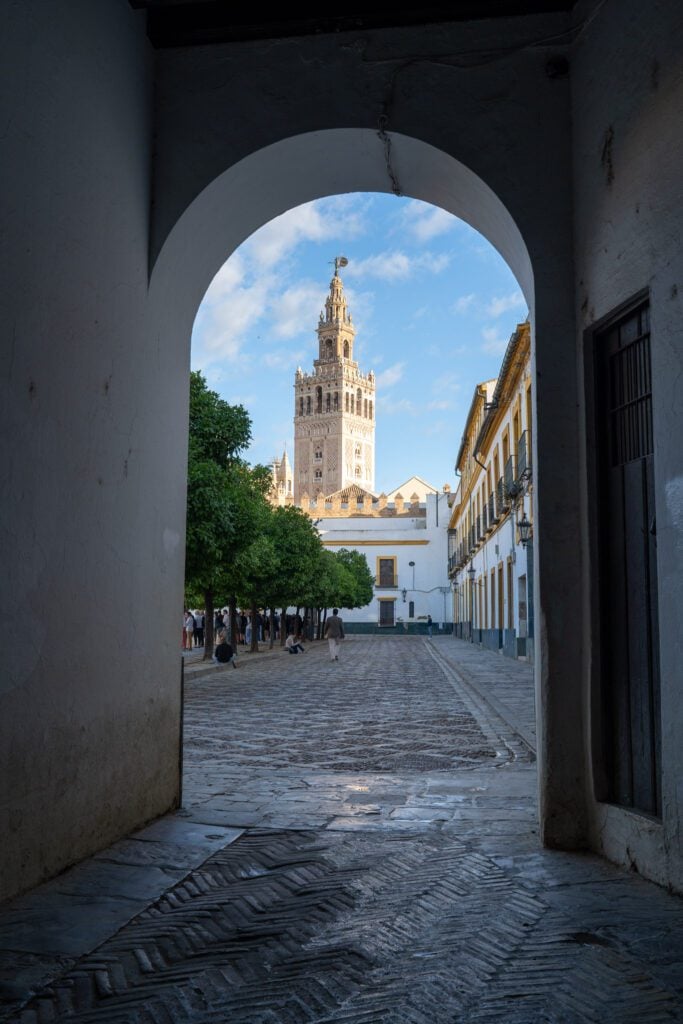
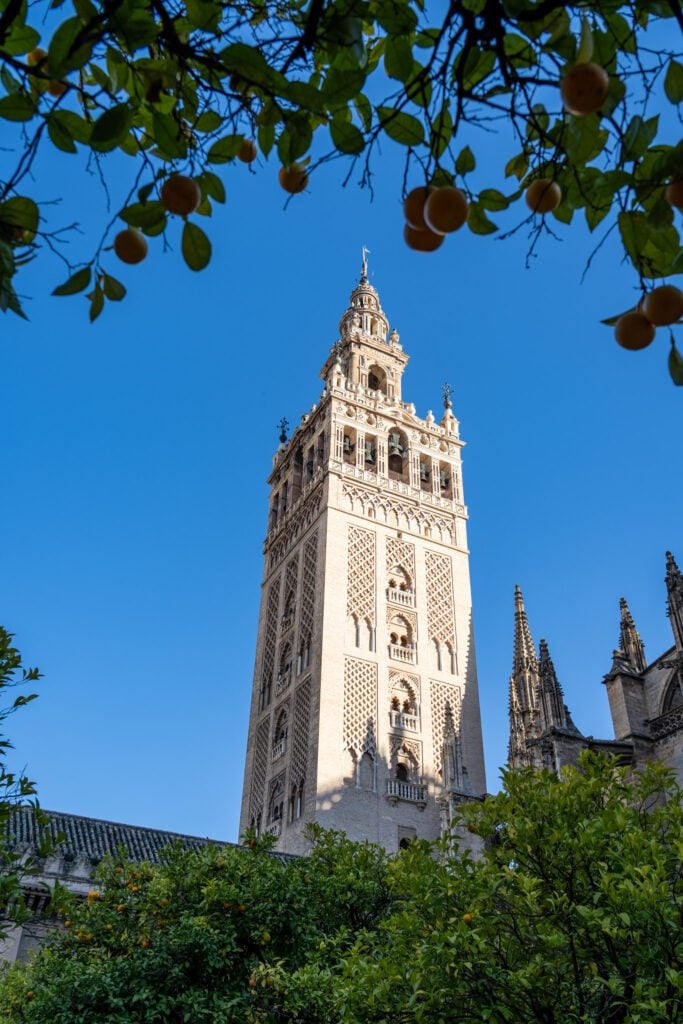
Third is the bell tower, called the Giralda, which is the original minaret where the imam would issue the call to prayer (more on this particular structure below).
You can clearly see the original design on the side of the bell tower, and they basically topped it with a bell and some Christian iconography and called it a day.
The rest of the cathedral was built over the course of the 14th and 15th Centuries in a Gothic style, and it has all the flying buttresses and high ceilings (in order to be as close to God as possible) you could possibly want.
The interior is vast, and it supplanted the Hagia Sophia as the biggest cathedral in the world when it was finished.
You should definitely climb the Giralda (the bell tower) for great views out over Seville.
The climb is done via a set of ramps – NOT stairs, like you find in other cathedrals in Europe.
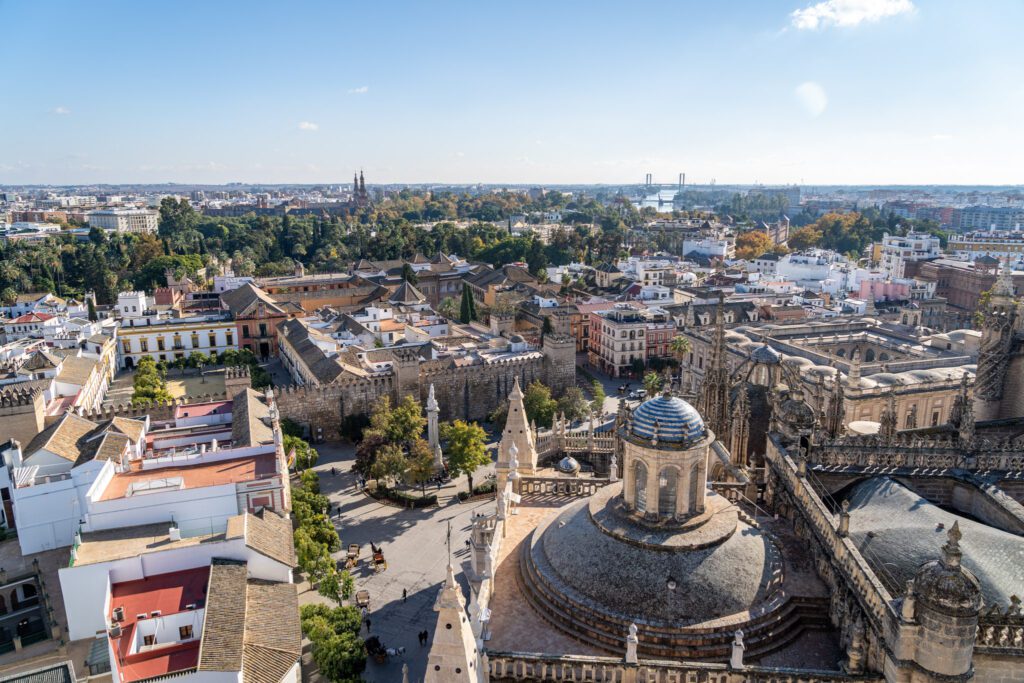
And this goes back to the fact that it was originally the minaret of the mosque that stood here before the Reconquista.
The ramps are to allow the imam, who would have to climb up to issue the call to prayer many times a day, to use a pack animal to avoid keeling over in the heat.
It certainly makes for an easier climb, we think.
The other thing you’ll find is the grand tomb of Christopher Columbus, one of the “heroes” of Seville’s history.
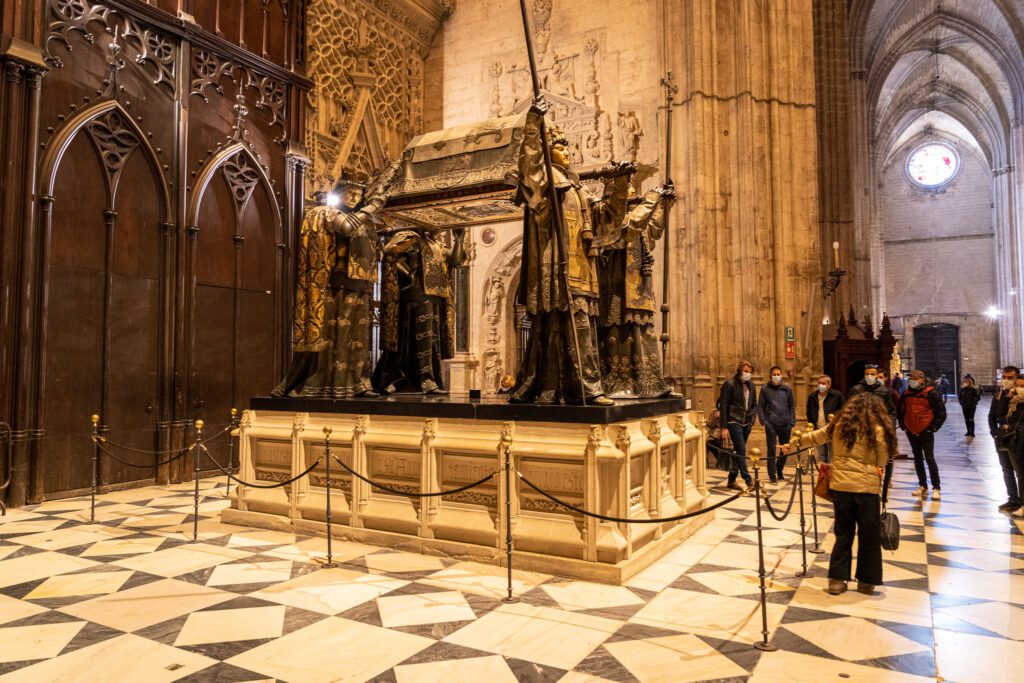
We find the way that the Spanish lionize Columbus pretty fascinating, and it’s similar to how Americans treat the founding fathers like George Washington, skipping all the terrible things about Washington to focus on his heroic acts.
On our first trip to Seville, I made a joke about Columbus to a Spanish person, insinuating that maybe he was actually a pretty terrible person that caused a lot of unnecessary death in the Americas.
Plus, he was not actually good at his job considering he died thinking he had made it to somewhere near Asia (and refused to entertain the idea that maybe he was wrong despite mountains of evidence to the contrary).
They looked at me like I was crazy.
And since that interaction I’ve heard all sorts of rationalizations about Columbus and Spanish colonization efforts more broadly.
We’re not here to litigate whether Columbus was a good person (spoiler: he almost certainly wasn’t, and even the Spanish knew it at the time), but he IS essential to the Spanish Golden Age with his discoveries in the Americas and all of the economic power that came with them.
Columbus was instrumental in ushering in Spain’s Golden Age in the 16th and 17th Centuries by unlocking the trade routes to the Americas, even if he had not one single clue what he had actually discovered.
And the place where all that wealth was gathered? Seville.
All trade from the Americas was required to come through Seville by royal decree, and the city was extremely wealthy during that period which can almost directly be attributed to Columbus’ explorations.
His tomb is massive and ornate, though it is unclear exactly how much of Columbus is actually in the tomb since he was buried in the Dominican Republic and posthumously brought back to Spain to be re-buried in Seville.
This is another site where you need to book tickets in advance to avoid either missing it, or spending hours in line to get tickets on the day of your visit.
You can do that here on the official website.
We don’t think a guided tour of the Cathedral is really necessary, and we’d prioritize all of the other tours we’ll mention in this guide (particularly the Alcázar and food tours, which will give you a much deeper understanding of the city).
If you don’t do a guided tour (we’d opt for the Alcázar if you only have the time or budget for one tour), then we’d definitely recommend the audio guide.
Tickets cost €13 per person, plus another €5 for the audioguide (which, again, we would recommend for more details and context).
You save €1 by booking a timeslot online in advance, which we would strongly recommend to avoid the long lines at the ticket office (which you skip if you have a ticket already).
See their website for updated hours and costs, as they change fairly often, and to book your tickets.
Dive into Seville’s Food Culture
Diving into the food culture in places we’re visiting is one of our favorite aspects of traveling, and we try to include a food tour, cooking class, or market tour in most places we visit.
The food of a place tells you so much about the culture, history, and influences that have shaped it, and exploring a city through its food scene is a unique perspective that a lot of people don’t even consider.
After the two main attractions in Seville, which are going to be anchors on your Seville itinerary (do them on different days, trust us), the next thing we think you should do is a whole lot of eating and drinking.
An important note at the top here: Matt has Celiac Disease, which means the way we experience a city’s food scene is almost certainly different from the way you will.
If you also need to eat gluten free, here’s our gluten free guide to Seville, which has lots of great options.
If you don’t, we wanted to take a second to link you to resources we’d use to figure out what to eat and where to eat it (aside from booking this food tour with Devour, which we’ve done a version of elsewhere in Spain and loved).
The first place we’d turn to is the Eater guide to Seville, which is a look at the essential places that local food writers recommend.
It’s not the end-all, be-all, but it’s a great starting point (we look at the Eater guide to Portland often as a sort of gut check, and generally agree with their recommendations).
Another place we like to look for food recommendations is Reddit threads, mostly because on Reddit, you’re usually getting crowd-sourced information from locals or fellow travelers who have actually experienced the things they’re mentioning.
Take a read through this thread, this thread, and this thread as a starting point.
We’re going to split this section into two different parts for organizational purposes:
- What NOT to eat & drink in Seville
- What to eat & drink in Seville
If you are really interested in going deeper on food culture in Seville, we would highly recommend booking a guided food tour while you’re in town.
After the Alcázar tour, this would be the second tour that we’d prioritize.
Unfortunately for us, the reality is that because Matt has Celiac Disease and can’t have even a speck of gluten without being sick for days, a food tour or cooking class wasn’t in the cards for us in Seville (though we did one up in San Sebastián that was one of the highlights of our entire recent three week Spain trip).
HOWEVER. That does NOT mean it shouldn’t be for you!
We’d highly recommend it because it gives you a local’s perspective on the city’s food scene – what and where to eat and drink – and you get to connect with fellow travelers and try some amazing food.
Here are some options for you that have been on our list on past trips, but can’t accommodate Matt’s gluten-related needs.
First is Devour’s Ultimate Food Tour, which is a three hour afternoon extravaganza that takes you to a bunch of different spots around the center of the city to try local specialties, including drinks.
We like Devour, who are in many ways the O.G. of this style of food tour in Spain, and their sister company (Walks) is our favorite tour company in Europe (we’ve done 8+ tours with them across Europe over the past few years).
We actually did a Devour tour up in San Sebastián on this latest trip to Spain and it was arguably the highlight of the entire trip.
The second tour we’d recommend is Devour’s Tapas, Taverns, and History tour, which is a similar idea but takes place at night and focuses on Barrio Santa Cruz and Arenal.
Last but not least is this highly rated food tour that takes you to four tapas bars and taverns that are a little bit off the beaten path in Seville.
What NOT to Eat in Seville
First, we should talk about what NOT to eat in Seville.
Most people don’t fully appreciate this, but Spain is a big country, which means that the food culture is highly regionalized because the raw ingredients that exist in, say, Madrid and Seville, are wildly different.
As much as possible, you should try to eat the local specialties in the place you’re in, rather than trying to seek out the most famous Spanish dishes.
Which brings us to paella.
Paella is a rice-based dish that, aside from being so clearly influenced by cuisine from North Africa, comes from Valencia, a city up the coast towards Barcelona.
We have one golden rule in Spain that we have broken a few times and regretted it: do not order paella in a restaurant that is not specifically Valencian or specifically known for paella (often called an “arrocería”).
There are, I’m sure, exceptions, but ordering paella out at a random restaurant is usually not going to be good, speaking from experience.
Another example is sangria.
As far as we can tell, sangria is a completely made up concoction designed for tourists.
Which doesn’t mean it’s bad, necessarily, but we believe that you should try to drink what the locals drink, and that’s not sangria.
Which brings us to the next section; what should you eat in Seville?
What to Eat & Drink in Seville
First, let’s talk about drinks (since that’s where we left off).
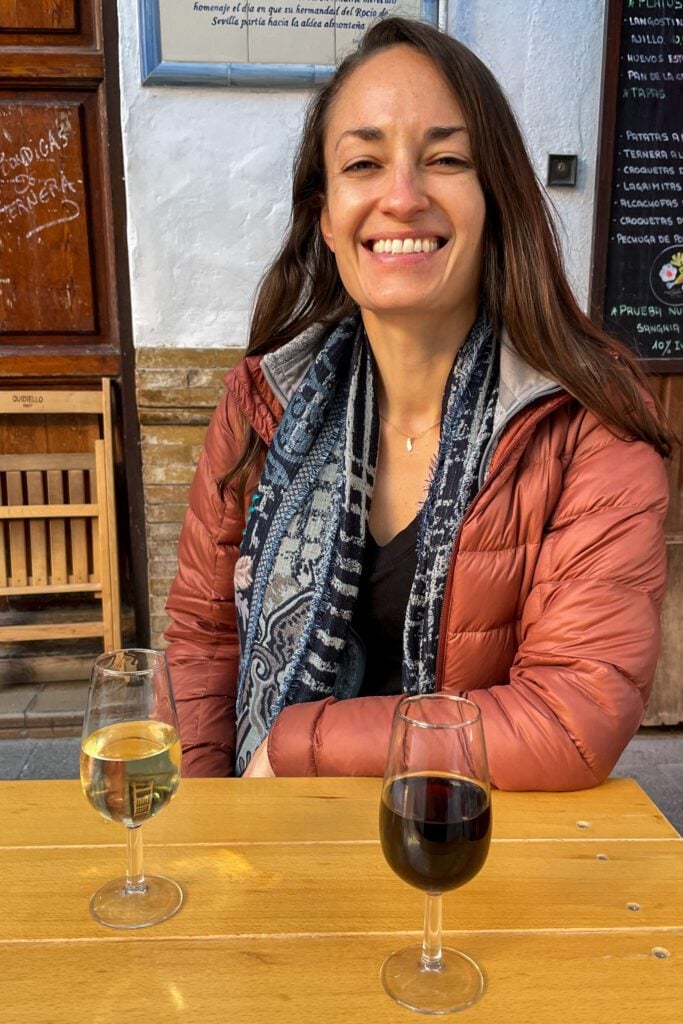
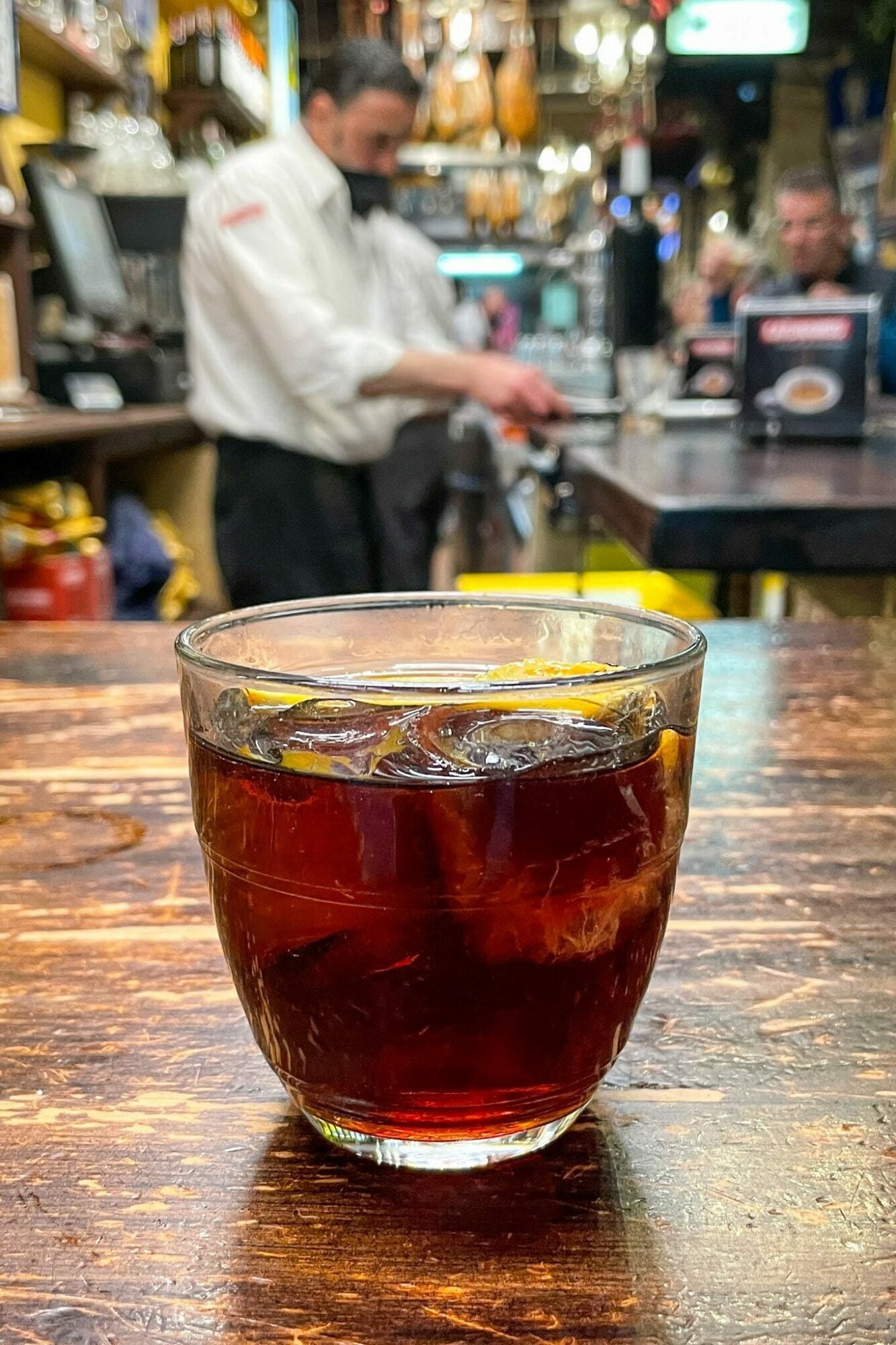
Instead of sangria, opt for vermut, which you may know as vermouth.
Typically, the vermouth we get here in the U.S. is more a mixer for cocktails than something you’d drink on its own, and it comes from France or Italy.
Spanish vermut, on the other hand, is a wild sweet and spicy drink that stands on its own, and it’s one of our favorite things to drink in Spain.
Specifically vermut rojo. Order it on tap if they have it by asking for “vermut de grifo.”
There are two other drinks to try while you’re in Seville that are specific to Andalucía.
The first is vino de naranja, an orange wine (not the normal kind of skin contact wine, literally wine made with skin contact with bitter oranges) that comes from Huelva, which is west of Seville (towards the Portuguese border).
We tried it at Taberna Álvaro Peregil, which is a short walk up from Plaza Virgen de los Reyes in front of the cathedral (it’s here on Google Maps).
The second drink to try is sherry, which is another fortified wine from Andalucía, this time from Jerez (which is southwest towards Cádiz).
I asked multiple people about a good place to try sherry, and nobody had a good answer for a bar with a selection of sherries (kind of like vermut, it’s just something people order with their meal).
Now, there are a wide variety of styles of sherry, ranging from dry white sherry (Manzanilla) to heavier, aged, and sweeter versions (like Amontillado or Oloroso).
If you’re looking to learn more about sherry, we had this in-depth sherry tasting experience on our list (but we were recovering from colds, so we skipped it on this last trip).
On the food side, there are a handful of things that Seville (or Andalucía more broadly) are known for, which you should make an effort to try.
- Jamón: Specifically, Jamón Ibérico (from Bellota) made from those delicious acorn-fed pigs that gives it a different marbling and texture than your average jamón. We’d go to the famous Jamonería José Luis Romero at the Mercado de Triana for high-quality meats in a fun atmosphere.
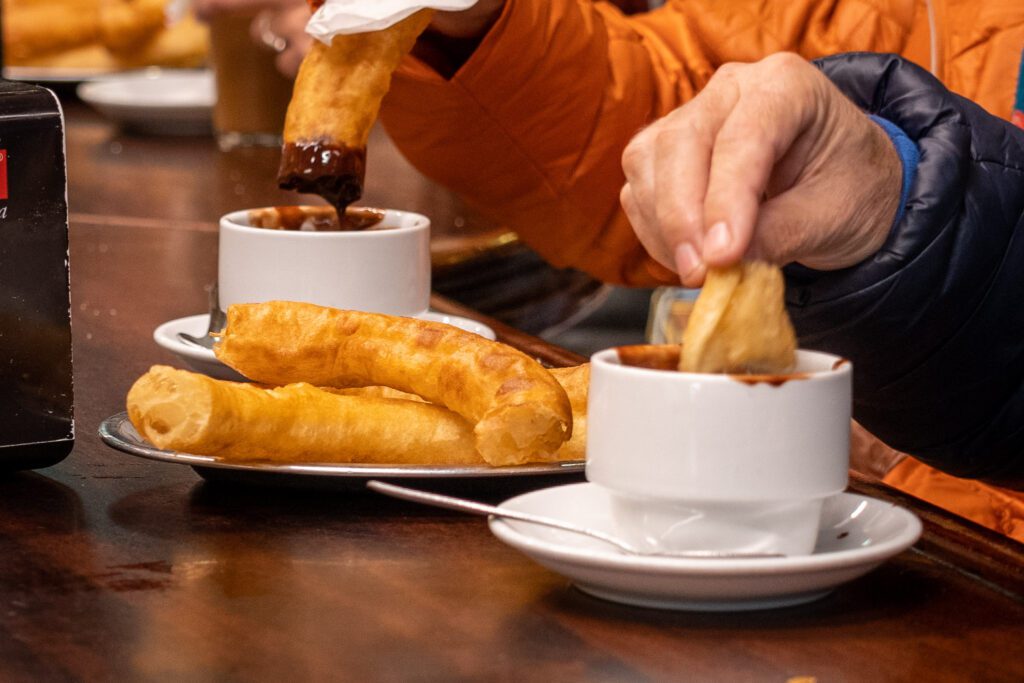
- Churros con chocolate: In Seville, churros are a breakfast food! However, you should know that the churros are a little different from what you’d picture based on experiences in the Americas. They’re not coated in sugar, they’re simply just fried dough, which makes them decidedly more savory (until you dunk them in chocolate). Bar El Comercio (which has been open since 1904) in the center is where Alysha demanded we go, and she loved it. Also worth noting that a mini casual chain called Kukuchurro was also recommended to us by multiple locals.
- Fried fish (pescaíto frito): Fried “little fish” like calamari or sardines, usually served as a snack at the bar (and best consumed with a big squeeze of lemon and a cold beer).
- Solomillo al whisky: Grilled pork in a whiskey-based sauce. Not really our cup of tea (Alysha doesn’t eat a lot of pork, Matt doesn’t like whiskey).
- Espinacas con garbanzos: A simple dish of stewed spinach and chickpeas with tomatoes and garlic that is quite possibly the most satisfying and wholesome tapa around.
Plaza de España (and Parque de María Luisa)
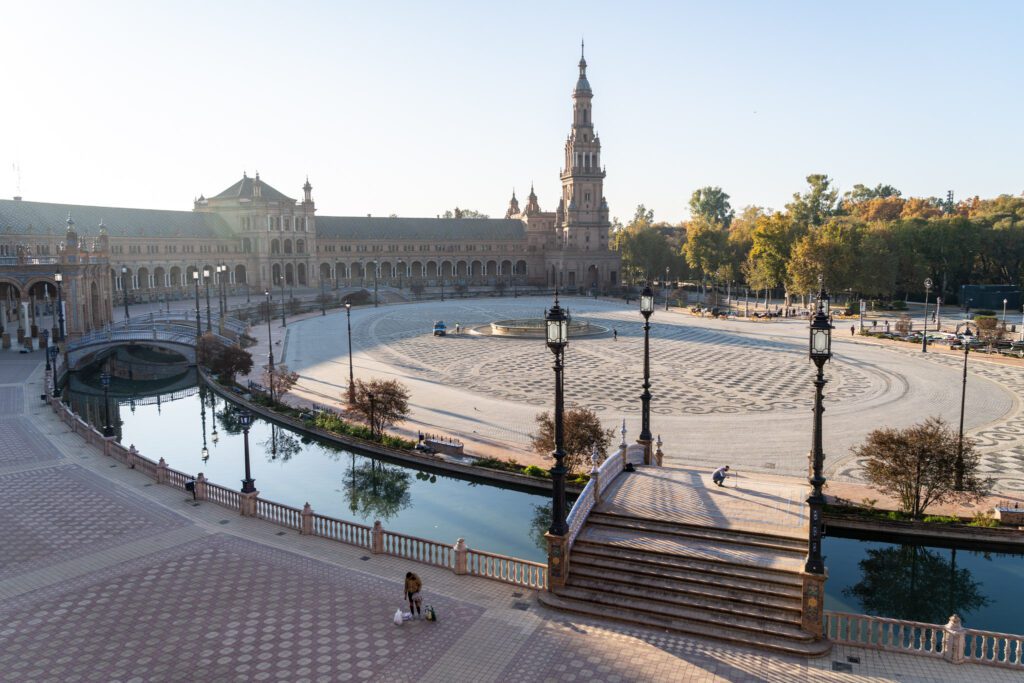
Outside of the Alcázar and Cathedral, the biggest tourist attraction in the city is probably the Plaza de España.
It’s is a big, opulent plaza just south of the city center that has been featured in several big movies, including Lawrence of Arabia and Star Wars: Attack of the Clones (Matt’s a big Star Wars nerd, and has recently gotten Alysha quoting the movies, a big win in his book).
Before we get too deep into this section, we have one HUGE tip here: It is extremely important to visit Plaza de España in the early morning.
The reason? We think it’s really important to have the time and space to take in all of the tiny details around the Plaza that make it a magnificent work of art, and the crowds from 10am to 7pm are thick, which makes it hard to do that.
We’d strongly recommend making it a priority to be here before about 9:30am so that you have the place mostly to yourself and you can take the time to marvel at all the exquisite tilework and details around the plaza.
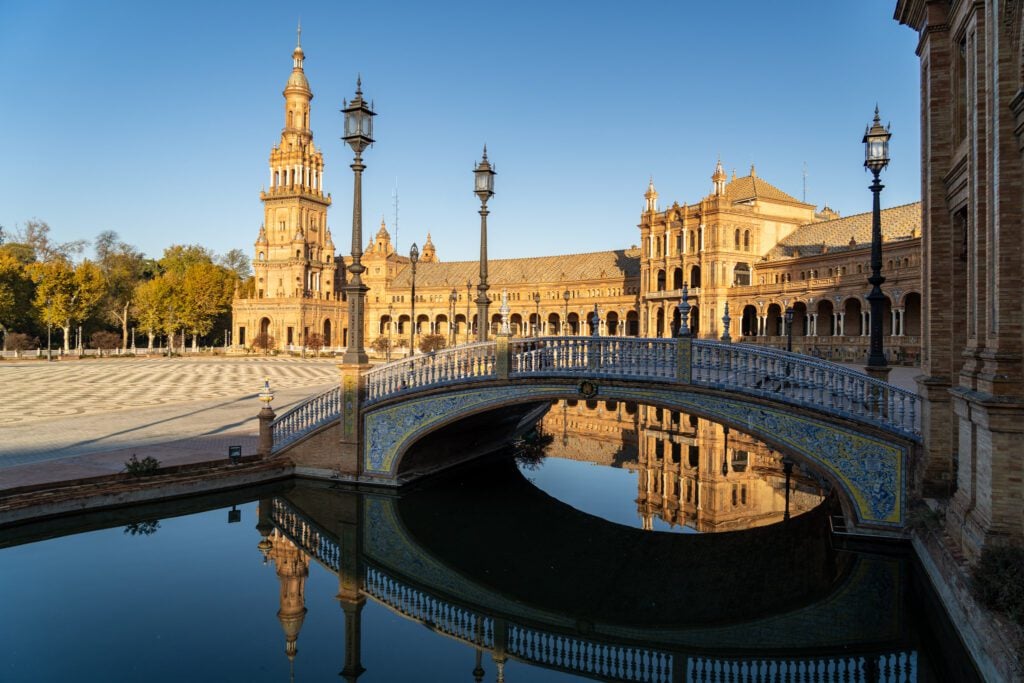
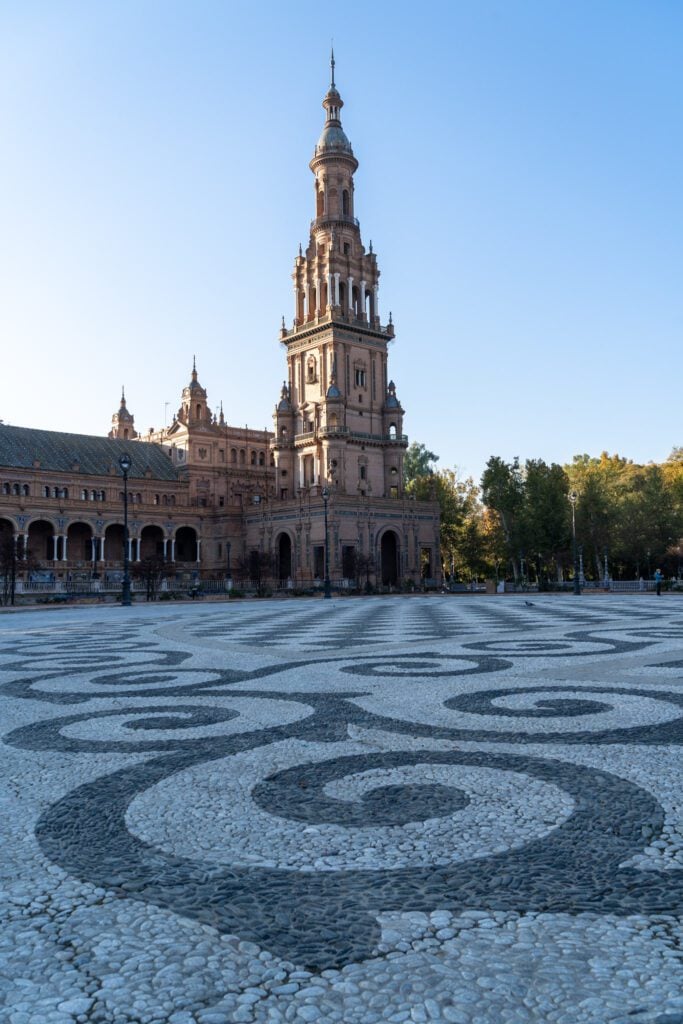
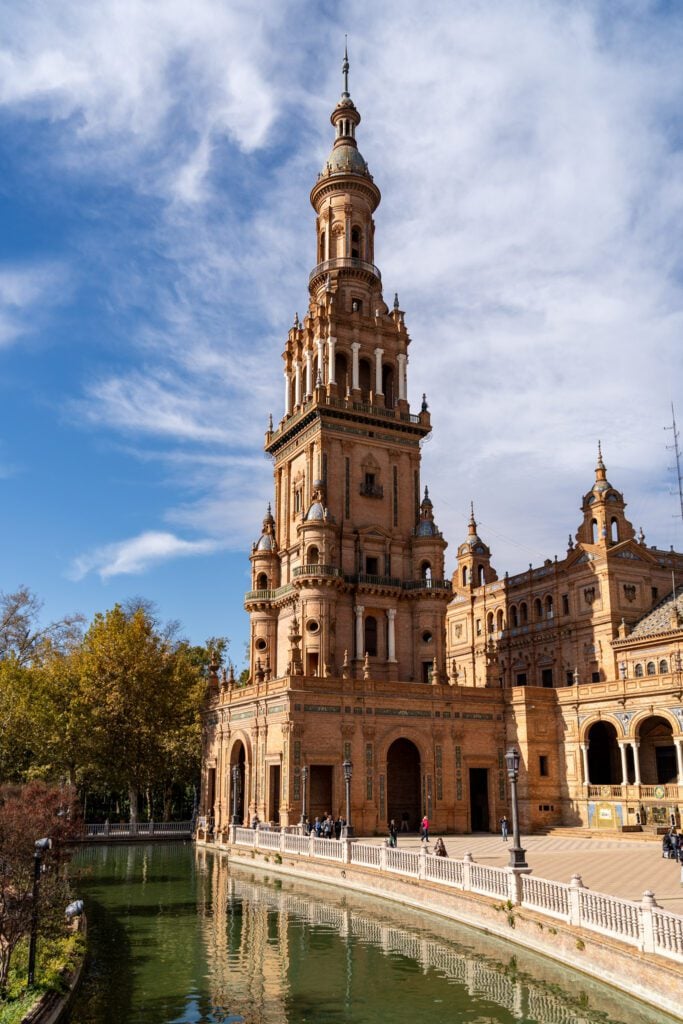
We love Plaza de España, but the story of how it came to be is fairly amusing.
The big plaza was commissioned for the Ibero-American Exposition of 1929.
After a period of revolutions and independence for former colonies, Spain was looking to rebuild relationships with countries in the Americas, and they decided to hold a big exposition in Seville to bring everyone together.
You know what else happened in 1929? The stock market in the USA crashed and dragged the world economy down with it into the Great Depression, which led to all sorts of butterfly effects (including, arguably, the conditions for the ushering in of Franco’s dictatorship in Spain).
So in terms of the objective of stimulating global trade, the exposition gets a big fat “F”, but in terms of giving us the beauty of the Plaza itself, we’re good with an “A”.
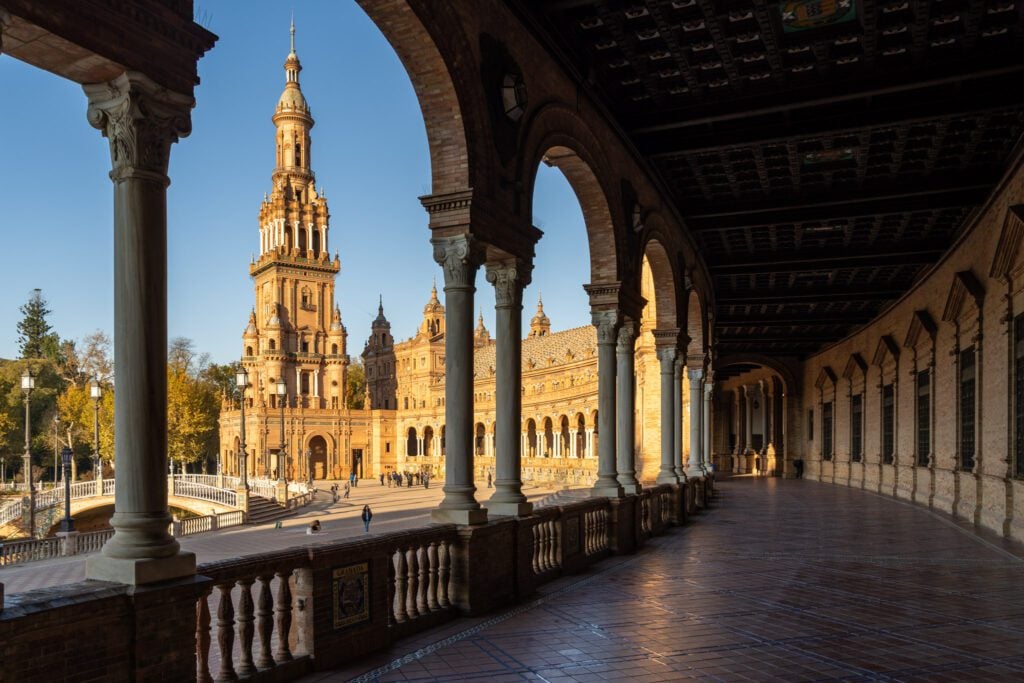
The entire plaza forms a big semi-circle, and the two towers on either end loom over it. There are canals with four bridges representing the four kingdoms of Spain – Castille, Aragon, León, and Navarre.
Those four kingdoms are also represented on the crest in the middle of the Spanish flag, which I didn’t realize until noticing it here and asking about it on my first trip to Spain years ago.
The other cool part of the design is the 48 tiled alcoves depicting the different provinces of Spain around the arch, starting with “A” (Albacete) on the left side, and ending with “Z” (Zaragoza) on the right.
Plaza de España is on the edge of a big park named for María Luisa, the Spanish princess who donated the land to the government (it was formerly part of the grounds of a palacio).
While the park is great, the most interesting part is the pavilions of the various countries in the Americas that participated in that exposition in 1929.
Today, many of those pavilions have been repurposed into things like libraries and cultural centers, but the opulent buildings are still standing.
The highlight is the Mexico Pavillion (here on Google Maps) which is a university today, but you can go inside and check it out.
The other thing here we had on our list was the Archeological Museum of Seville (Museo Arqueológico de Sevilla in Spanish) because, as we’ve covered, the city has all sorts of history (including Roman history).
However, we learned that it has been “temporarily” closed for several years with no known opening date.
Experience the Magic of Flamenco
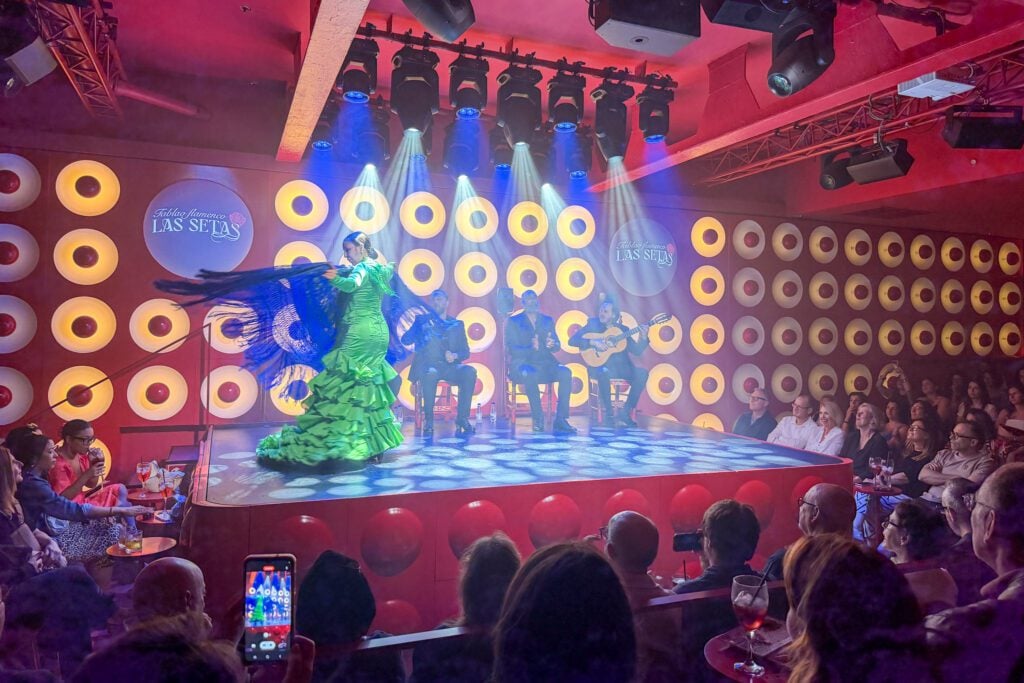
Of all the examples of cultural mixing we’ve talked about so far, the one that I can talk about for the longest is probably Flamenco.
I find it utterly fascinating how a dance influenced by the Muslim and Romani populations of the Iberian Peninsula became one of the single most “Spanish” things that tourists flock to see.
But as we’ve talked about multiple times, that’s kind of the whole thing with Spain, isn’t it?
There is perhaps, nothing more “Spanish” than Flamenco, though that idea has all sorts of layers to it that we’re going to take a second to talk about here, because it’s fascinating and important.
The term itself is complex. It’s more of a genre umbrella than a specific kind of music, like saying “rock music”, and there are sub-genres of Flamenco that are more specific, often related to a region.
Seeing a show in Seville is important because Andalucía is the birthplace of Flamenco due to it being the place where that cultural mixing was most prevalent.
It’s legitimately a really impressive art form that involves music (usually a guitar along with some percussion) and dance.
It can feel exciting, sad, tragic, and angry, and sometimes all of those seemingly contrasting emotions at the same time.
If you walk out of a show having felt nothing, I really don’t know what to tell you.
Beyond the art itself, Flamenco is one of the most interesting examples of the cultural mixing of Andalucía, and it’s an even better example of how so many of the things that are “stereotypically Spanish” (we’d say Flamenco fits that definition) are often rooted in that same diversity.
That cultural diversity is part of the reason we’ve fallen in love with Spain; the history and identity of modern day Spain are so complex and shaped by literally thousands of years of history and different cultures mixing throughout the Iberian Peninsula.
At its core, Flamenco is the result of the mixing of musical and dance traditions from two of Spain’s historically marginalized communities.
First is Muslims, who were persecuted and forced to the fringes of society during the Inquisition after the conquest of southern Spain.
Second is the Romani, who migrated from northern India over the course of many centuries and were always viewed as outsiders in Spain because of the incompatibility of their semi-nomadic lifestyle with Catholic ideals.
What I was struck by most during my first Flamenco show was how much some of the singing (which is in Spanish) sounded like the Muslim call to prayer in its intonations, which completely makes sense knowing what I know now.
There are two ways to experience Flamenco in Seville; at one of the big “tablaos” that are set up exclusively for tourists, or in a more informal bar setting.
Generally speaking, it’s more convenient to do a show at the tablaos, but it’s a more sanitized, watered down version in a less atmospheric venue.
We opted for this hour-long Flamenco show at the venue in the base of the Setas, and we enjoyed it.
Heads up: There are different ticket levels that come with a variety of drinks, tapas, and seating options – we did the “General Entry Ticket” (the second tier) to get more central seats, and it came with a complimentary cocktail. That’s what I’d do again.
Another option that we liked was La Casa del Flamenco, which stood out because of the venue, a restored palace in Barrio Santa Cruz.
We also got a recommendation for this place from a walking tour guide, for what it’s worth.
If, instead, you want to experience a more intimate Flamenco show at a local bar, there are a couple of recommendations we got from Sevillans on our latest trip.
The gist of how it works is you’ll show up, pay a “cover” at the door (usually in cash), and there’s open seating and drinks and tapas at the bar.
There are two places that came up multiple times across our research, both in person in Seville and online.
Peña Cultural Flamenca Torres Macarena: Up in the Macarena, which few tourists make it to. Tickets on sale at the door at 8pm (cash only), the show is about 2 hours long.
La Carbonería: Recommended by a walking tour guide as we walked by it, this is an outdoor courtyard with Flamenco happening several nights a week. It’s basically just a bar, no formal shows or anything like that.
Planning a trip to Seville? We’d love to help!
Here are our other Seville guides that you might find useful as you get into planning your trip.
Where to Stay in Seville / 2 Day Seville Itinerary / Gluten Free Sevilla / Seville to Córdoba Day Trip
Cross the River to Explore Triana
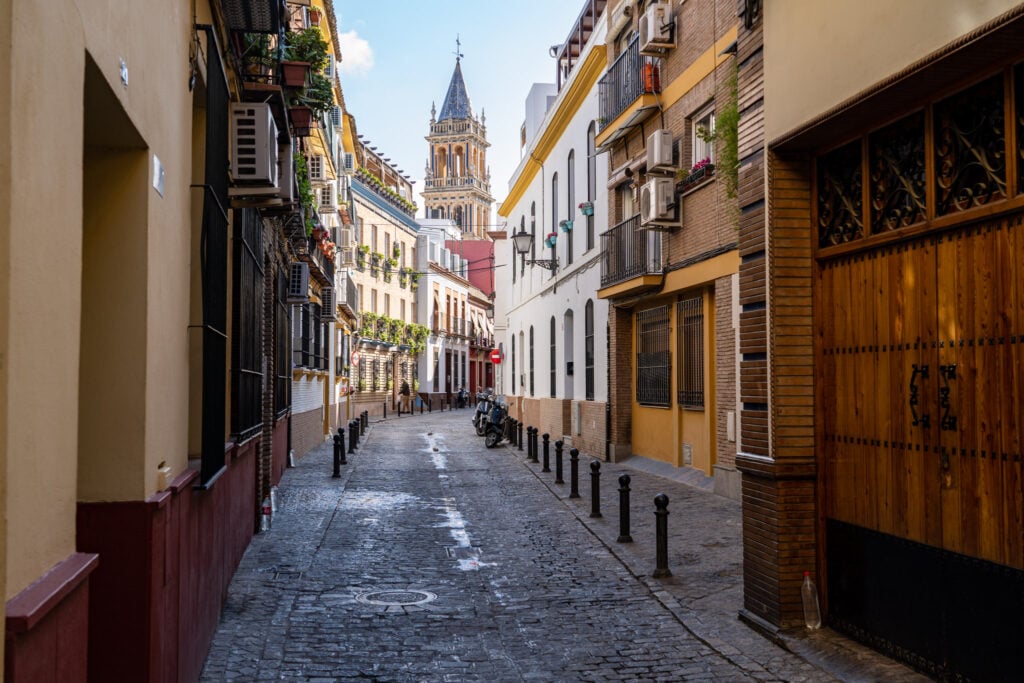
The Guadalquivir River, which runs through the center of Seville, plays an important role in the city’s history by connecting the city to the ocean (which made it the connection point between the Spanish Empire’s holdings in the Americas and the Spanish mainland).
That is, until the boats became large enough that the river could no longer accommodate them, and the connection point moved closer to the coast in Cádiz which led to a big recession in Seville.
The original walled city, the Casco Antiguo, sits on the east bank of the river, and the neighborhood right across the river on the west bank of the river is called Triana.
While the Casco Antiguo is the center of political and religious power in Seville (and has been for nearly 1,000 years), Triana is where everyday working people actually live.
When we’re talking about Triana, we’re referring to the neighborhood on the western bank of the river, roughly between the Puente del Cristo de la Expiración (here on Google Maps) and the Puente de los Remedios (here on Google Maps).
Generally speaking, the closer to the river you are, the closer to the vibe of the Casco Antiguo. We wouldn’t eat on the riverfront promenade because, like the other side, you’re going to be paying a lot for a meal that probably isn’t the best quality you can find in Seville.
The exception to that rule, though, is the Mercado de Triana, the neighborhood’s food market, which is worth visiting for lunch over the course of your Seville itinerary.
Up until relatively recently, Triana had a bit of a bad reputation driven by the fact that it was the neighborhood outside the city walls – on “the other side of the tracks”, if you will – and was where the Romani population settled.
There’s a painting in the Museo de Bellas Artes de Seville of Triana in the 19th Century, and the waterfront promenade is depicted as something closer to a slum than the vibrant, modern neighborhood you see today.
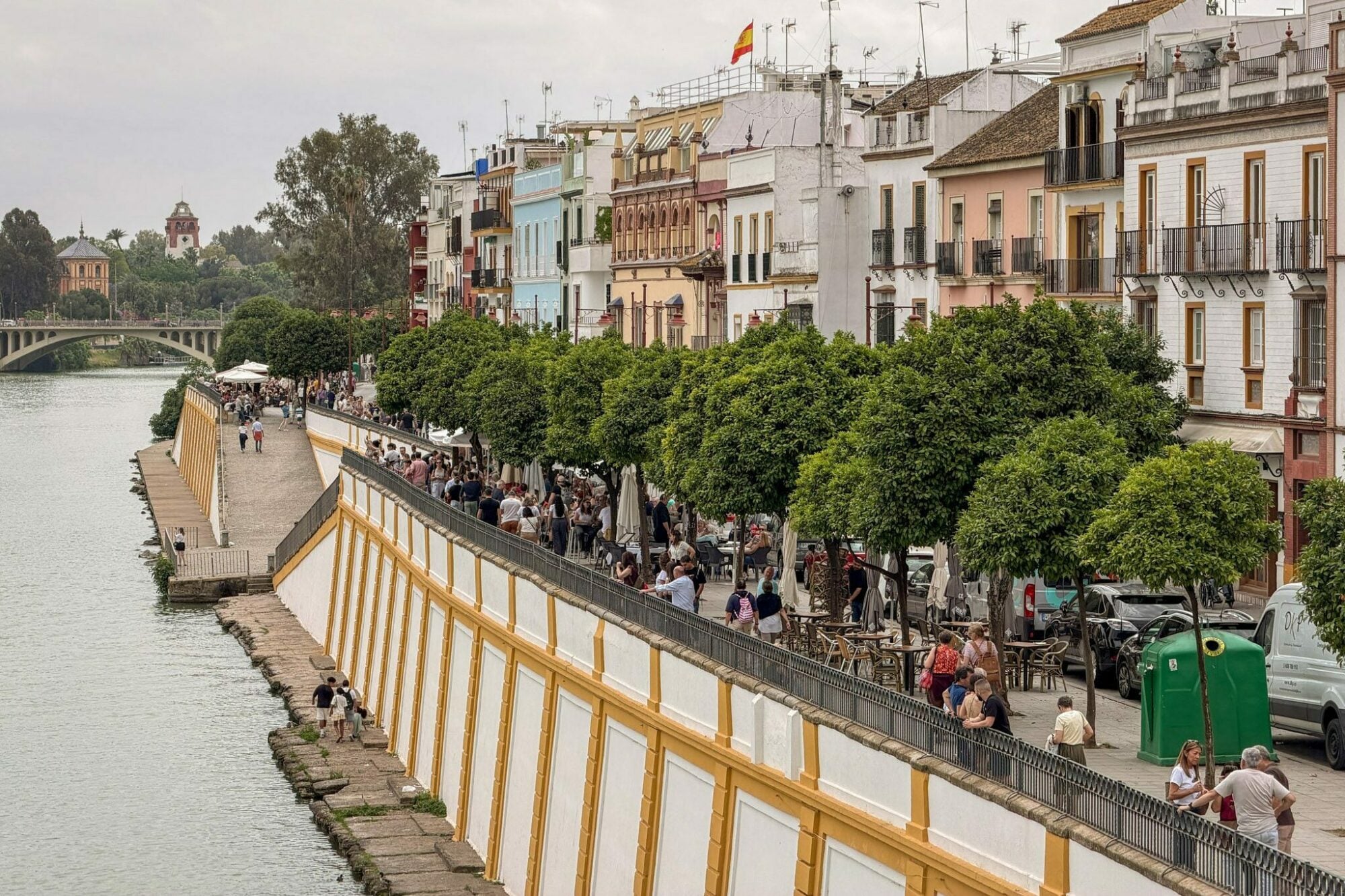
Today, Triana is where people actually live, which is hardly the case for the center of Seville nowadays as it has been hollowed out by the sharp increase in tourism and investment related to tourism.
At a high level, there are three things to do in Triana; browse the Mercado de Triana, check out the remnants of the prolific ceramics industry that used to thrive on this side of the river, and create your own tapas bar crawl.
Many people (including us on our first trip, frankly) just come to walk across the bridge to the Mercado de Triana and go right back, but we think that would be a mistake.
Here are a few more details on each of those things. Yes, we’re aware that two of these things involve eating and drinking, but isn’t that kind of the best way to see a city?
First, let’s talk about the Mercado de Triana, the neighborhood’s original food market. The market is part artisans selling ingredients (like meat, cheese, charcuterie, etc), and part ready-to-eat food.
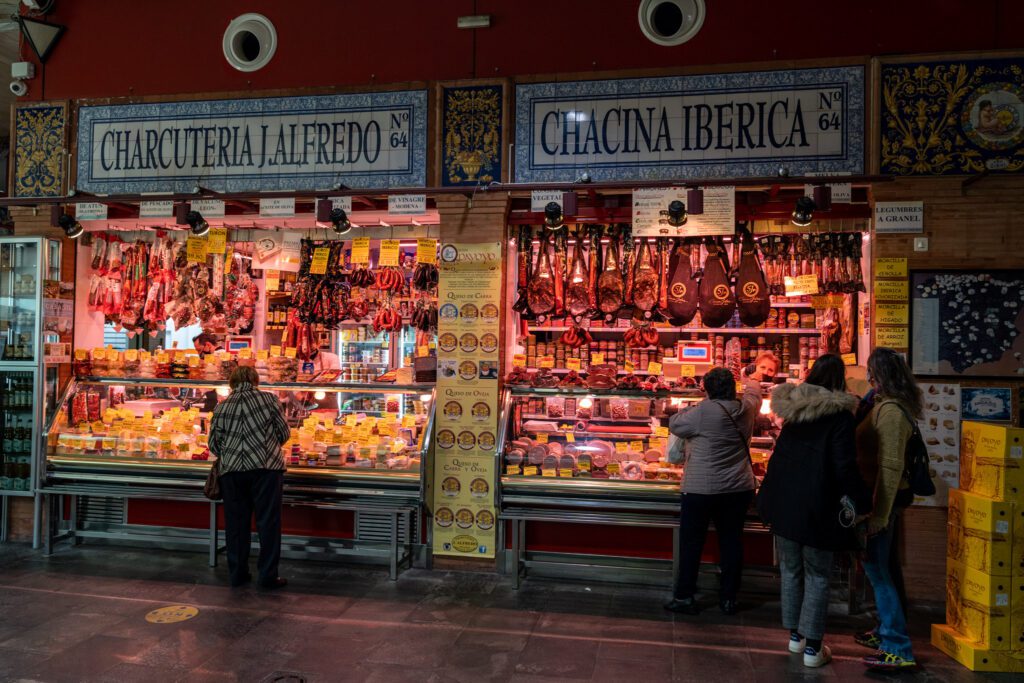
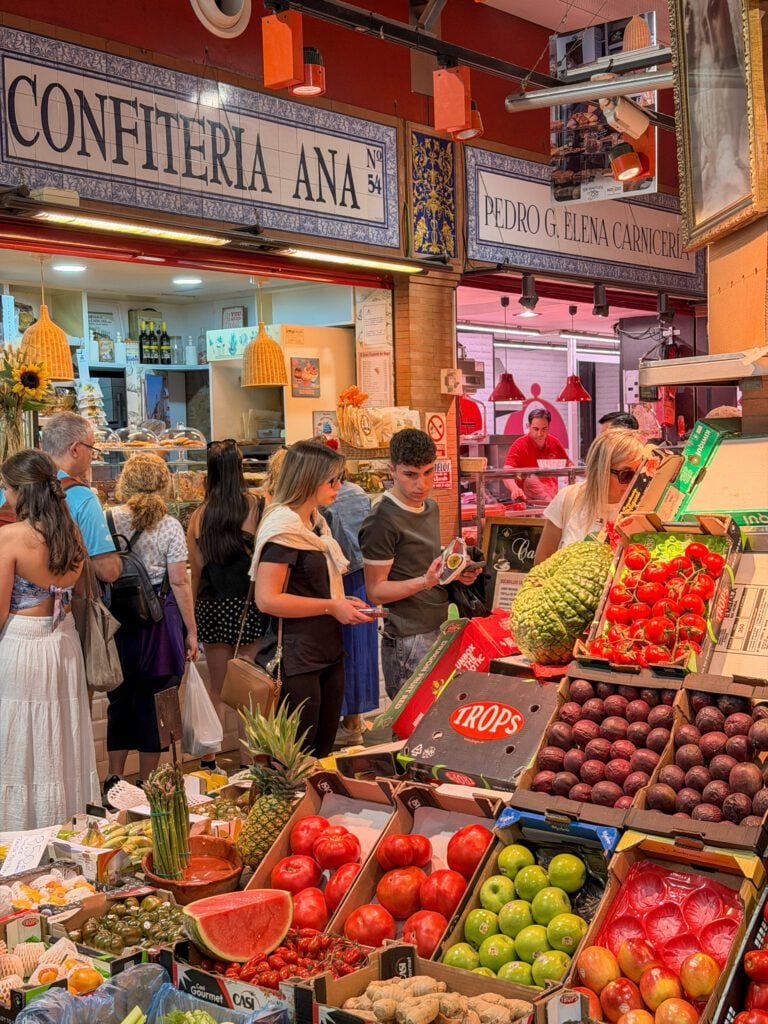
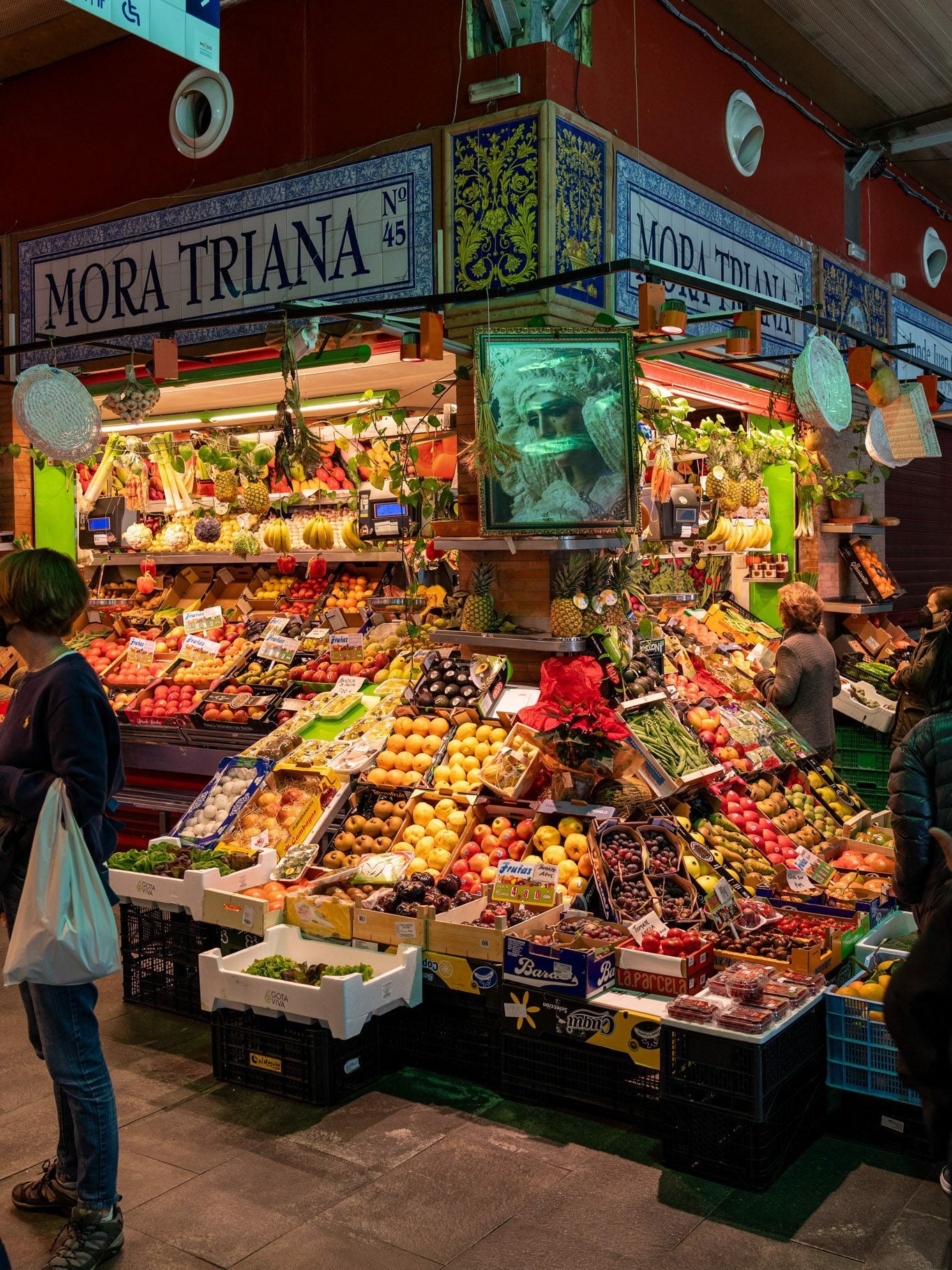
First thing’s first, we wouldn’t get too full here because there are arguably better places to eat in the neighborhood, which we’ll get to in a second, but we do like the atmosphere at the market, and it would be a great place to get some ingredients for a picnic or siesta snack.
Specifically, we’d go to the famous Jamonería José Luis Romero for charcuterie at the counter, and Arrocería Criaito Triana if you want paella (as a reminder, don’t eat paella just anywhere, only at an arrocería or a specifically Valencian place).
Next, let’s talk about ceramics.
Triana used to be a hub of the ceramics industry in Seville, and there was a big factory right in the center of the neighborhood a block or two southwest of the Mercado that has been turned into the Ceramics Museum.
Nearby, there are a bunch of ceramics shops selling everything from commemorative tiles to cups and mugs and plenty of other formats of ceramics.
If you want to take some ceramics home as a souvenir, this is arguably the best place to do it in any of the major cities in Spain. The specific shop that got recommended to us as reputable (and not just reselling pieces from elsewhere) was Cerámica Ruiz.
Last, but certainly not least, let’s talk about eating and drinking in Triana.
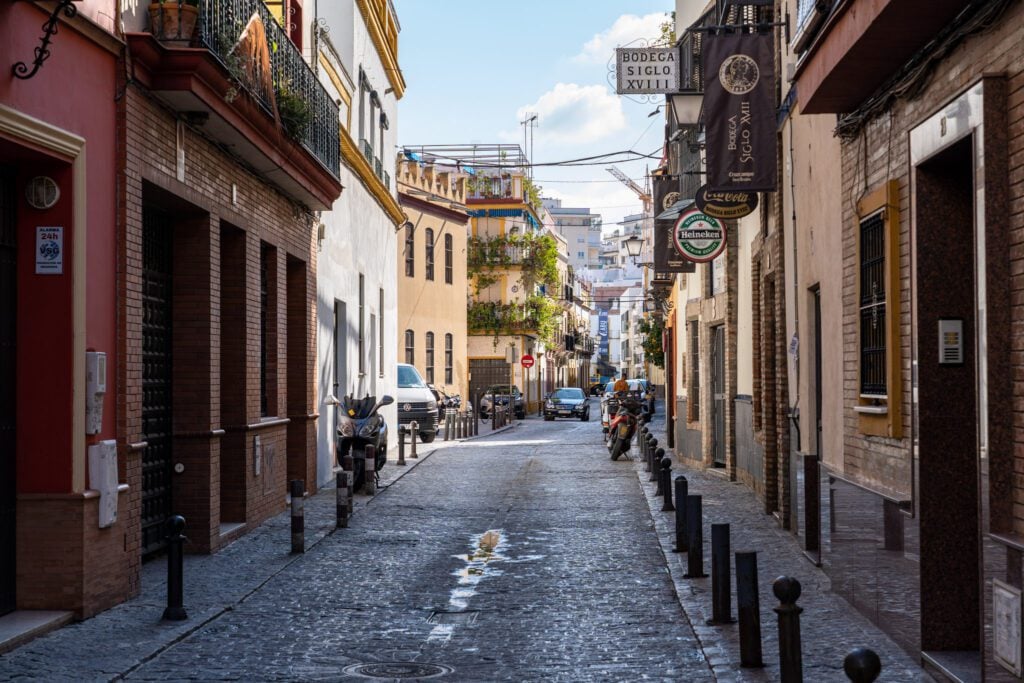
Because people actually live here, the food options tend to lean towards the more authentic side compared to the other side of the river (not to mention cheaper).
The way to do this is to turn it into a walking tapas crawl, connecting a few food stops with some good old fashioned wandering.
Once again, it’s worth noting that the further away from the river you get, the better luck you’re likely to have.
Two specific recommendations we got were Bar Casa Ruperto (for tapas, cash only) and Bar Juan Carlos (for an amazing beer and cheese selection).
We should also note that the best gluten free bakery in Seville is a little further south in Triana (Pastelería Durazno y Chajá).
Because we’re not really the right people to talk about the “best” places to eat – Matt has Celiac Disease, and our experience eating and drinking likely looks different than yours – here’s a guide to eating in Triana.
The Palacios: An Alcázar Alternative
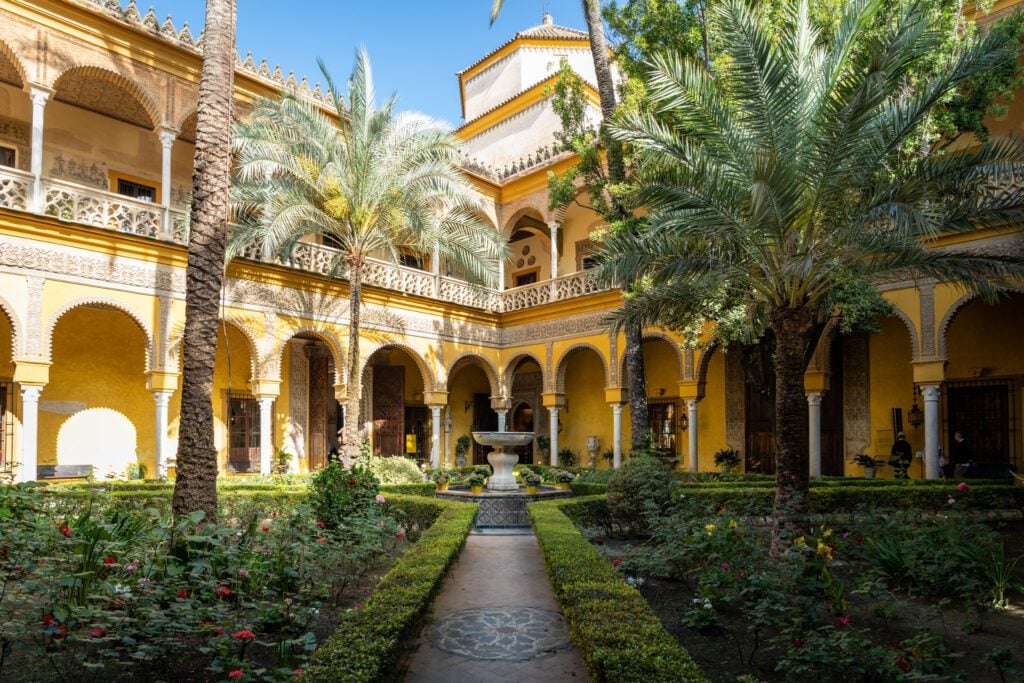
If you happen to have missed out on the Royal Alcázar, there are a couple of other examples of Mudéjar architecture throughout the city that see a fraction of the visitors and are well worth venturing out to.
Many of the former palaces around the city share the same layout as the palaces at the Alcázar, with an interior garden as the centerpiece, with rooms off the garden.
Which is clearly inspired by the Muslim architecture you see at, say, the Alhambra.
Even if you do the Alcázar, we’d still recommend visiting because they’re very cool from an architecture standpoint.
We visited Caso de Pilatos, Palacio de las Dueñas, and the Alcázar on our last trip, and would recommend all three.
We’d prioritize them in this order: Alcázar, Casa de Pilatos, Palacio de las Dueñas.
Since we have a whole section dedicated to visiting the Alcázar above, we’re going to focus on the other two in this section.
It’s worth taking a second to understand how these palaces came to look the way that they did.
There’s a much longer version of the story, but the short version is that the Christian kingdom that conquered the Iberian Peninsula and drove the Muslims further and further south actually adopted some of their design elements despite having fought a war for 700-800 years.
This led to the birth of a design family known as Mudéjar, which basically refers to a style that incorporates elements inspired by Muslim architecture, like horseshoe arches and intricate geometrical carvings.
However, unlike, say, the Alhambra (which was built by Muslims, for a Muslim), this architecture was commissioned by and built for Christians, not Muslims (though it was often built by Muslim artisans), and is a sort of imitation of the original style.
The Royal Alcázar is an example, and after its construction you started to see other palaces follow the trends that the royals were using, so a bunch of palaces in Seville that were built in the 15th and 16th Centuries ended up with prominent Mudéjar elements.
They were often added through renovations to existing, much older buildings to follow the style du jour.
The biggest benefit of visiting these two palaces is the fact that, by and large, you won’t be surrounded by hordes of tourists. There were people around when we visited, sure, but it was very much a slow trickle.
First, our favorite of the two, Casa de Pilatos, a lovely mix of Mudéjar and Italian Renaissance architecture just southeast of the main center of Seville (a 10-15 minute walk to the southeast).
The interior courtyard is beautiful, with busts of famous Spaniards lining the walls, a nice fountain in the middle, and gorgeous tilework on the walls.
Marble columns, colorful tiles, and intricate carvings – everything we love about the architecture from this period in Andalucían history.
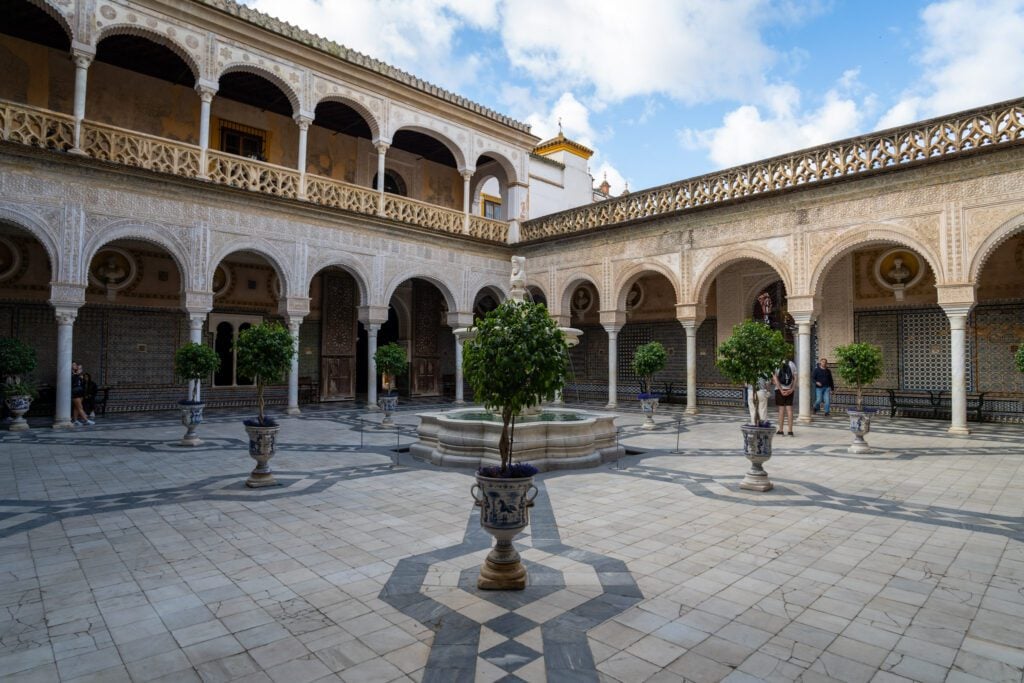
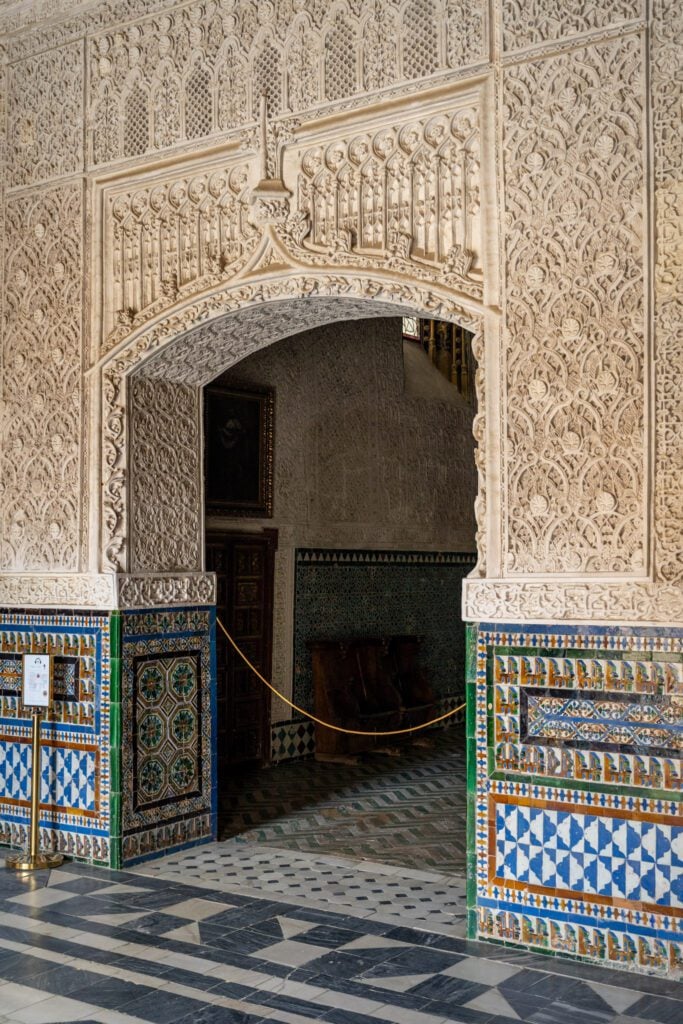
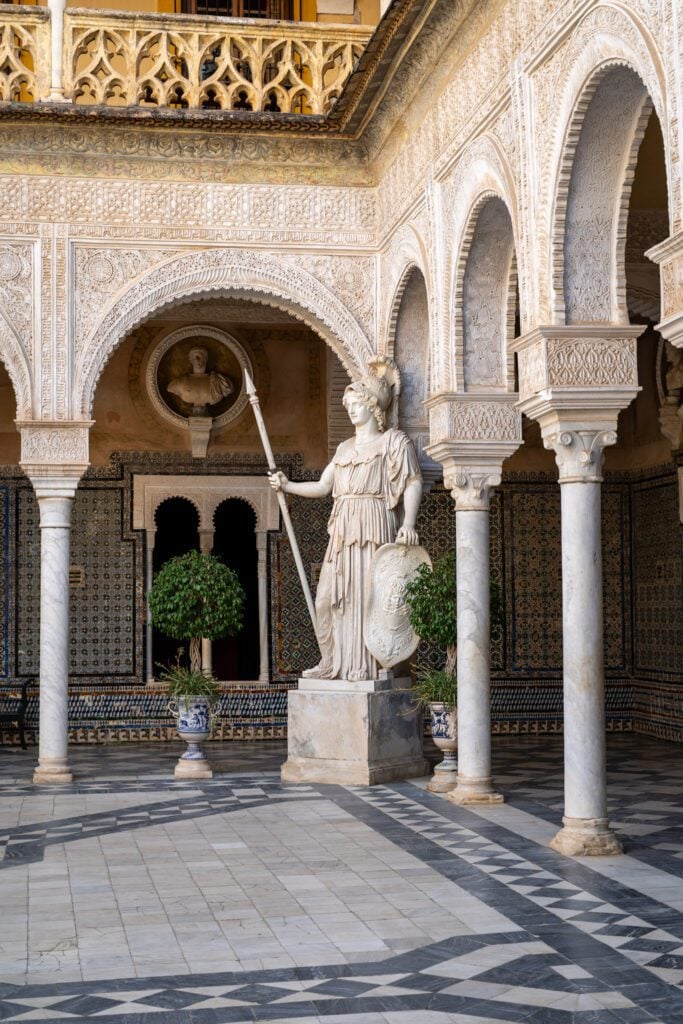
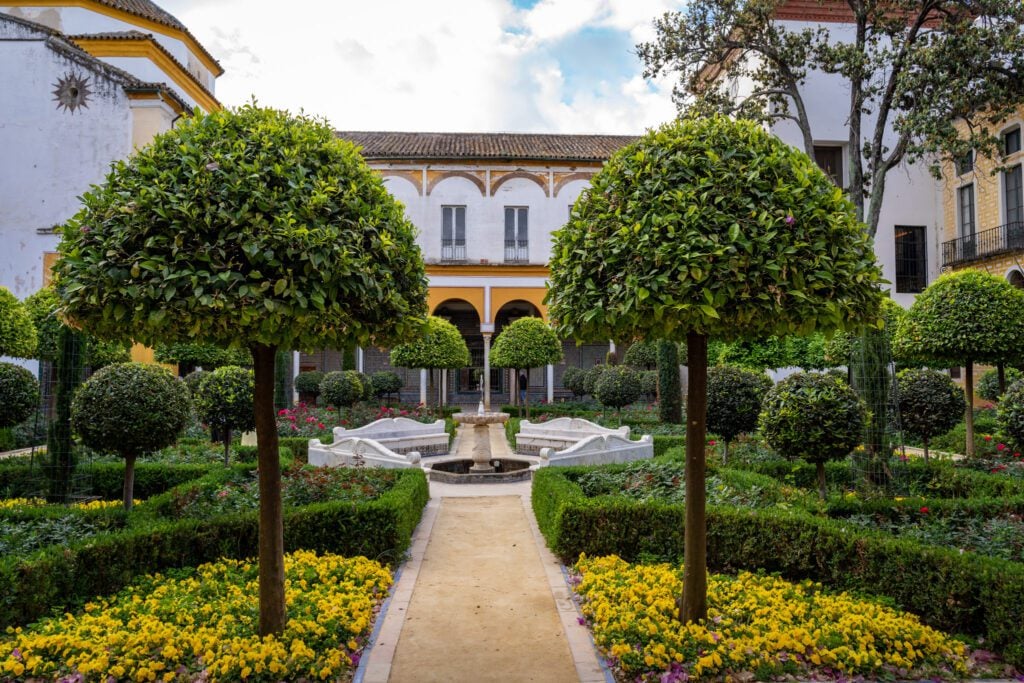
The gardens are also really nice, and being there in May was a great time to see all of the blooming flowers.
You can buy tickets onsite, or you can buy them in advance on the official website. If you can time it right, you can take a tour of the second floor (it’s only accessible on a tour).
The Palacio de las Dueñas is another great architectural mix of Gothic and Mudéjar styles, with lush gardens, beautiful courtyards, and opulent rooms.
It was built in the 15th and 16th Centuries, and eventually ended up under the control of House Alba (a Spanish noble family from centuries ago that, today, is one of the richest families in Spain).
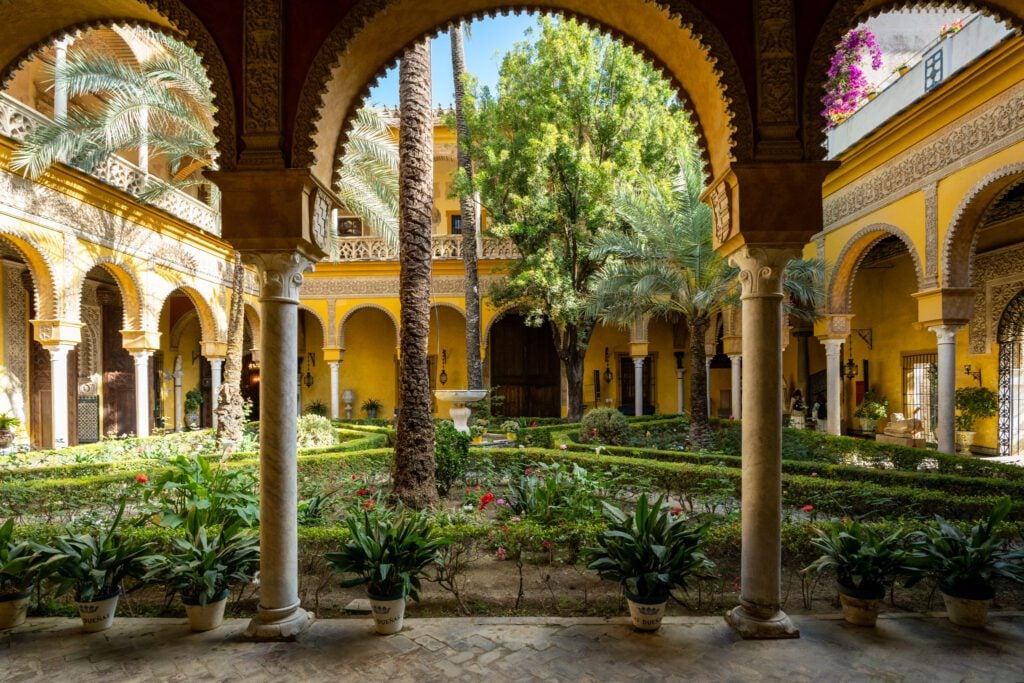
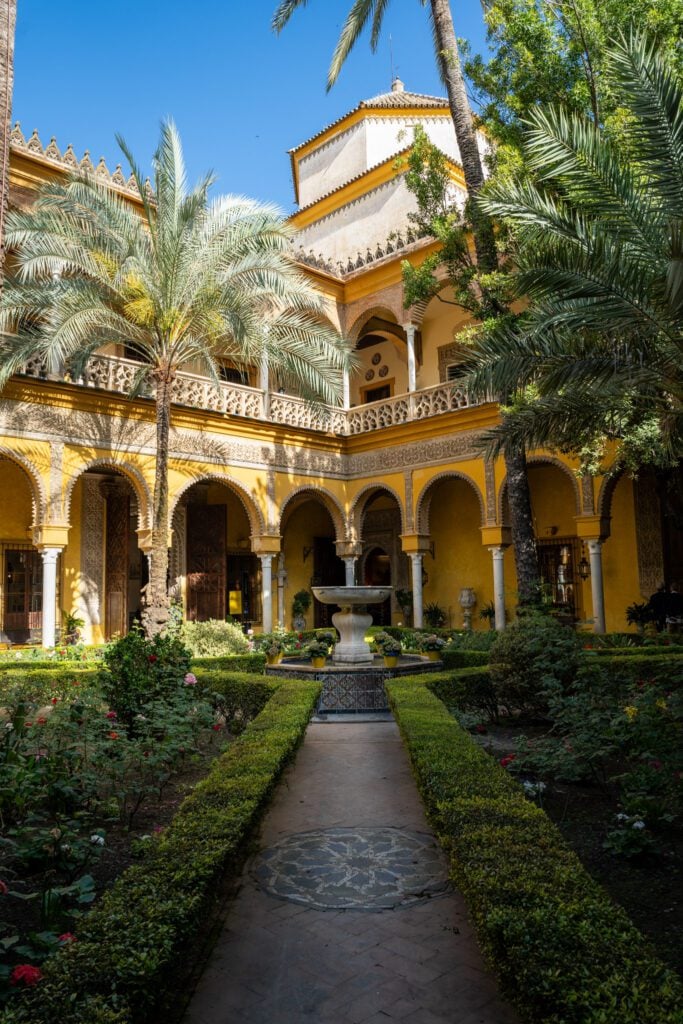
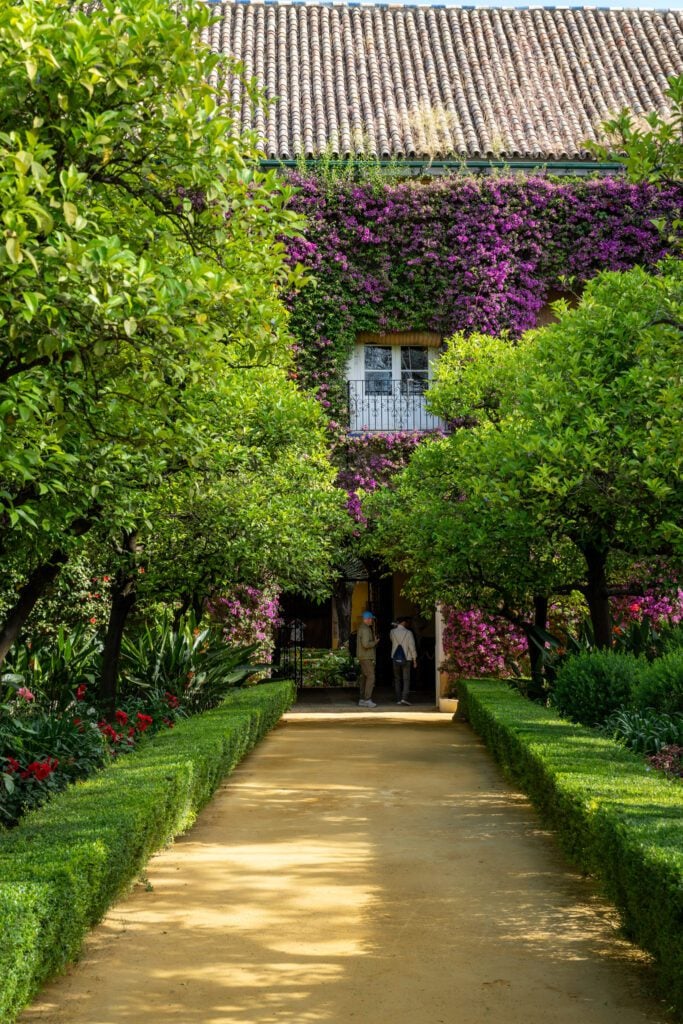
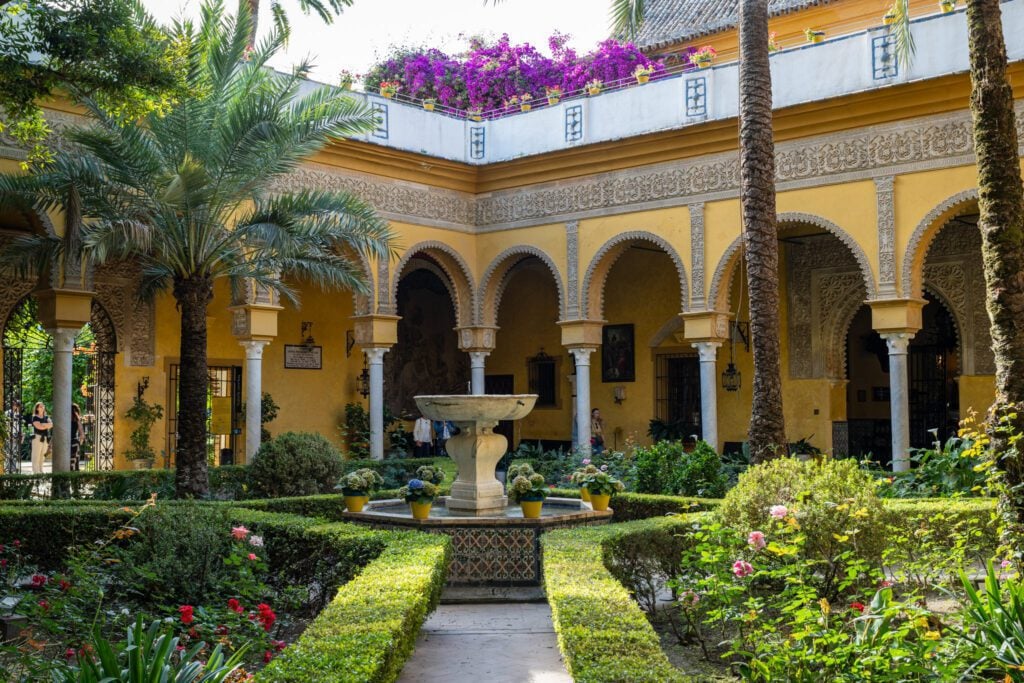
The cost of a visit is €15, but it’s free on Monday afternoons after 4pm if you happen to be in town.
This one is just east of the Setas, so it’s an easy walk from anywhere in central Seville.
More information on the official website here.
Take a Waking Tour to Get Oriented to the City
Walking tours are our favorite way to get oriented in a new city for a few reasons.
First, you get a crash course in history and culture, which is a valuable baseline that will make the rest of your trip more enjoyable.
Second, you get to spend a few hours with a local who will give you all sorts of tips about what to eat, drink (and see), and specifically where to find the best version of said things.
Last but not least, you’ll discover places that you definitely would never have found on your own.
We always do a walking tour on our first day in a city, and Seville was no different. We even did a walking tour on our latest visit to get re-acquainted with the city.
We’ve now done a couple of walking tours of Seville, and our favorite is this small group tour of Seville with Ron, an expat who has been in Seville for a long time and can offer a slightly different perspective than other tours we’ve done.
We really liked the route, which includes stops at the exterior of the Cathedral and Alcázar, and then meanders through the narrow alleys of Santa Cruz.
We have also done this walking tour, which wasn’t quite as in-depth and rich as Ron’s tour, but still covered the history of Seville and was a nice way to spend a couple of hours getting oriented to the city.
The Archivo General des Indies
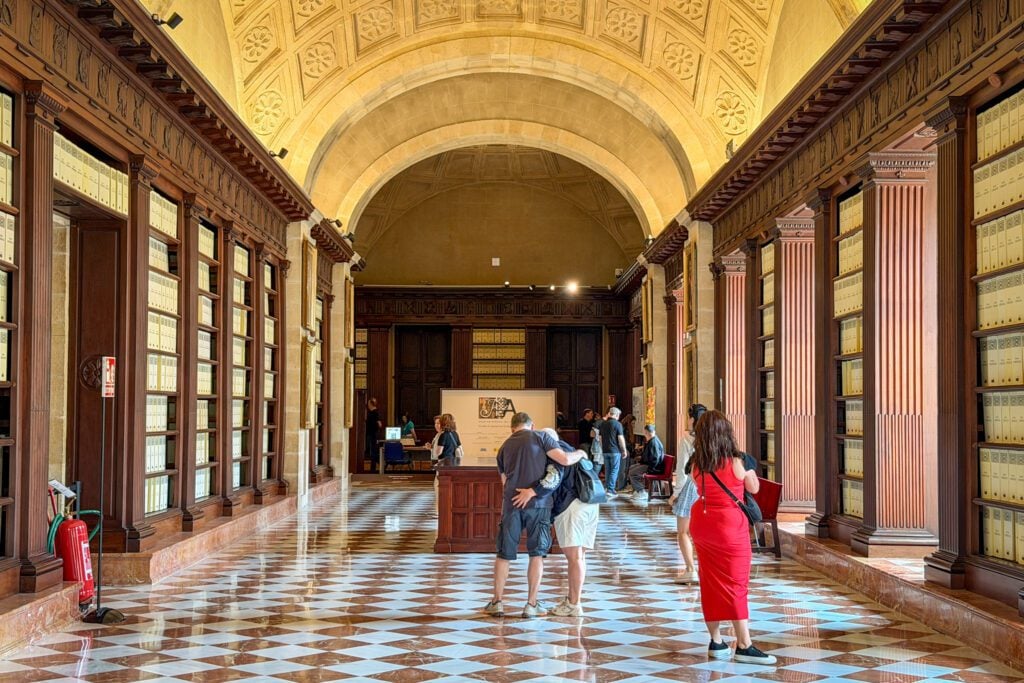
First, I can’t believe that we’re roughly 500 years into knowing that the Americas are not, in fact, the Indies and yet that’s how we’re still calling them.
Maybe it’s a “preserving history” thing, but this building should really be called the “Archivo General des Americas” because it was built to house all of the important documents related to administering the empire in the Americas.
This is the third (of three) UNESCO World Heritage Sites on the plaza outside – the Plaza de la Concepcion Immaculada – and it was originally built as a house of trade to move the merchants from the streets surrounding the cathedral (and even inside the patio of the cathedral) to a new location.
Then, it became a sort of customs house for trade with the Americas, which was required to go through Seville by royal decree, and all of the exotic goods like potatoes, tobacco, and tomatoes (not to mention gold) came through this building.
A few centuries later, the Spanish government was overflowing with cash from the expansion into the Americas, and it was repurposed as an archive to house all of the documents related to the exploration of the Americas.
It’s completely free to enter (no need to book in advance or buy tickets), and the building itself is gorgeous, with marble staircases and a nice courtyard.
Plus, they have a rotating selection of documents on display from a long, long time ago that have been restored and housed in the archives.
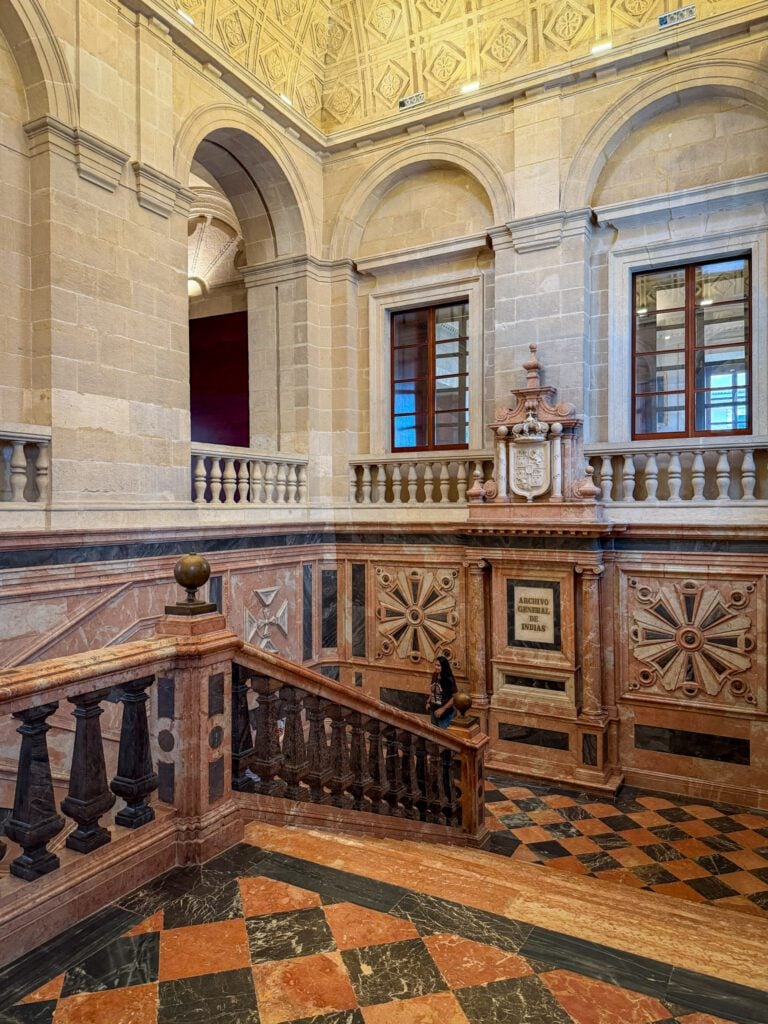
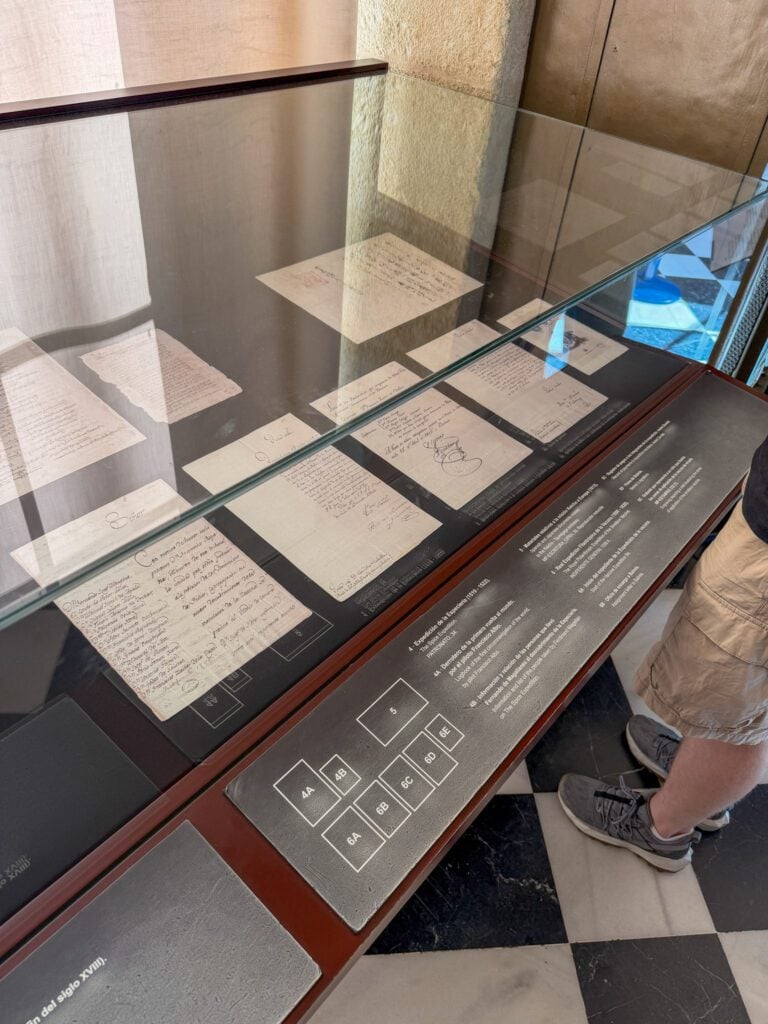
The thing that struck us is how similar the written Spanish from the 15th and 16th Centuries looks to Arabic.
Yet another example of the influence of the Iberian Peninsula’s Muslim history on Spanish culture and language.
Step Inside the Museo des Bellas Artes de Sevilla
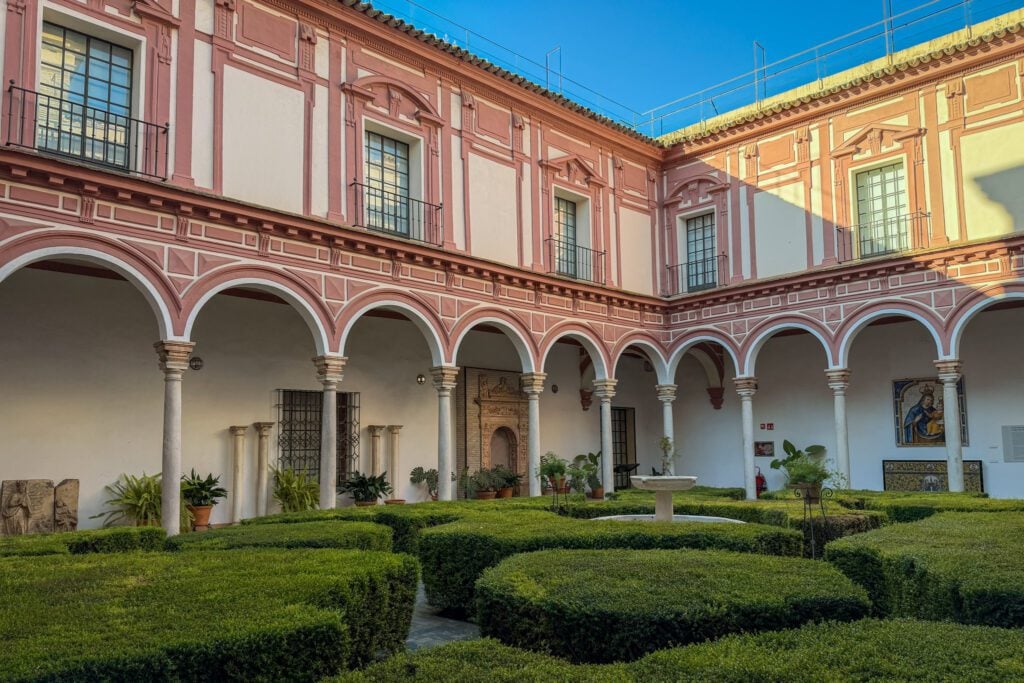
I went into this museum, which was billed to me by a tour guide as the second most important art museum in Spain after the Prado in Madrid, with relatively low expectations.
After about an hour spent wandering the galleries here, I walked away slightly disappointed in the art collection.
It’s known for being one of the best collections of Sevillan Baroque art in the world, which unfortunately means that the art leans heavily into religious themes, which just isn’t my jam.
I already struggle to focus on and understand art (which is why I like to do guided tours of art museums so that I can get some of the story behind the collection and specific works), and it gets infinitely harder when I’m looking at slightly different takes on the same three to five events.
There are a few pieces from Spain’s masters, like Goya and El Greco (among others), but the best part was actually the explanations from room to room, which laid out the history of the art scene in Seville and how it related to Spanish history more broadly.
All that being said, there are two reasons why I think this is actually worthy of a visit.
First, it’s in a beautiful building – a 16th Century convent – that has been carefully restored.
It has beautiful courtyards, and a portion of the gallery is in the original church of the convent, with the frescoes on the ceiling still intact.
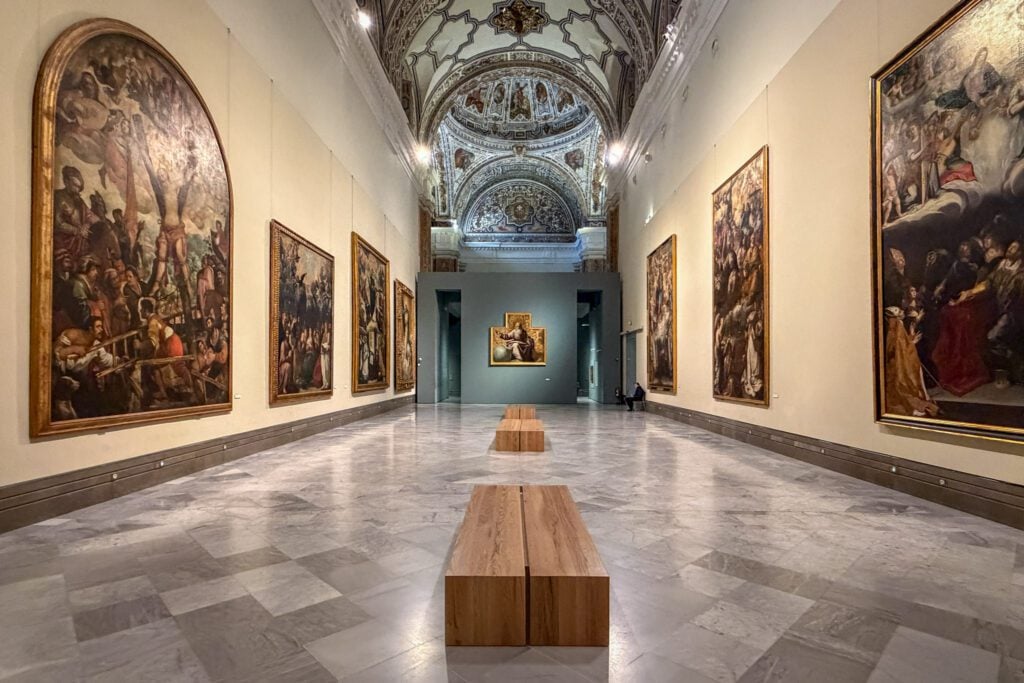
Second, it’s small, quiet and only costs €1.50 and about an hour of your time, so the investment here is relatively small even if you’re just here to see the building and skim through the collection.
No need to buy tickets in advance (I’m not even sure you can), just show up when you have an extra hour and buy them at the ticket office onsite.
Climb Atop the Setas de Sevilla
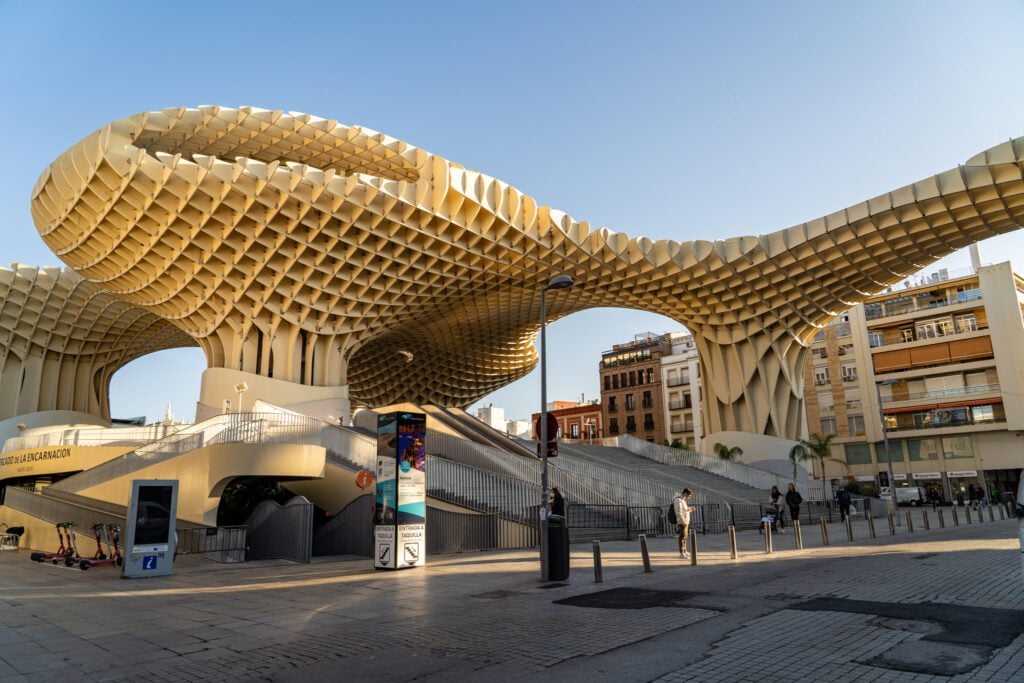
The Setas de Sevilla (technically known as the Metropol Parasol) are the big, wooden structures that sit on Plaza de la Encarnación in the very center of Seville.
You’re likely to notice them because they look, shall we say, out of place?
Which makes sense given that they were built in the early 2000’s, and designed by a German architect in a post-modern style, while the city around it was built centuries before in a completely different style.
Before the Setas were built, this beautiful plaza was… a parking lot. Which is actually true of a lot of the beautifully landscaped plazas you see around the city. Surface-level parking lots as far as the eye can see!
Lucky for all of us, the city council set out to beautify all of those parking lots, and the result is all of these beautiful public spaces.
We like the Setas as a concept because there are multiple levels here that serve completely different purposes.
The basement has a museum showcasing Roman ruins found here. The ground level is a food market with stalls selling fruits, veggies, and meats.
The middle level (under the shade of the Setas) is a sort of public square with seating and a little play structure. And the top is a viewpoint with nice views out over the city.
All in one structure! It’s cool, and we wish we did more of this here in the U.S.
The reason that the Setas are on this list is the fact that we like the view from the top of the Setas, and think it’s the second best view from above in town after the Giralda.
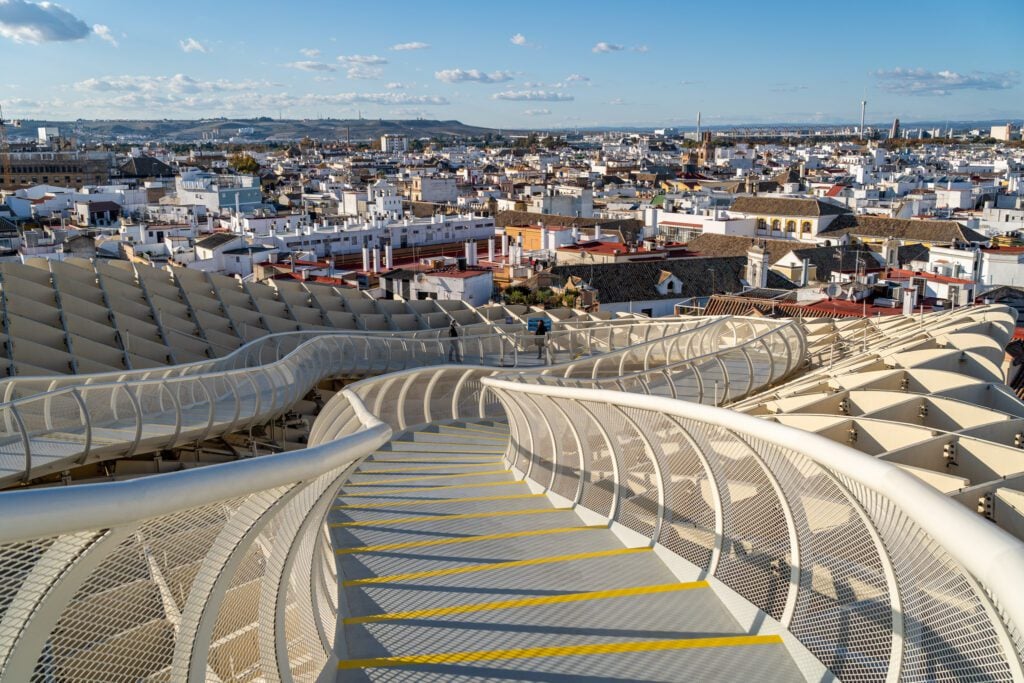
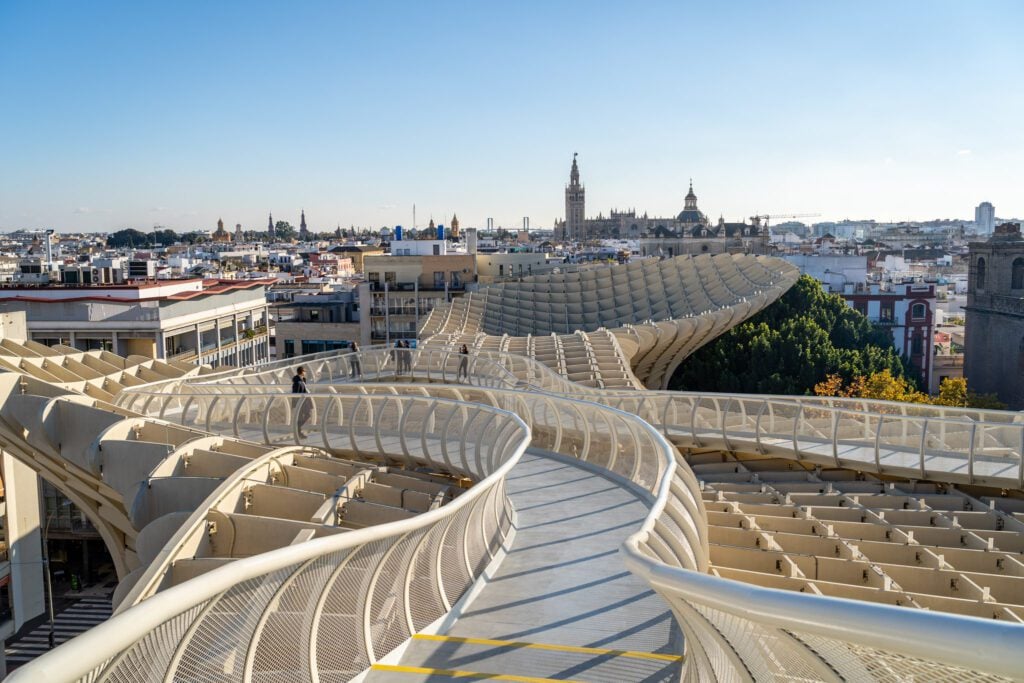
It’s a bit pricey now (it was less than half the price when we first did it a few years ago), but we think the views are worth it, and it’s one of the more unique structures in the city.
You can also come up here after the sun goes down, when there’s a light show that looks pretty fun. It costs extra, as does coming up around sunset.
Learn more and buy tickets in advance to skip the lines here.
Catch a Futbol Match
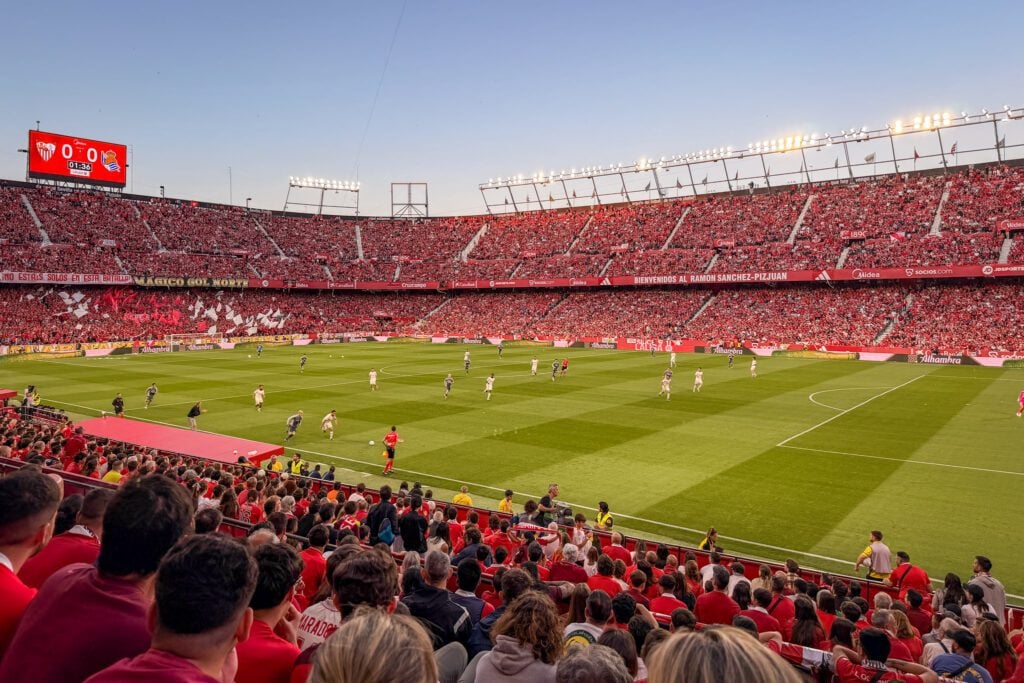
I, Matt, the resident football (soccer, for Americans) nerd, love going to games in Europe because the atmosphere is often so much better than it is at home (though in Portland we’re spoiled with the Timbers and Thorns).
As soon as we started planning our trip, I began looking at the schedules of the teams in each of the places we were visiting, and circled the game between Sevilla and Real Sociedad as the one I wanted to go to (and the one where the dates lined up).
The atmosphere was incredible, despite the fact that Sevilla was in a relegation battle and not having a great season.
Fans were singing for the entire 90 minutes, and we experienced the whole range of emotion with the die-hard Sevilla faithful, from anger and indignation to relief at the final whistle as they scraped a 1-0 win.
Now there are two teams in Seville, both of which would be a fun outing, which gives you a better chance of lining up a game while you’re in town (they tend to play on Saturdays and Sundays unless there’s a rare midweek game).
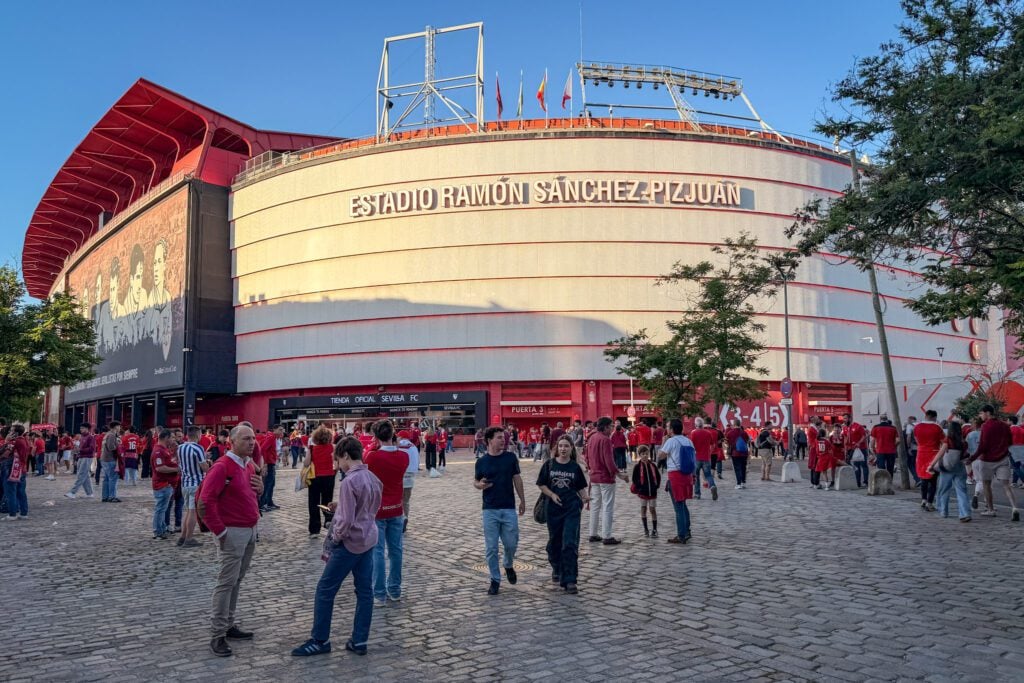
First, there’s Sevilla, whose stadium – the Estadio Ramón Sánchez-Pizjuán – is a 30 minute walk east of the center (we walked and it’s a little further east than the train station).
Then there’s Real Betis, arguably the more popular team with actual Sevillans, who play at the Estadio Benito Villamarín (which is south of the center, probably a bus or tram ride away).
If you’re interested in going to a game, you’ll want to check both schedules and buy tickets through the official club website, which we linked above.
Tickets can be difficult to come by for bigger games (against Real Madrid or Barcelona, for example), but we got tickets a week or so before the game we went to without too much hassle.
Don’t buy through third party vendors (like Ticketmaster), which are sketchy at best for football matches in Europe.
Planning a trip to Spain? We’d love to help!
Here are our other Spain travel guides to help you plan an incredible trip (even if you have to eat gluten free!).
If there’s no link below, it means we’re still working on it – long, in-depth guides take time! We’re working on it, though, we promise.
The first place to start, if you haven’t already found them, is with our detailed itineraries. We have one shorter version for 7 days in Spain, one version that covers 10 days in Spain (a good middle ground, we think), and one longer version for two weeks in Spain (with ideas for more and less time in both guides).
Our Barcelona Guides
- What to do in Barcelona (as a First Timer)
- How to Plan an Amazing 4 Day Barcelona Itinerary
- Where to Stay in Barcelona: A Complete Guide for First Timers
- 12 Things to Know Before You Visit Barcelona
- Gluten Free Barcelona: A Complete Guide to GF Restaurants + Bakeries
- Where to Find the Best Specialty Coffee in Barcelona
- How to Plan an Incredible Day Trip to Montserrat (from Barcelona)
Our Madrid Guides
- What to do in Madrid (as a First Timer)
- How to Plan an Amazing Madrid Itinerary (2 Days)
- Where to Stay in Madrid: A Complete Guide for First Timers
- 12 Things to Know Before You Visit Madrid
- Gluten Free Madrid: A Complete Guide to GF Restaurants + Bakeries
- How to Plan an Amazing Day Trip to Toledo (from Madrid)
Our Sevilla Guides
- Our Favorite Things to Do in Seville (for First Timers)
- A Perfect 2 Day Seville Itinerary (for First Timers)
- Exactly Where to Stay in Seville (The Best Areas + Hotels)
- Gluten Free Seville: Our Favorite GF Restaurants & Bakeries
The Rest of Spain
