
How to Plan an Amazing Day Trip to Toledo (from Madrid)
Look, if you’re here, you probably already know that we have a strong recommendation for you: if you find yourself with an extra day in Madrid, you should go to Toledo.
Before Madrid became the capital of Spain – which is a relatively recent change that saw Madrid go from backwater to capitol in a matter of years – Toledo was the most important city in the region.
To this day, it is the seat of the most important archbishop in the Iberian Peninsula.
It’s a charming hilltop city with beautiful views, some unique monuments (mostly religious) that illustrate the mixture of cultures that have inhabited Toledo, and it’s all just a short train ride away from Madrid, making it a perfect day trip destination.
In this guide, we’re going to cover exactly how to plan out your day trip to Toledo.
We’ll start with logistics, like why to visit and how to get there, and then go into a stop-by-stop guide for seeing the main sights in Toledo, with suggestions on what to do with more time in a section below the itinerary.
By the end, we hope you’ll have both the historical and cultural context for understanding the importance of Toledo, and also have the information you need to plan your own visit.
Sound good to you? Let’s get into it.
Disclaimer: Some of the links in this post, like hotel links, are affiliate links, meaning at no additional cost to you, we make a little bit of money if you click through and book. That being said, we would never recommend something to you that we don’t stand behind 100%.
Why Should You Visit Toledo?
Putting aside the fact that Toledo is a beautiful city sitting up on a hill above a river, there are a couple of good reasons why Toledo should be on your list of places to visit while you’re in Spain.
First of all, Toledo has been the religious capital of Spain since the Reconquista (that’s the process of the Catholic conquest of Muslim Spain over hundreds of years).
It is the seat of the archbishop of Spain, and is the seat of the most powerful religious figure in the country.
Second, Toledo was briefly the political capital of Spain when Charles V, the Holy Roman Emperor, moved his court to Toledo in the 16th Century.
I use the word “briefly” because shortly thereafter, the son of Charles V, Phillip II, had a little spat with the archbishop in Toledo and decided to move his court to Madrid on a whim.
That move is what turned Madrid from a literal backwater with a couple of thousand people to the biggest city in Spain and, eventually, the capital (and led to a corresponding downward trend for Toledo).
Last but not least, Toledo is conventionally talked about as a city where the “three religions lived in harmony” (the three being Christianity, Judaism, and Islam).
While that’s a bit of an oversimplification – the Spanish Inquisition did also reach Toledo and there were plenty of tensions and tough times – I think the reason you hear people say that is the fact that there are standing synagogues and mosques in Toledo that you can see, including a few of the oldest examples in the country.
Contrast that with other cities in Spain like Córdoba or Sevilla, where the mosques and synagogues have either been repurposed as churches or have been demolished, and you see where the “harmony” line comes from.
However, it’s worth noting that one of the synagogues and the mosque in the itinerary below are technically STILL owned by the Catholic church, so that “harmony” is a little more…complicated.
Take all of that historical and cultural context, combine it with a picturesque hilltop city with a few fun culinary delicacies, and you’ve got the perfect recipe for a great day trip destination.
How Much Time to Spend in Toledo
Usually, we don’t like to recommend spending less than two days in any place, and if you happen to have two days to spend in Toledo, it would be a lovely place to spend a couple of days.
However, given the limited vacation time that most people have, we also know that there are other places in Spain that we’d recommend over a second day in Toledo.
We’re big proponents of using day trips as a way to cover more ground (rather than spending one night in a place) because we’ve learned over the past decade (ish) of running a travel website that the worst part of traveling is packing all your stuff up and moving.
Toledo is a quick train ride away from Madrid and we think you can cover most of the highlights in a day, so it makes sense to do it as a day trip if you’ve got limited time.
Part of the reason we like Toledo so much is that it could not be any easier to access as a day trip from Madrid thanks to the high speed train route that connects the two cities. More on that in the next section.
Getting to Toledo from Madrid
At a high level, you have three options for getting to Toledo from Madrid: the AVANT train (high speed, medium distance), the ALSA bus, or booking a guided tour. Let’s talk about all three options.
On the High Speed Train

Our top recommendation for getting from Madrid to Toledo is the high-speed AVANT train that is operated by Renfe, Spain’s public rail company.
Similar to Córdoba, which is a short train ride away from Sevilla (here’s our guide to planning a day trip to Córdoba), Toledo is an extremely easy 35 minute high speed train ride away from Madrid.
You’ll want to catch the train at Madrid’s Puerta de Atocha Station, which is the city’s main train station just southeast of the historic center.
Toledo’s train station is a beautiful Mudéjar building that sits on the other side of the Tagus River from the city center.
You can walk from the train station to the city in about 15 minutes, but it is uphill and probably not great for people with mobility restrictions. There are taxis waiting outside the station if you don’t want to walk.
One thing we noticed on our recent trip is the fact that the morning trains to Toledo from Madrid were sold out a few days in advance for weekends.
We were there in early May, which is one of the highest months in terms of tourism in Spain.
We’ve read that you don’t need to book in advance, but if you’re visiting between April and October, we’d consider booking in advance so that you have access to that early train (which will give you more time to explore Toledo).
You can book tickets directly on the Renfe Website, which is the operator for trains in Spain, and trains come hourly for most of the day (sometimes twice an hour).
On the Bus
If the train is sold out, there is a bus option that will get you from Madrid to Toledo.
However, you should know that the train is superior in almost every way; it’s the same price, it’s faster, and it’s more convenient to get to the train station than the bus station, which is here on Google Maps.
The route is operated by ALSA, a big bus company in Spain, and you can book tickets directly through them.
On a Guided Day Trip
There are a few reasons why you might want to book a guided day trip that includes transportation to and from Madrid.
First, many of the tours include multiple stops alongside Toledo, so if you want to cover a lot of ground and see, say, Segovia and Toledo in the same day, this is the best way to do that.
Second, you may be interested in a local guide who can give you the context and history you need along the way.
The trade off is, of course, that it is significantly more expensive than doing it without a guide.
If you’ve read any of our European travel guides, we’re big proponents of booking guided tours with locals who can help give you important insight into the culture of the place you’re visiting, and we think the extra context you get on a guided tour is going to lead to a deeper, richer travel experience.
To be transparent, we didn’t really find any guided tours we were excited about recommending, so if you do one that you liked, we’d love to hear about it!
Exactly How to Plan Your Madrid to Toledo Day Trip
With the logistics out of the way, let’s get into our favorite things to do and see while you’re in Toledo.
This itinerary is basically going to take you in a clockwise loop through Toledo, starting with a great view of the city at 3 o’clock, and working your way all the way around the city.
A word here on the Toledo wristband, which is an option for tourists that includes admission to seven different monuments for €14.
We’ve seen it recommended in multiple places, and we were curious if it is really worth it, or, like many tourist cards in cities around the world, it’s more of a gimmick.
Of the seven monuments that are included in the wristband’s price, we put four into the main itinerary below; the Alcázar, the Mosque de Cristo de la Luz, the Sinagoga de Santa María La Blanca, and the Monasterio de San Juan de los Reyes.
Two additional churches are in the “with more time” section.
If you buy tickets individually, those four “must-visit” monuments come to €17, so buying the bracelet saves you a few Euros versus paying for each individually (more if you end up fitting in the other two churches in the “more time” section).
Plus, you don’t have to wait in line at the ticket offices for each monument, so we’d say it’s worth it.
You can get your wristband here, and pick it up on arrival in Toledo (which does mean a slight detour before jumping into the itinerary below).
Cross Puente de Alcántara for a Great View
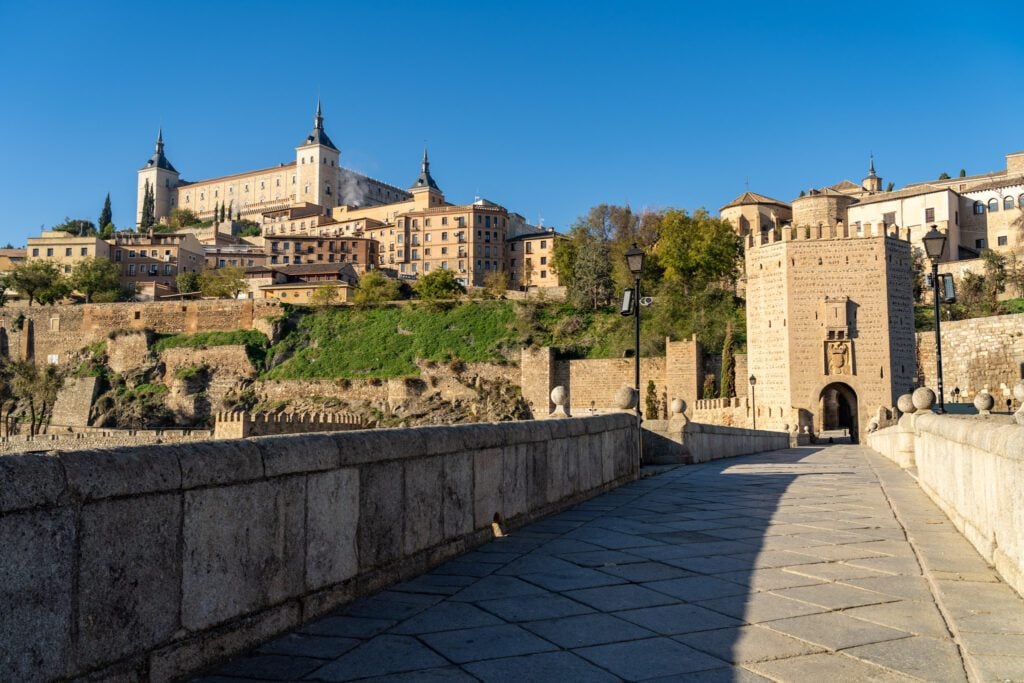
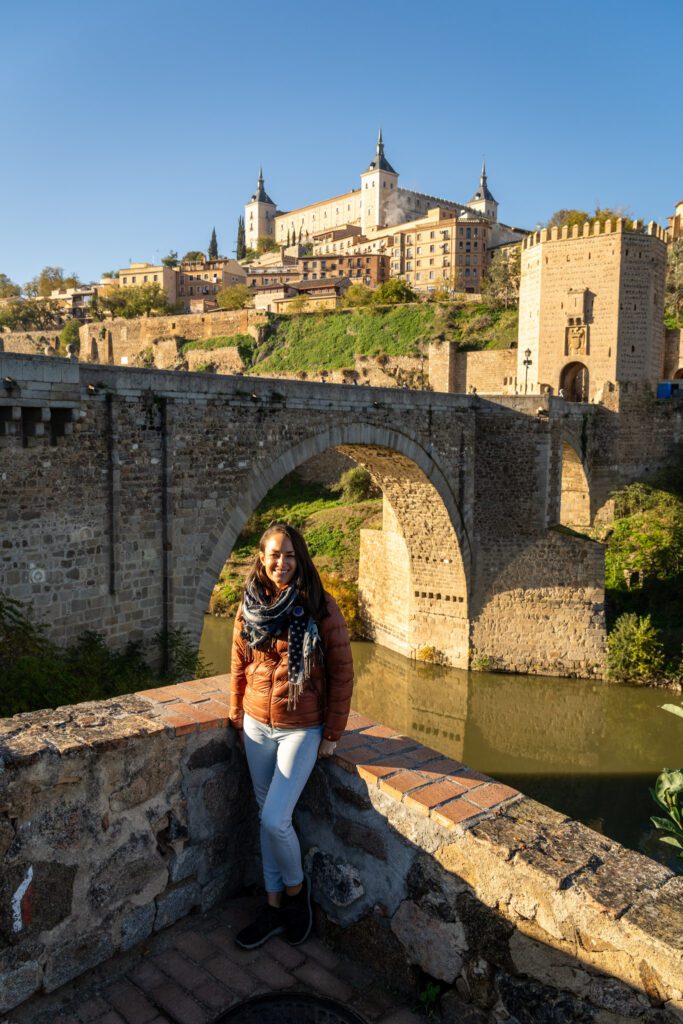
One of our favorite views in Spain is the view from the eastern side of the Tagus River looking up at Toledo on top of the hill with Puente de Alcántara in the foreground.
You can find that view here on Google Maps.
If you’re taking the train to Toledo (which you should), we’d highly recommend a slight detour on your way up to the city to get this postcard-perfect view.
Rather than crossing the river at Puente de Azarquiel (here on Google Maps, also a fantastic view), take a left at the roundabout as you exit the train station and head up the hill.
From the viewpoint, you can cross the bridge, pass through the gate, and turn right to get to the set of escalators that takes you up to the center of Toledo (which is, as we’ve covered, on top of a steep hill). Find the escalator here on Google Maps.
The Alcázar de Toledo
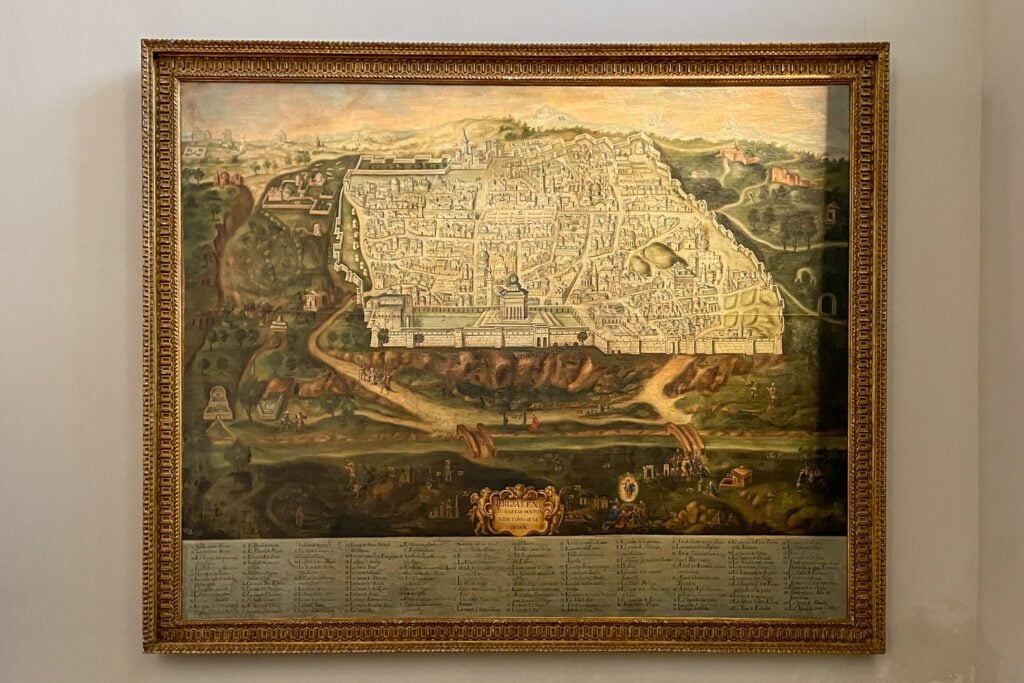
We have this as a first stop on your time in Toledo for a couple of reasons.
If you’ve read any of our guides to places in southern Spain (like Sevilla), then you might know what’s coming here.
Many cities in Spain were, at one point in the Middle Ages, part of a series of Muslim Caliphates (kingdoms, essentially) that spanned the vast majority of the Iberian Peninsula (modern day Spain and Portugal).
The word “Alcázar” is a bit of history hiding in plain sight, and it’s one of our favorite things to talk about.
It is, essentially, a word that the Spanish language adopted from Arabic that means castle or fortress (the Arabic word is “al-qasr”).
In fact, most words that start with “al” or “az” are adopted from Arabic, which was the primary language spoken and written on the Iberian Peninsula for centuries (somewhere between 400 and 800 years, depending on the place).
The primary reason that the Alcázar is the first stop on this itinerary is the fact that it is, in many ways, the beginning of Toledo’s history.
It was originally constructed as a fortress atop the hill in Roman times, and you can actually see the remains of that building inside the modern building.
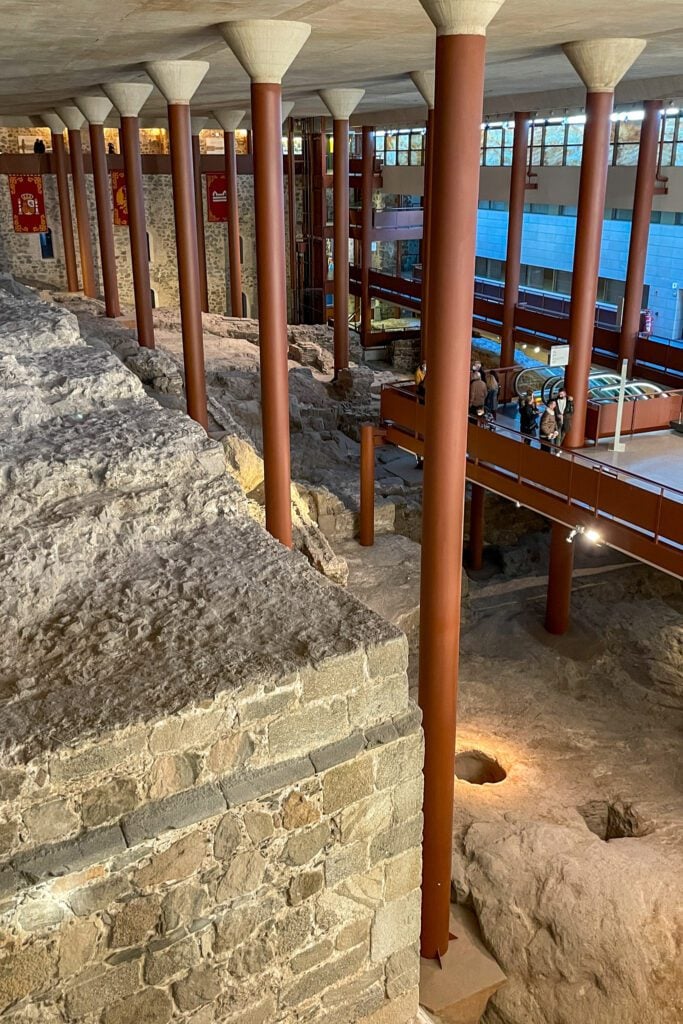
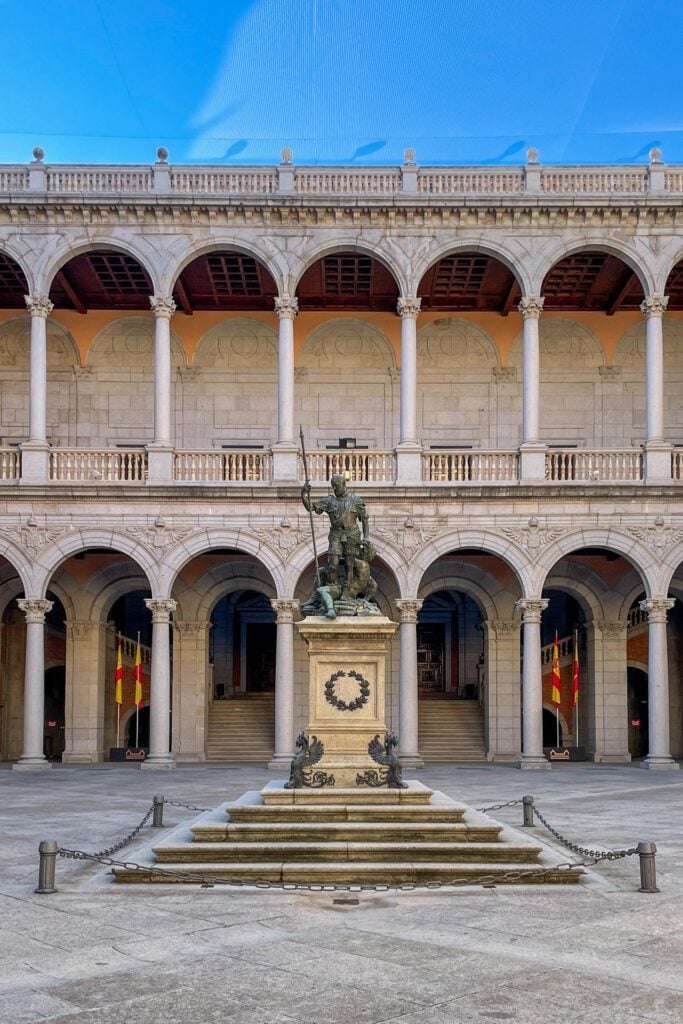
From there, it was used by the Visigoths, Muslims, and, finally, the Catholic Kings we now know as the Spanish.
The beautiful Renaissance palace built by Charles V was destroyed during the Spanish Civil War, when it came under siege by forces loyal to Franco, and had to be completely rebuilt after the war.
Today, the building is home to the Museo del Ejército (Army Museum), which contains a very detailed chronicle of Spain’s history in six chapters.
While it does include a lot of things focused on the military, I actually found that it uses a much wider aperture to explore the history of the country.
I, a history enthusiast who is fascinated by Spanish history, specifically, loved it, and spent a couple of hours journeying through time as Spain went from an afterthought in the Roman Empire to the most powerful empire in the world over the course of 1,000 years or so.
They also have some collections of guns and swords and stuff like that, which isn’t that unique or impressive, in my opinion.
If you’re not into history, you probably don’t need to go inside. There are some nice views from some of the courtyards.
It’s well worth the couple of hours it’ll take you to go through Spain’s history. The museum is free on Sundays!
The Toledo Cathedral
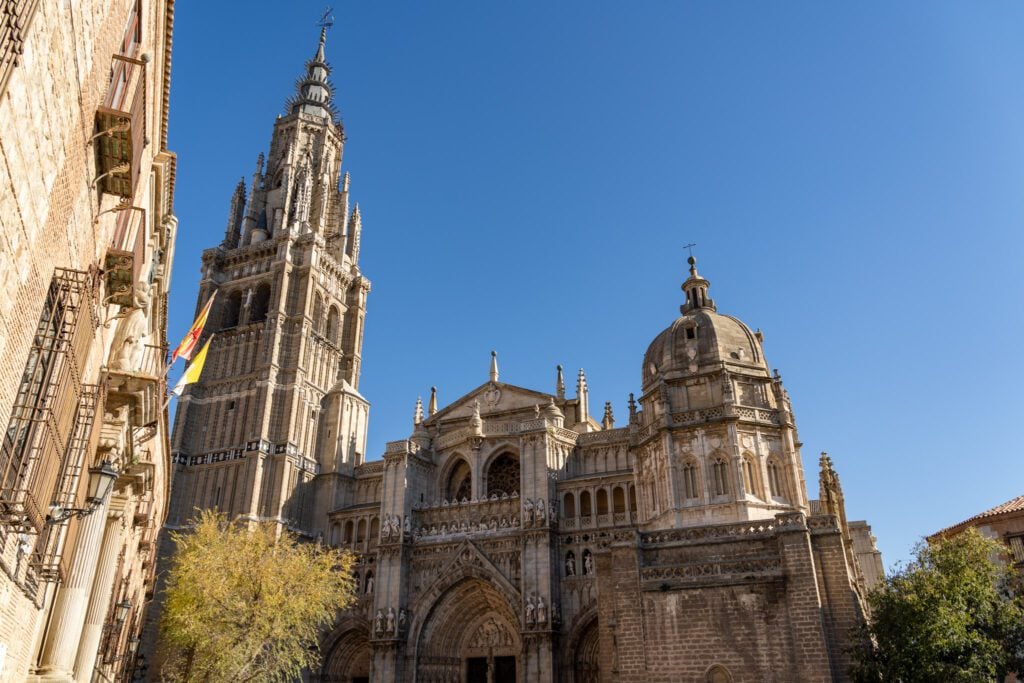
After the Alcázar, work your way clockwise by heading a few blocks southwest to the Toledo Cathedral.
The full name is the “Santa Iglesia Catedral Primada de Santa María”, but for the purposes of our (already high) wordcount, we’re going to just refer to it as the Toledo Cathedral.
As you might gather based on the grandeur of this cathedral in a city the size of Toledo, this was the most important cathedral on the entire Iberian Peninsula for centuries, serving as the seat of the Archbishop of Toledo.
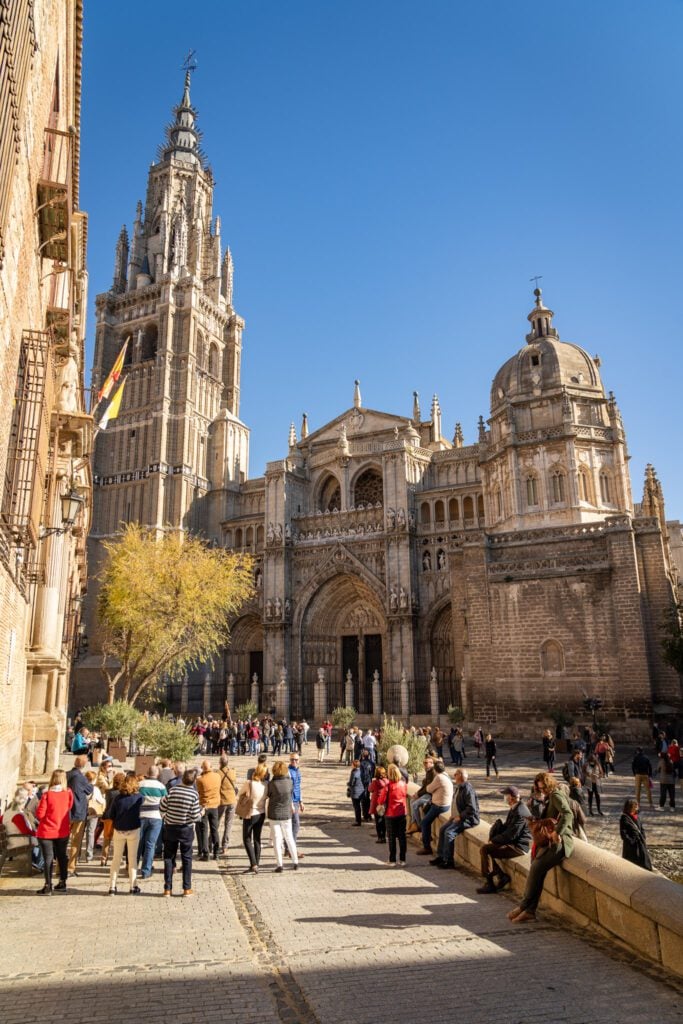
You’re never going to guess what lies under this grand cathedral. That’s right, it’s a mosque! (And also a much smaller Visigothic church that the mosque was built on top of).
The whole reason this building was built was to cover up the city’s mosque, which had been built during the period when the series of Muslim Caliphates fought over the city, and to act as a symbol of Christianity’s superiority.
The design has five naves, which is odd, and the reason is that the architects were directed to cover up all of the different holy spaces in the original mosque, including the big central courtyard.
Construction began in the early 13th Century and went on for several centuries.
The design is definitively Gothic, though there are definitely some other flourishes inside that don’t quite match (it’s because they were added later in the process).
Because of its importance, the interior of this cathedral is magnificent, and it’s well worth going inside. It’s going to be busy, but we think it’s worth it.
You can find more information on opening hours and current ticket prices on the official website.
It can get busy during the middle of the day, so it’s worth buying your tickets in advance online and building the rest of your itinerary around your visit.
If you’re following this itinerary and getting an early start, a visit somewhere around 11am should be perfect assuming you also go inside the Alcázar (though this will obviously depend on your own specific itinerary).
The Synagogue of Tránsito
The next two stops on this itinerary are two unique synagogues in Toledo’s historic Jewish quarter, just west of the cathedral, and both are worth your time.
However, we also wanted to take a second to talk about the claim that Toledo was a city where the three religions lived in peace and harmony, because it’s a gross oversimplification of the actual experience of being a Muslim or Jew in Toledo after the Christian conquest of the city.
On the one hand, Toledo was a place where we saw an incredible mixing of cultures, with scholars from all corners of the Mediterranean world making their way to Toledo to share knowledge (and translate that knowledge between languages, crucially).
Notice the tense we used.
It WAS a place where cultures mixed.
Until it was conquered by the Christian kingdoms moving from north to south, and then it mostly fell into the same pattern as almost every other city in Spain, with a strict hierarchy where Catholics were on top, and the other cultures were tolerated at best, and forced to convert, expelled, and murdered at worst.
However, everything we just wrote is largely true of every city in Spain.
This is all to say that Toledo is not particularly special, though its importance did mean that people from all over the known world gravitated there during the Middle Ages (and were subsequently sent away).
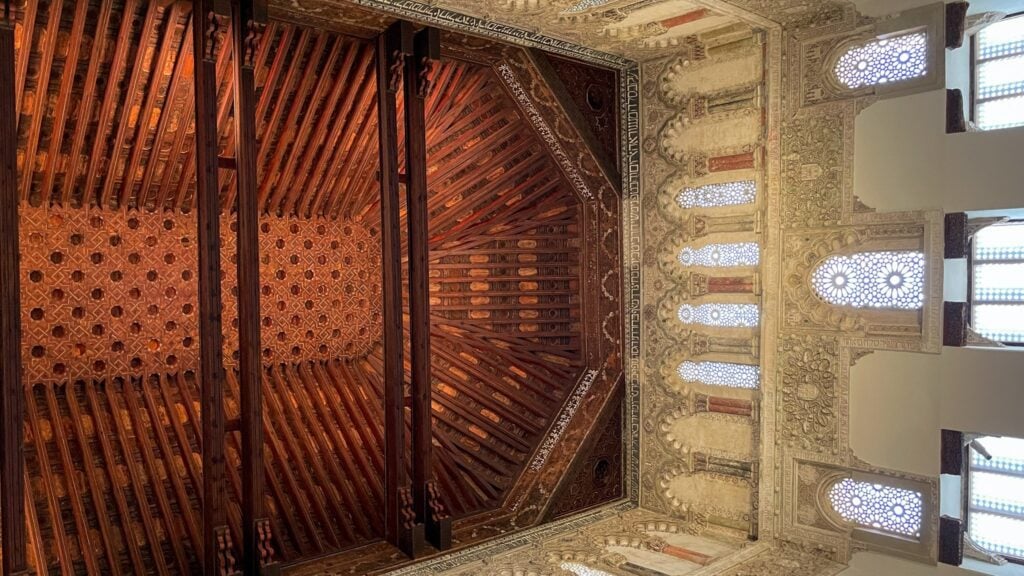
The first synagogue is the Sinagoga del Tránsito, also known as the Sephardic Museum of Toledo.
This one is much more about the information it provides about the Jewish community in Toledo, while the other is the more beautiful and architecturally interesting of the two.
Though that’s not to say this one isn’t beautiful, especially the roof.
If you weren’t aware, the term “Sephardic” refers to Jews whose ancestors came from the Iberian Peninsula (who were subsequently persecuted during the Spanish Inquisition and spread all over the world).
The museum portion is actually really great, and tells the story of the Jews who came to the Iberian Peninsula and chronicles their experiences during the Middle Ages.
The synagogue was, again unsurprisingly, seized during the inquisition and turned into a church, and it was only returned to the Jewish community to become a museum in the early 20th Century.
You can buy tickets on arrival here, no need to make a reservation in advance.
The museum is closed on Tuesdays, and admission is free on Saturdays after 2pm. For more information on hours and prices, head over to the official website.
If you’re looking for a nice stop between synagogues in the Jewish Quarter, we’d recommend heading to Teteria Dar Al Chai who have a nice tea menu, a beautiful tiled interior, and a nice patio outside.
The Sinagoga de Santa María La Blanca
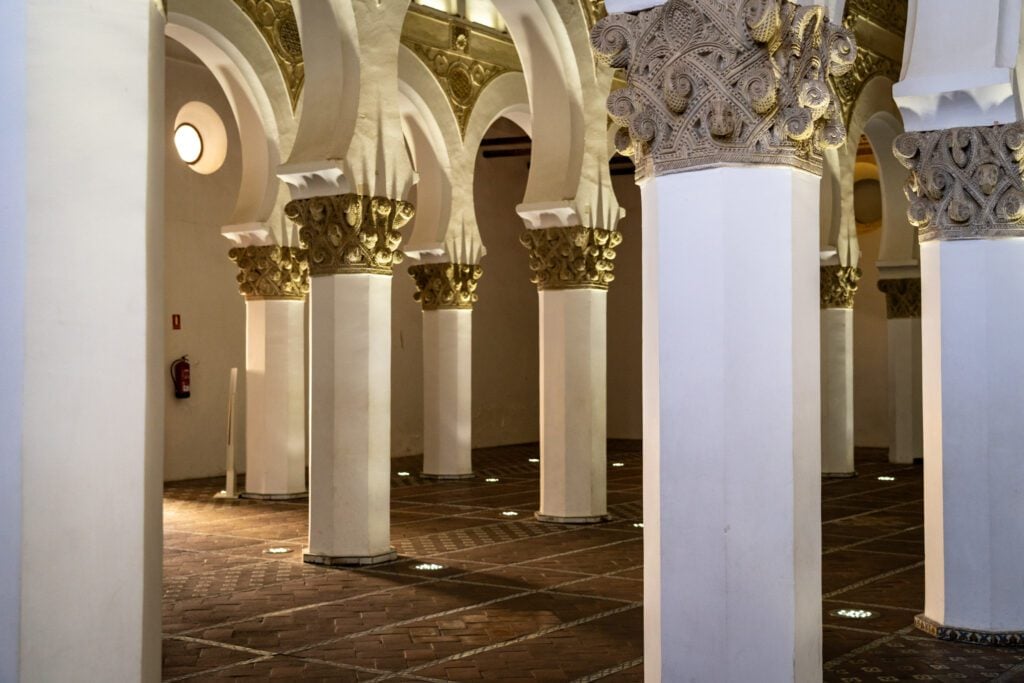
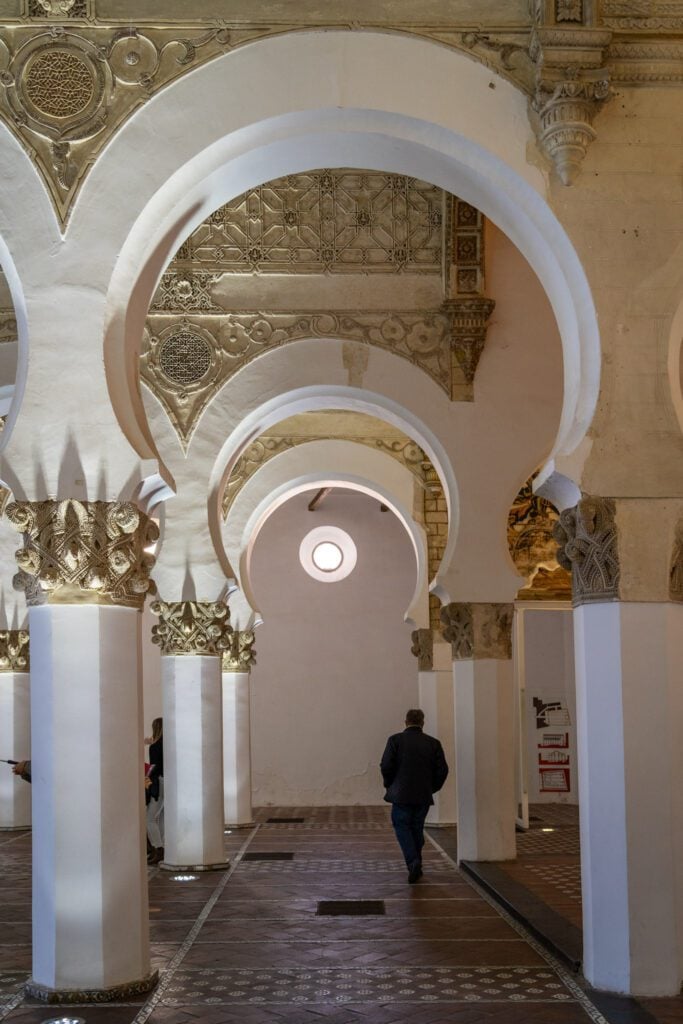
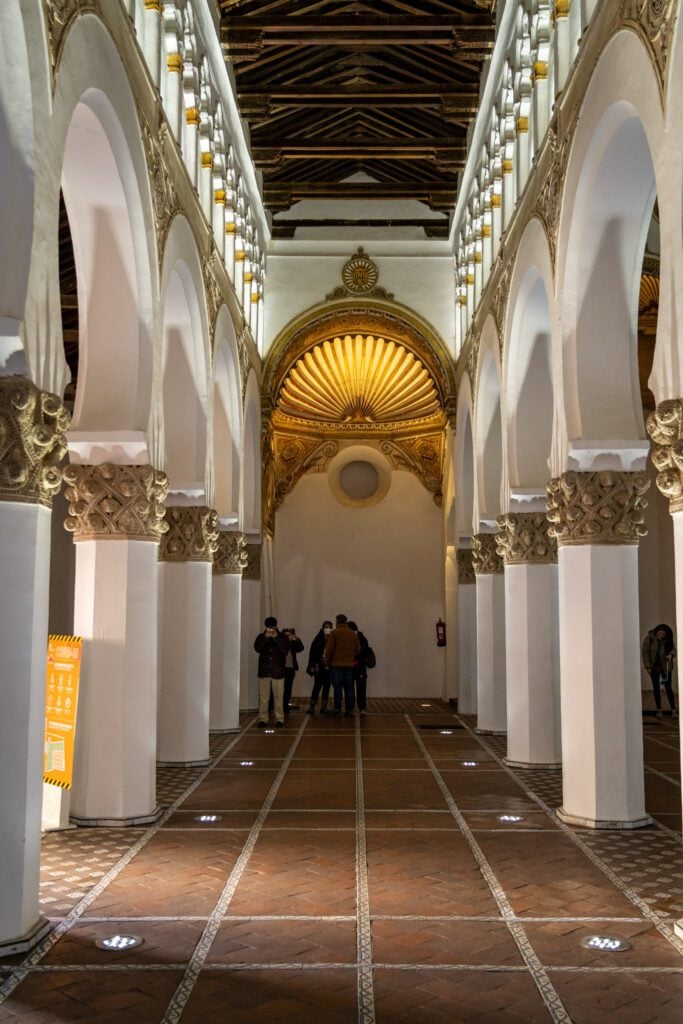
This synagogue, the Sinagoga de Santa María La Blanca, is the more famous one, and I was a little surprised at the lack of information inside.
This was the main synagogue in the city, and was built sometime in the 12th Century (though we don’t have great records, and we aren’t exactly sure when it was constructed).
I can see why some people are underwhelmed and advocate for skipping it, but I think, given the cheap entry price and the “hit-you-in-the-face” nature of the Mudéjar elements incorporated into a synagogue makes it a must-see because it is perhaps the best example of that cultural mixing we’ve talked about.
If you find yourself with time for just one of the synagogues, this is the one we’d choose (though not if you’re looking to learn more about the Sephardic community).
It’s technically no longer a synagogue after it was confiscated when the Jews were expelled or forced to convert under the Spanish Inquisition.
Today, it’s owned by the Catholic Church, who has yet to return it to the Jewish community despite them asking the church to do so.
The interesting piece of the story here, we think, is the incorporation of Mudéjar elements into the design, which were en vogue across Spain when it was constructed.
Mudéjar is an architectural style that uses elements from Islamic architecture, like horseshoe arches and intricate carvings, but was commissioned by someone who was not Muslim.
For example, the Alhambra is not Mudéjar because it was built by Muslims, for Muslims, while the Alcázar in Sevilla is Mudéjar because it was built by Muslims for a Christian king.
The incorporation of Mudéjar elements makes this synagogue one-of-a-kind, and we think it’s worth visiting.
Buy tickets onsite. Lines can be long, and you can skip them with the tourist wristband we talked about at the top, which can be a pretty good value.
The Monasterio de San Juan de los Reyes
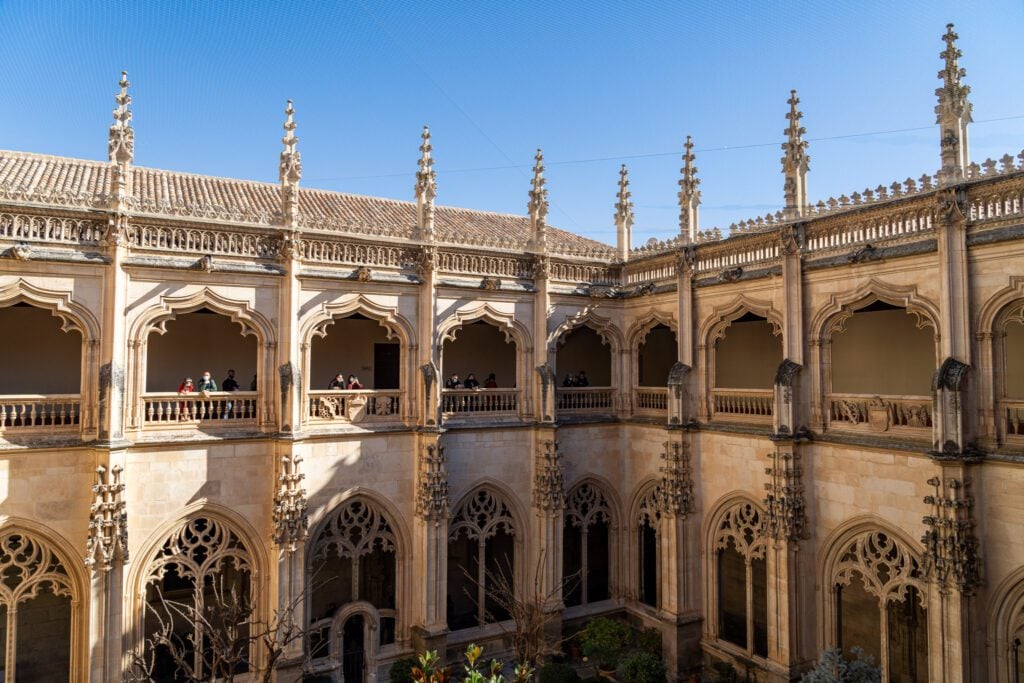
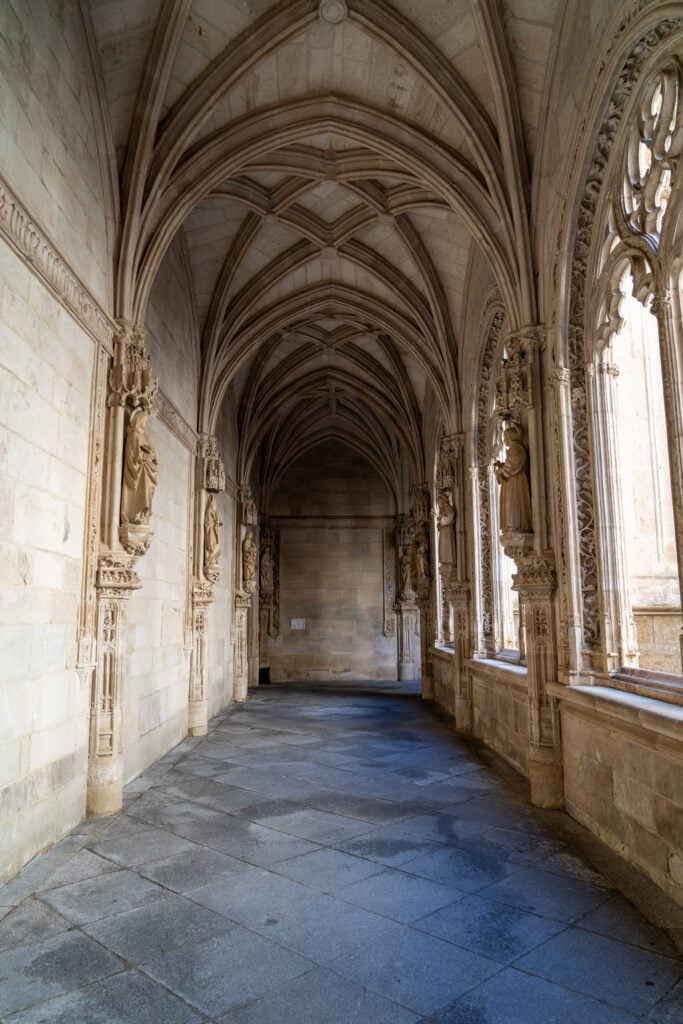
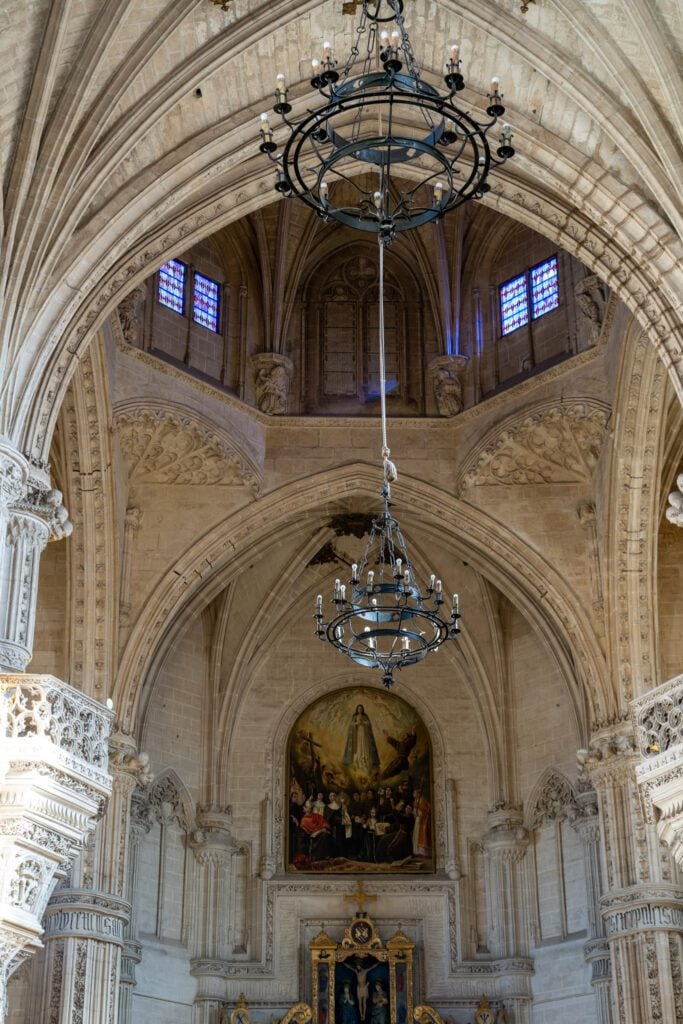
Continue your clockwise exploration of Toledo by heading a few blocks north to the Monasterio de San Juan de los Reyes, a nice monastery whose main attraction and highlight is undoubtedly the multi-floor cloister in the middle.
Originally, it was supposed to be the burial place of Queen Isabella and King Ferdinand – the royal couple responsible for bringing the two Spanish kingdoms together – but they ended up deciding on Granada later in life after they conquered the last Muslim kingdom in Granada in 1492.
It was built by Isabella and Ferdinand as a celebration of the birth of their son and their victory in a major battle (more on this in a second), which tells you everything you need to know about the importance of Toledo within Spain prior to the moving of the royal court to Madrid in the 16th Century that preceded the city’s decline.
That “victory” at the Battle of Toro (against Portugal) was part of the War of the Castilian Succession, and it was widely considered to be a draw.
However, results on the battlefield aside, Isabella used it to solidify her claim on the throne of Castile and directly led to the unification of Spain under Isabella and Ferdinand.
The monastery itself is beautiful, at least partially because it was restored relatively recently after first being damaged by Napoleonic troops during their foray into Spain (a common refrain you’ll hear across the country) and then abandoned until the late 19th Century, when restoration began.
Make sure to do the ground floor and upper floor of the cloister, and check out the gargoyles on the upper floor.
Buy tickets onsite, or use the tourist wristband.
For an excellent view of the monastery from the outside (plus the landscape beyond it), head up the hill to Plaza de Virgen de Gracia (here on Google Maps), which is where we enjoyed the lunches we packed with a nice view.
The Mezquita del Cristo de la Luz
You’ve seen Christianity, you’ve seen Judaism, now for the last of the three main Abrahamic religions, Islam.
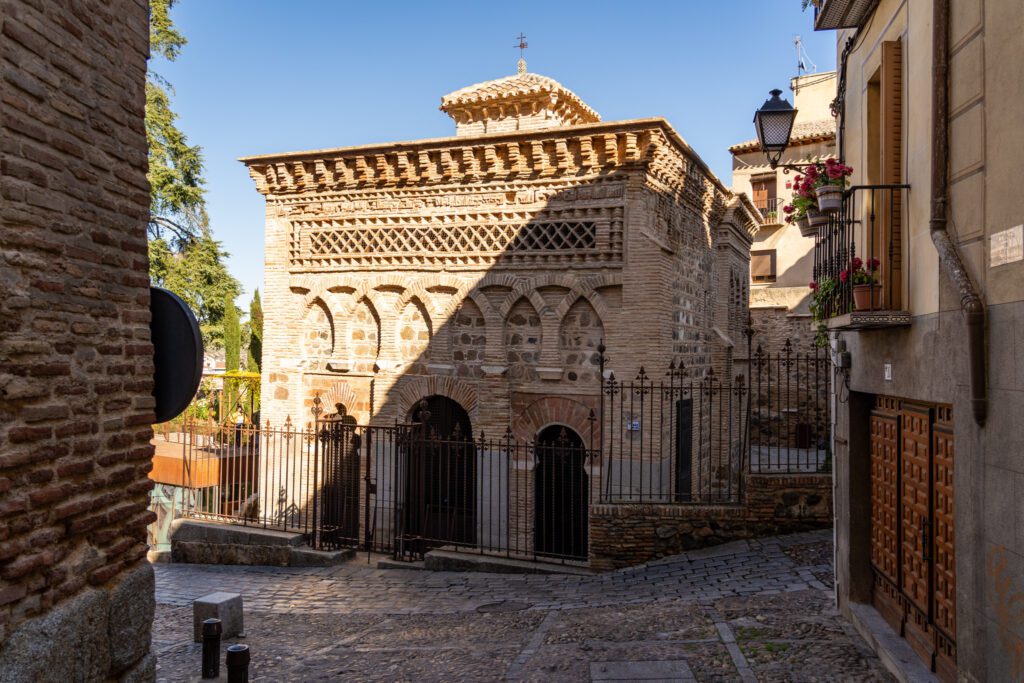
There’s a small (former) mosque in the center of Toledo near Puerta del Sol that was built in 999 C.E., which will serve as the last stop on your big clockwise loop around Toledo before you head back to the train station.
Throughout our time in Spain, particularly in Andalucía, we were struck by the contrast between the grandeur of cathedrals and churches, which were very much meant to project power first and foremost in the context of the Reconquista, and mosques, which tend to be more humble places of worship.
This former mosque, called the Mosque of Cristo de la Luz, is absolutely tiny compared to any church in the city, and it was converted into a church when the Christians reconquered the city (SURPRISE).
The claim on the official website that the conversion of the mosque into a church represents the mixing of cultures, when in reality it’s closer to an attempt to completely erase one culture, but still be frugal and recycle.
It’s nothing spectacular, especially if you’ve been to the Mezquita in Córdoba (or any number of mosques in northern Africa or the Middle East), but it is more than 1,000 years old, and the gardens are lovely.
Other Things to Do in Toledo
If you find yourself with extra time in Toledo, here are a couple of other things to add to your visit.
Note that the first two are included in the Toledo wristband if that’s the direction you go, so they’re essentially free to visit.
The Iglesia de Santo Tomé
Hey look, another church constructed on the site of a mosque back in the 12th Century!
Look at the bell tower, which to this day looks very similar to the minaret of a mosque (down to the Mudéjar design elements adorning the tower, which were added during the rebuild becuase it was the hot design trend at the time).
It was essentially used as-is following the reconquest of the city, and then it was completely rebuilt a few centuries later in the current footprint.
The reason it’s famous is the fact that El Greco, one of the most celebrated painters in Spain’s history (though he was Greek – specifically from the island of Crete – as you might have guessed from the name), painted The Burial of the Count of Orgaz here.
If you’ve been to the Prado in Madrid, you know that El Greco LOVES to divide his paintings in half, with heaven on top and earth on the bottom, and that’s exactly what’s happening here.
It depicts an event that may or may not have happened (I’ll let you decide) where two saints came down from heaven and buried the mayor of Toledo.
The Iglesia del Salvador
Another church built on top of a mosque, but this time the elements of the mosque AND the Visigothic church it was built upon are still visible.
This is a humble little church, so you’re not getting the grandeur of some of the bigger ones on this itinerary, but I do think it gives you a unique perspective into the city’s history.
A pretty cool illustration of the layers of history on the Iberian Peninsula, and if you have the wristband, it’s included and only costs you a slight detour up the hill from the two synagogues.
Would we pay €4 per person to see this separately? Probably not, which is why it’s here in the “with more time” section.
Mirador del Valle
We’re big fans of a viewpoint that requires a bit of a hike to reach because it usually means you leave the crowds behind.
The viewpoint that has been recommended to us (and we’ve seen recommended all over the internet) is Mirador del Valle, which is on the southern bank of the Tagus River up on the other side of the valley.
Unfortunately, this is a hard place to reach without a car, and it either involves an extra taxi ride (or two, if you take one there and back) or a long, exposed walk. So we haven’t done it ourselves yet.
You can find it here on Google Maps.
If you want to visit, you can either take a taxi, hop on the tourist train (expensive and requires a 45 minute ride, but does stop at the viewpoint), or walk (if you walk, we’d add it to the beginning of the day from Puente de Alcántara, which is 1.7km each way and allows you to do it early in the day before the sun hits hard).
Planning a trip to Spain? We’d love to help!
Here are our other Spain travel guides to help you plan an incredible trip (even if you have to eat gluten free!).
If there’s no link below, it means we’re still working on it – long, in-depth guides take time! We’re working on it, though, we promise.
The first place to start, if you haven’t already found them, is with our detailed itineraries. We have one shorter version for 7 days in Spain, one version that covers 10 days in Spain (a good middle ground, we think), and one longer version for two weeks in Spain (with ideas for more and less time in both guides).
Our Barcelona Guides
- What to do in Barcelona (as a First Timer)
- How to Plan an Amazing 4 Day Barcelona Itinerary
- Where to Stay in Barcelona: A Complete Guide for First Timers
- 12 Things to Know Before You Visit Barcelona
- Gluten Free Barcelona: A Complete Guide to GF Restaurants + Bakeries
- Where to Find the Best Specialty Coffee in Barcelona
- How to Plan an Incredible Day Trip to Montserrat (from Barcelona)
Our Madrid Guides
- What to do in Madrid (as a First Timer)
- How to Plan an Amazing Madrid Itinerary (2 Days)
- Where to Stay in Madrid: A Complete Guide for First Timers
- 12 Things to Know Before You Visit Madrid
- Gluten Free Madrid: A Complete Guide to GF Restaurants + Bakeries
- How to Plan an Amazing Day Trip to Toledo (from Madrid)
Our Sevilla Guides
- Our Favorite Things to Do in Seville (for First Timers)
- A Perfect 2 Day Seville Itinerary (for First Timers)
- Exactly Where to Stay in Seville (The Best Areas + Hotels)
- Gluten Free Seville: Our Favorite GF Restaurants & Bakeries
The Rest of Spain
