
Where to Stay in Madrid: Complete Guide for First Timers
We have now been to Madrid three times over the past five years to dive deeper into Madrid’s culture, history, and (gluten free) food scene, which has cemented its place as one of our favorite cities in Europe.
There’s something special about Madrid that other big European cities lack.
I think it has to do with the fact that many tourists overlook Madrid in favor of other parts of Spain, skipping it between Sevilla and Barcelona or spending just a day in Madrid to break up the train journey.
That fact means that you’re seeing and interacting with a higher proportion of local Madrileños as you explore the city than you do in Barcelona, resulting in a very distinct culture and cohesive approach to life that you can really feel as you’re exploring the city.
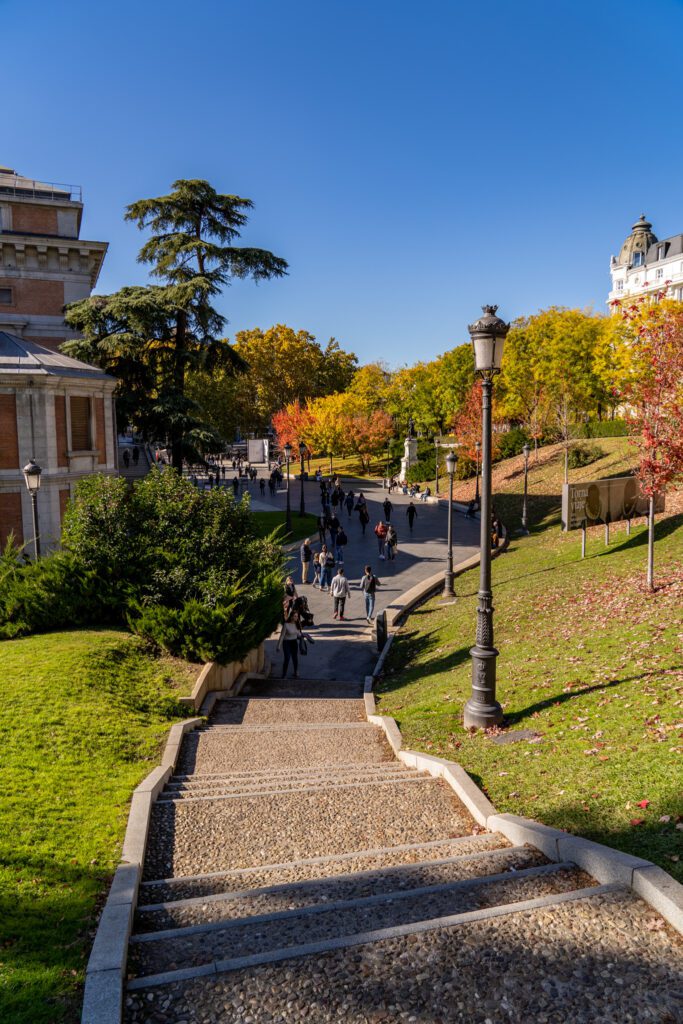
The Prado Museum is excellent, and it’s worth doing this early access tour that I recently did to have the normally busy place to yourself.
Madrid has an underrated food scene (all of the tapas and Spanish wine, please!), a fascinating history (Madrid was a crumbling castle on a hill until relatively recently), and an easy going vibe (for lack of a better description).
In this guide, we’re going to use our experiences exploring the Spanish capital to do our best to walk you through all the information you need to figure out where to stay in Madrid for your particular style, budget, and preferences.
Rather than just give you a list of hotels, we like to focus on the different neighborhoods and what makes each of them special (and what they offer to visitors) so that you can find the right one for your style.
Each neighborhood offers a different blend of vibes, prices, and pros and cons, and we’ll cover it all below so that you’re armed with all the information you need to figure out where to stay.
Our intention is that, by the end of this guide, you have everything you need to choose the right place to stay for you and your travel companions.
Sound good to you? Let’s get into it.
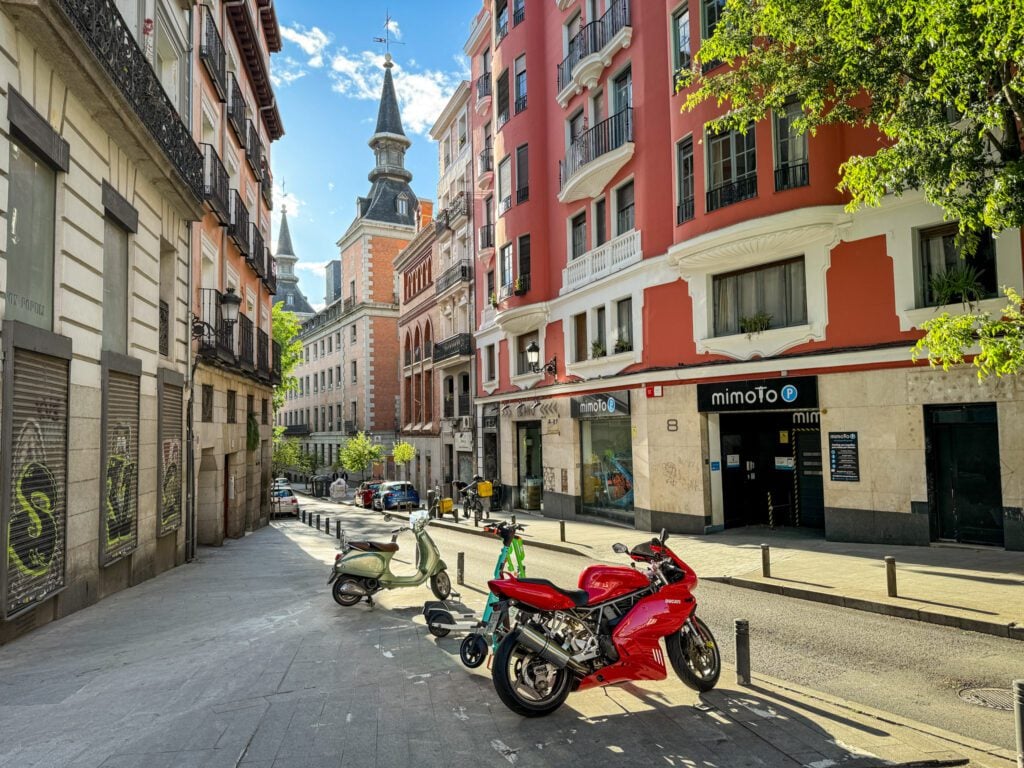
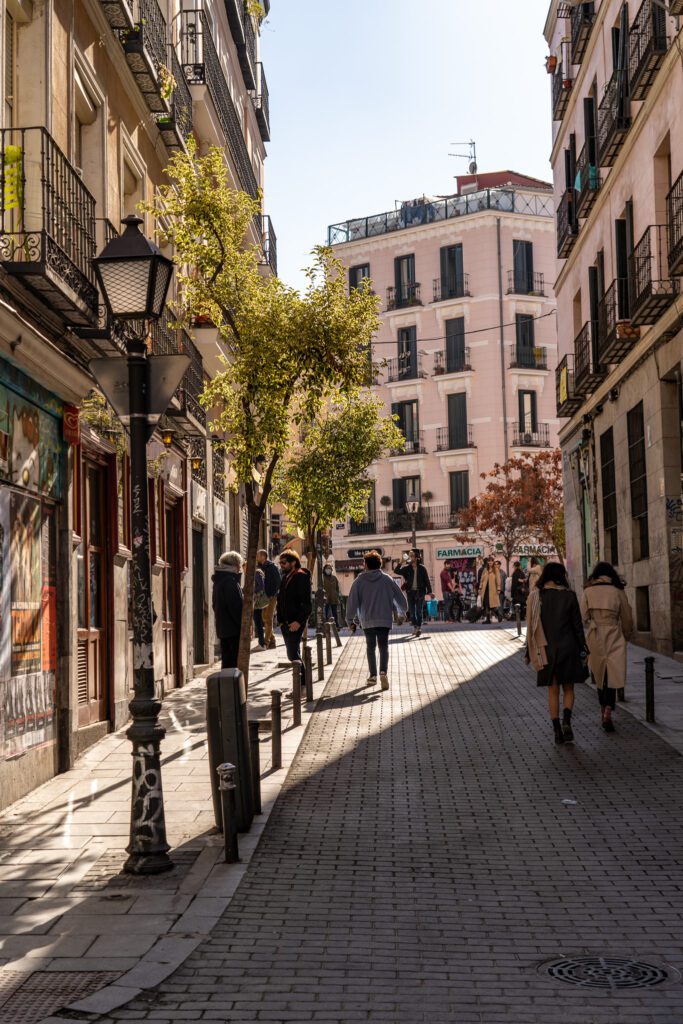
Disclaimer: Some of the links in this post, like hotel links, are affiliate links, meaning at no additional cost to you, we make a little bit of money if you click through and book. That being said, we would never recommend something to you that we don’t stand behind 100%.
Our Favorite Places to Stay: A Quick Summary
Before we get into the detailed neighborhood sections, we’re well aware that there is a contingent of you who are currently ready to throw your left shoe at the screen, saying “I don’t have time to read all of that, JUST TELL ME THE BEST PLACE TO STAY!”
Here’s a quick summary of this guide if you’re short on time (though we’d recommend reading the section of the place you end up staying for tips and places to add to your list!).
Generally speaking, we think you’re choosing between the first three neighborhoods in this section, and they’re all pretty close in terms of how much we like them and think they make for a good home base.
Our top recommendation is to stay in Malasaña, which is our favorite part of the city. It’s more cosmopolitan than other parts of Madrid, and you’ll see a mix of all kinds of different bars and restaurants as you walk around.
It’s a central location – I walked everywhere when I stayed here – and it has tons of great places to eat, drink, and shop.
Plus, it’s full of narrow streets and bustling plazas, which are peak Madrid to us.
It’s the hippest part of the city, and it’s a mix of tourists and Madrileños that you’ll find out and about until the early hours of the morning.
The big downside here is the fact that it can be extremely loud, depending on where you stay.
If you want a hotel, look at the lovely 7 Islas Hotel, which is in a walkable and well connected location on the border between Malasaña and Sol, and is decorated beautifully.
If you want an apartment, look at Casa Malasaña, a nice apartment building with a handful of units (all units are two bedrooms, so perfect for a group of four) on the western edge of the neighborhood, which is a little quieter and also closer to transit connections.
We’ve stayed in Malasaña at an aparthotel that has since closed (RIP Sonder) and been rebranded (and renovated) to be Líbere Malasaña, which has modern apartments (studio and one bedrooms, mostly) in a great, surprisingly quiet location two blocks from both the metro and Plaza del Dos de Mayo.
If you’re looking for the most charming part of Madrid with top tier food and drinks, we love Barrio La Latina (home of the famous tapas street, Calle Cava Baja).
Honestly, this is a pretty close second with Malasaña.
Located just south of Plaza Mayor, it’s more residential than other parts of the center, which means there are fewer places to stay.
It’s also a bit more historic and traditional than, say, Malasaña, and most of the restaurants and bars here are doing tapas.
There are a trio of great hotel options to choose from here.
Our pick is One Shot La Latina, which is a bit removed from the action (read: quieter) and is a beautiful, brand new hotel.
The other two are next door to each other right in the middle of the action on Calle Cava Baja; Posada del Dragón is the more affordable one, Posada del León de Oro is the fancier one.
If you’re looking for a slightly more affordable and equally walkable area, look at Barrio de las Letras.
It’s on the southeastern side of the city, close to both Parque El Retiro and the train station (Atocha), and it’s historically the part of the city where literary figures like Hemingway and Cervantes spent part of their lives.
It toes the line between being central but still retaining a lot of the character that makes Madrid special, with plenty of places to eat, drink, and be merry within its borders.
Armesto Rooms, a newly renovated guesthouse in a great location, might be the best value in the neighborhood (though the room layouts only really work for couples).
If you want a hotel, stay at Room Mate Alba, a nice boutique hotel right in the middle of all the action.
If you’d prefer an apartment, look at Limehome Madrid La Bolsa (we’ve stayed at Limehome properties before, and this location gets really good reviews) or U-Sense Madrid Santa Ana.
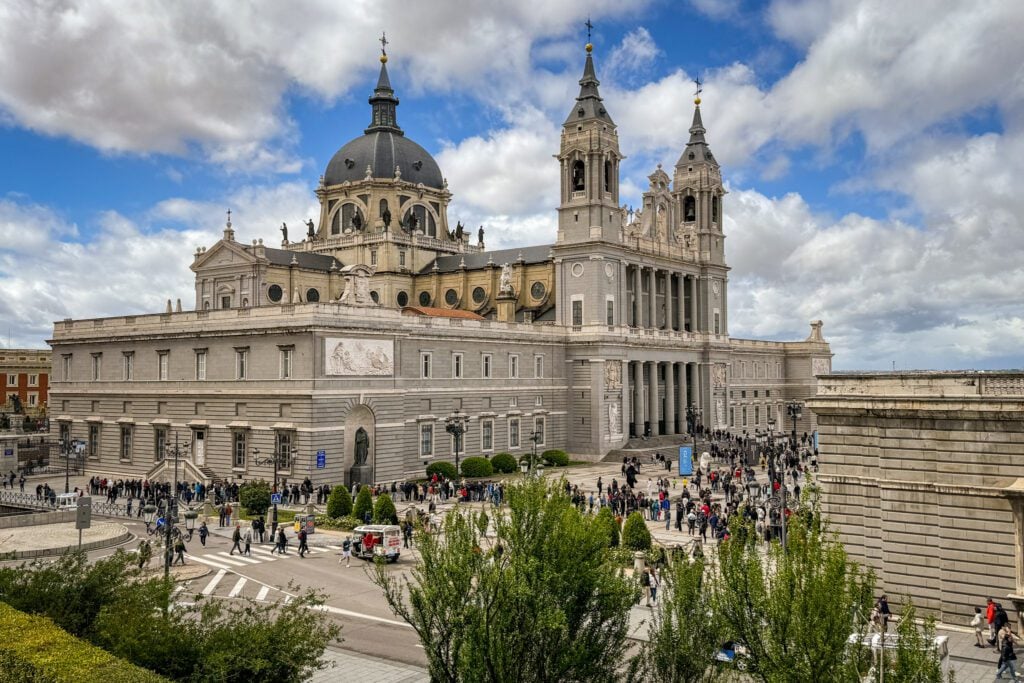
If it’s your first time in Madrid, you can’t go wrong with Barrio de los Austrias, the historic center of the city that sits between Plaza Mayor and the cathedral and Royal Palace complex that mark the city’s original footprint.
It’s historic, charming, and full of cool architecture that looks like it belongs in Germany or Austria (spoiler: the Austrian Hapsburgs ruled Spain when Madrid became the capital, which is why you see that).
Because of the historic nature of this part of the city, there actually aren’t that many options when it comes to places to stay (it’s hard to renovate smaller, older buildings).
On our last trip, we stayed at Palacio Conde Miranda, a set of serviced apartments in a renovated 16th Century Palace, and it was fantastic.
Great location, nice apartments (with full kitchens), and helpful staff.
Each of the rooms are restored with a theme of famous lovers, from Frida Kahlo and Diego Rivera to Han and Leia.
For a more affordable aparthotel (perfect for groups), there’s Numa Sol, which is just on the other side of Plaza Mayor and has a range of apartments from compact studios to spacious two bedroom units.
If you’re on a budget but want to stay centrally, ByPillow Citadel (a modern hotel) and TOC Madrid (a boutique hostel – we’ve stayed at their hostel in Barcelona) are two nice values considering their central location.
If you’re on a budget, there are a few good options in Madrid split between budget guesthouses and boutique hostels.
First, there are a couple of guesthouses down near the train station; Hostal Abadia Madrid and Hostal Anton Martin.
Nothing fancy at either one, but they’re a great value and they’re close to metro stops and walkable to the southern end of the city center.
Second, Madrid has a bunch of nice boutique hostels (a cross between the social aspects of a hostel and private rooms of a hotel).
TOC Hostel is right in the center of Madrid and we’ve stayed at their location in Barcelona, and it was nice.
Bastardo Hostel is also right in the middle of all the action, and would be another good option.
If you’re traveling with a group (and don’t want to book two hotel rooms or cram four people into one room), there are some great aparthotels and serviced apartments in Madrid.
I recently helped my mom and her friends plan a trip for four to Spain (including Madrid), and finding places where four adults have enough space is tough.
We wouldn’t recommend booking an Airbnb, which can be a little more risky (we’ve personally met multiple groups whose accommodations were canceled while they were in the air over the Atlantic), and we almost always stay in aparthotels and serviced apartments when we travel.
We completely understand the desire for more space to accommodate a group, and we want to introduce you to the concept of aparthotels, which are a type of accommodation we don’t see in the U.S. that often, but we find all over Europe.
Basically, it’s a hotel where the rooms are apartments, so you get all the convenience and amenities of a hotel, but the rooms usually have a kitchen and options for various numbers of bedrooms.
They give you the perks, like luggage storage and flexible check-in, along with the comfort of having more space and feeling like you’re more immersed in the daily life of the place you’re visiting.
We already mentioned Palacio Conde Miranda, where we stayed on a recent trip to Madrid. They have a few two bedroom apartments which would be perfect for a group of four.
Eric Vökel Boutique Apartments are another good option (they skew a little more upscale). Their Malasaña location is where my mom and friends ended up booking, for what it’s worth.
They have two locations; there is the one in Malasaña and one down near the city’s main train station, Atocha (also a good location, particularly convenient for a day trip to Toledo).
The other option we’d look at is Casa Malasaña, which we already mentioned above and has nice one and two bedroom units in a great location on the western end of our favorite neighborhood in Madrid.
With that (not-so-short) summary out of the way, let’s get into the detailed breakdowns of Madrid’s neighborhoods.
Our Recommended Neighborhoods in Madrid, Mapped
Our philosophy when it comes to deciding on a place to stay is to first choose the neighborhood, then move on to finding a great hotel, hostel, or apartment in that area.
The reality is that, depending on what you’re looking for, there are other neighborhoods not included in this guide that might meet your needs.
But these are the areas that we think are the best for 99% of travelers, and we’ve shown our work, doing our best to explain why we think that.
We put together an interactive map to help you visualize the areas we’re talking about and how they fit into the city’s geography. We also included a few key landmarks (e.g. the train station and the Museo del Prado).
To see a larger version, hit the button in the top right of the widget and it will take you to a separate page.
In the neighborhood descriptions below, we’ll talk about the layout and orientation of the neighborhoods, and hopefully this map will help you understand what we’re talking about.
See that big, black hole in the middle of the map? That’s the area near Plaza del Sol, which is the modern, commercial part of the city that we’d avoid (we stayed there on our first trip, it wasn’t our favorite).
Here’s a key for the neighborhoods on the map. You can also click on them to bring up the name.
- Blue: Barrio de los Austrias
- Purple: Barrio de las Letras
- Yellow: Barrio La Latina
- Grey: Lavapiés
- Red: Chueca
- Green: Malasaña
- Orange: Chamberí
- Pink: Salamanca
Malasaña: Our Top Recommendation in Madrid
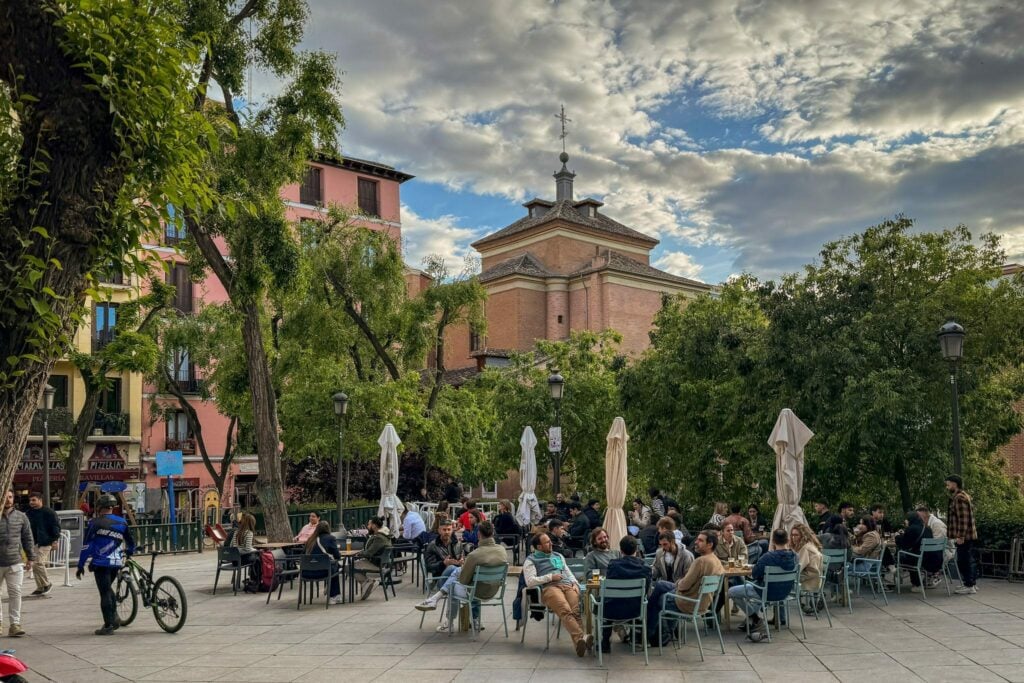
Malasaña is pretty clearly our favorite part of Madrid’s city center.
It is just north of Gran Vía and stretches up north, getting more residential the further north you go, and it’s full of our favorite places to eat and drink in the Spanish capital.
I stayed here on a trip a few years ago and absolutely loved it. After staying elsewhere on our last trip, I declared that I will never stay anywhere else whenever I’m in Madrid.
Just off of Gran Vía, it’s lively at all hours, from bakeries and coffee shops in the morning to plazas full of terraces for bars and restaurants, to people spilling out of bars onto the streets late at night.
We tend to find ourselves in this charming neighborhood many, many times – sometimes multiple times in a day – over the course of our trips to Madrid.
The number of coffee shops, bars, restaurants, and shops is unrivaled in any other neighborhood in Madrid, at least in our experience.
Being just off of Gran Vía, it’s also in a central location that will put you within walking distance of most places in Madrid.
When I stayed here, I walked almost everywhere, and didn’t need to use the metro as much as I thought I would (though it should be noted that the metro system is great!).
Normally when we talk about hipster, charming neighborhoods in a city – Trastevere or Testaccio in Rome, Capitol Hill or Ballard in Seattle, or Gràcia in Barcelona – the area is not as central as we’d like, but it’s worth the tradeoff to stay in a cooler neighborhood than some of the more central ones.
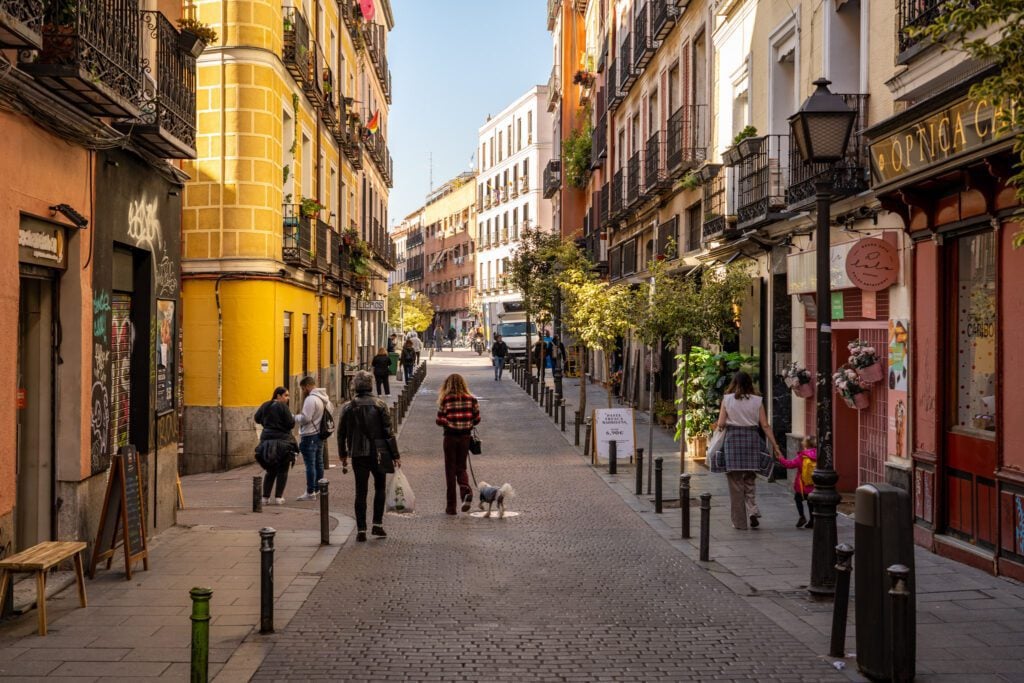
In Malasaña, you truly get the best of both worlds.
You’re central and within walking distance of just about everything you’ll want to see over the course of your Madrid itinerary, and you’re also smack dab in the middle of the coolest neighborhood in central Madrid.
The only tradeoff is that it’s generally a little louder and more boisterous than other areas, with people packing the plazas, bars, and restaurants at all hours. But that’s also true of most of Madrid’s central neighborhoods.
However, you can certainly find quieter corners where you’ll be able to get a full night’s sleep, if that’s what you want (especially along the edges of the neighborhood).
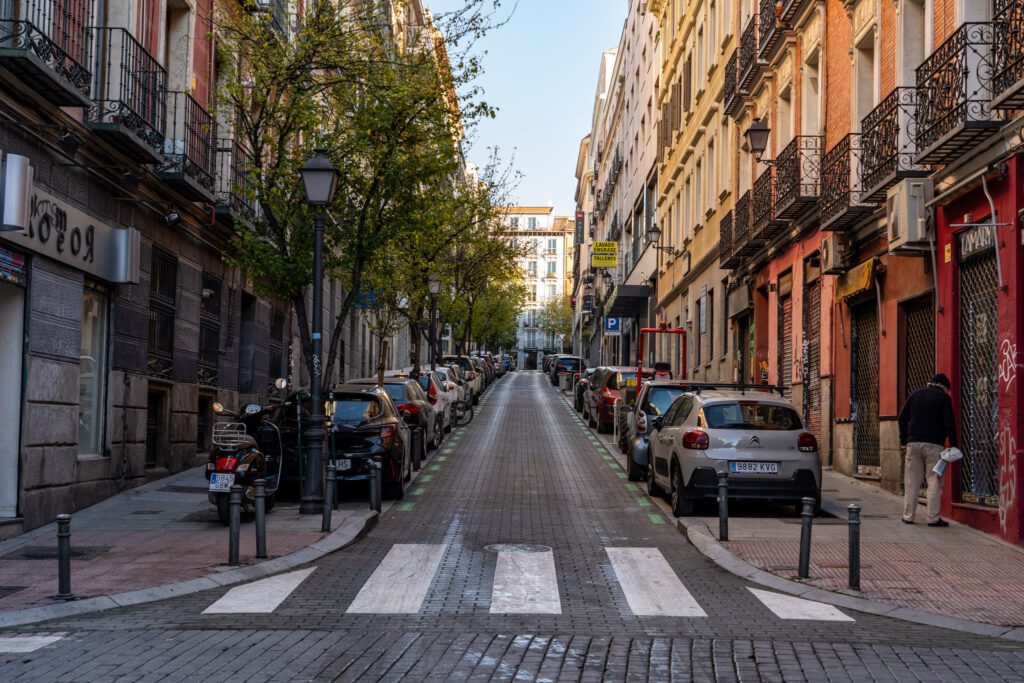
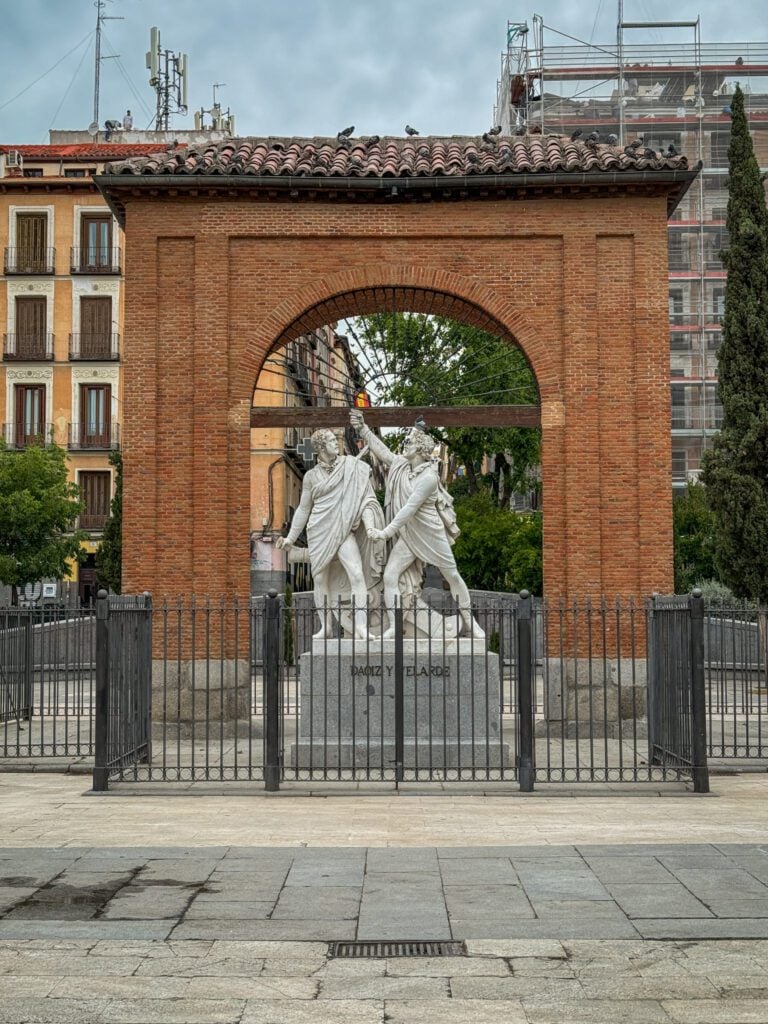
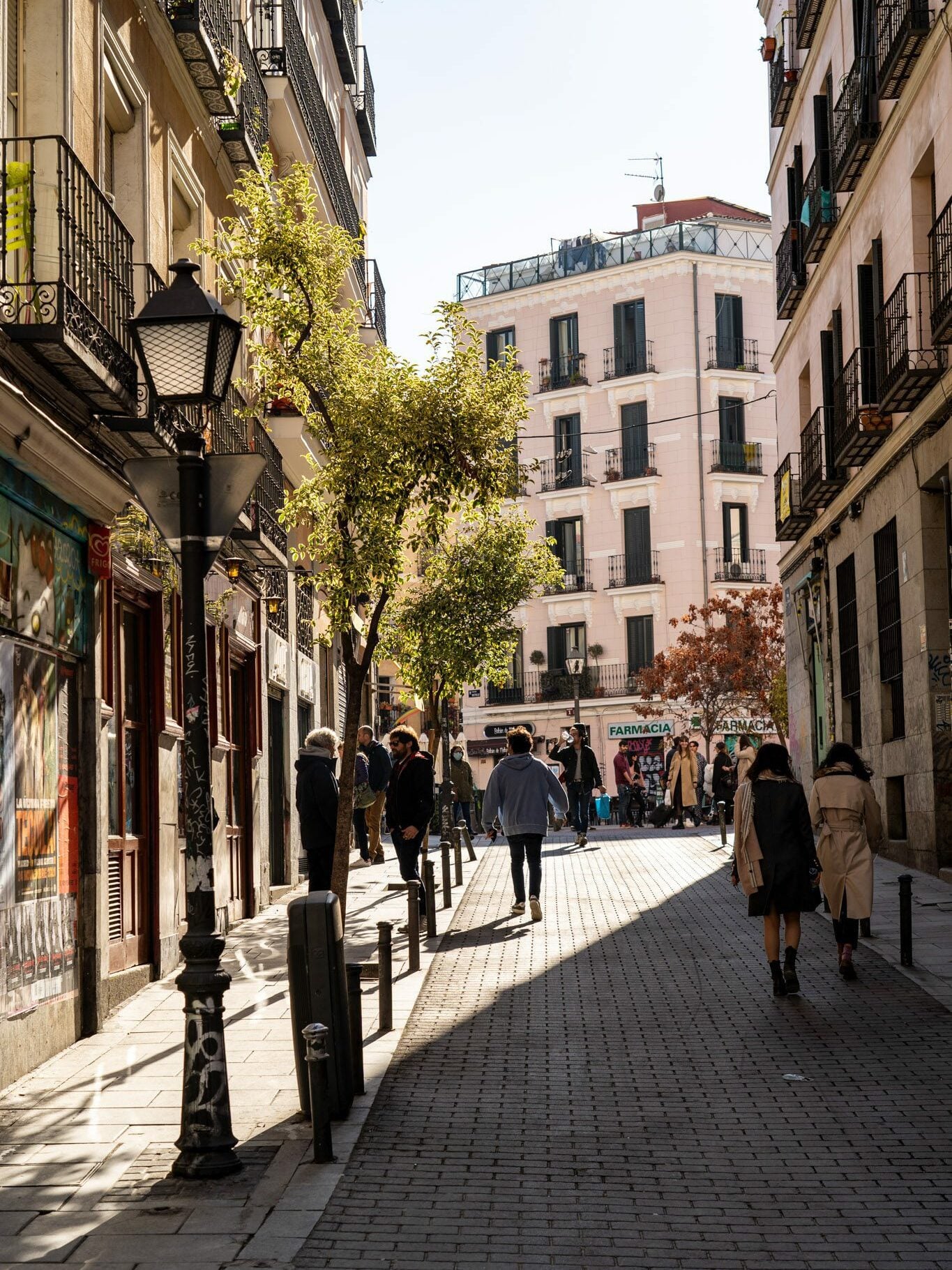
Pros and Cons of Staying in Malasaña
Here are the pros and cons of staying in Malasaña as we see them.
Pros of Staying in Malasaña
- It’s simultaneously hip and charming. Malasaña is a little bit hipster, and a lot bit charming. Every few blocks, you’ll come across an open plaza with people relaxing in the sun, sipping coffee or a beer, watching the world go by. Open public spaces within cities where people hang out is something that Spain (and Italy, and Colombia, and Mexico…) do really well, and we’re here for more of it at home in the US.
- The unparalleled variety of places to eat and drink. In between those charming plazas is an array of shops, bars, and restaurants offering nearly every kind of cuisine or drink under the sun. Authentic Venezuelan, Japanese, Italian – just about every region of the world is represented here.
- It’s very central. It’s just north of Gran Vía, the main artery running east-west in Madrid. It’s within walking distance of the Prado, the Royal Palace, and La Latina, which means you’ll be able to walk basically everywhere you want to go.
Cons of Staying in Malasaña
- It’s loud at night. Parts of the neighborhood are home to some of the best nightlife in Madrid, and as you might imagine, it’s not exactly the quietest place on earth. Walking through the streets after the sun went down, we regularly found most streets in the area packed wall-to-wall with people. If you’re looking for a quieter part, stay further north or further west.
Our Recommended Places to Stay in Malasaña
Here are some places to stay in Malasaña that caught our eye as we were perusing the options.
7 Islas Hotel (Stylish Boutique Hotel – $$) If we didn’t like to have access to a kitchen due to Matt’s Celiac Disease, we might have chosen to stay in this stylish boutique hotel just a few blocks north of Gran Vía in the southern end of Malasaña on our last trip.
There’s an art gallery on the ground floor, which is probably a little too on-the-nose, but we’re okay with it because of the elegant, minimalist decor in the surprisingly spacious rooms.
A family-owned property, the hotel was completely remodeled relatively recently by the original owner’s granddaughters and it was transformed into the place it is today.
Despite the corporatization of most hotels in major cities around the world over the past decade or two, this hotel is still run by those same three granddaughters, which we think is something worth mentioning and celebrating.
Rooms are simple, stylish, and comfortable, with an industrial-chic sort of theme with touches like those fancy light bulbs that stand alone without a shade.
IBIS Madrid Centro (Great Value – $$): This budget-friendly hotel is up on the northern edge of the neighborhood, which does mean that it’s a bit further from most of the places you’re going to be visiting on your trip.
It is just a couple of blocks away from Plaza del Dos de Mayo, though.
However, the price reflects that less central location, which is why it’s here on this list. There are a couple of metro stations within walking distance, depending on which line you need to catch.
IBIS Hotels are nothing particularly special, but they are consistent, which is a nice characteristic to have in a hotel. Rooms are basic but comfortable, with options for double beds and twin beds, depending on who you’re traveling with.
Bastardo Hostel (Affordable Hostel – $): If you’re looking for a nice hostel that is more affordable than a hotel, but quieter with more privacy than staying in a dorm, then choosing a private room in this upscale hostel in the center of the neighborhood will be a perfect choice.
When we’ve traveled over the past few years, we’ve fallen in love with the idea of a “boutique hostel.” The reason? We feel like they give you all the benefits of a boutique hotel plus the social aspects that draw people to hostels.
If you’re really on a budget, they also have dorms, but we’re a little too old for that (and more importantly, we value our sleep too much).
There are a variety of common areas to enjoy, including a sunny terrace and light-filled common room on the ground floor.
The private rooms are essentially hotel rooms, some have terraces, some have different bed configurations that will work better for families or couples, and all are at an affordable rate.
Casa Malasaña (Spacious 2BR Apartments – $$$): If you’re traveling with a group and want a comfortable, spacious apartment where you can spread out a little and you want to be in a lively neighborhood within walking distance to all sorts of great places to eat and drink, these stylish apartments would be a good option.
The location on the western edge of the neighborhood is nice because, while you’re a short walk from the heart of Malasaña (it’s near Plaza del Dos de Mayo), you’re also within five minutes of a metro stop (two, really, Noviciado and Plaza de España) and in a quieter part of the neighborhood that won’t keep you up late into the night (we love our beauty sleep around here).
In terms of the apartments here, they’re all two bedroom units, which makes them perfect for groups and families traveling together who don’t want to cram into a single hotel room (or pay for separate hotel rooms).
There are some units with a sofa bed, which means you could pretty easily house 5-6 people in one unit.
All of the apartments have full (beautiful) kitchens, nice hardwood floors, and nice design touches.
These are not going to be the cheapest option in town, but when you consider the amount of space you’re getting and the location, it’s fairly competitive (especially when you consider the cost of two separate hotel rooms).
Barrio La Latina: A Charming, More Residential Neighborhood
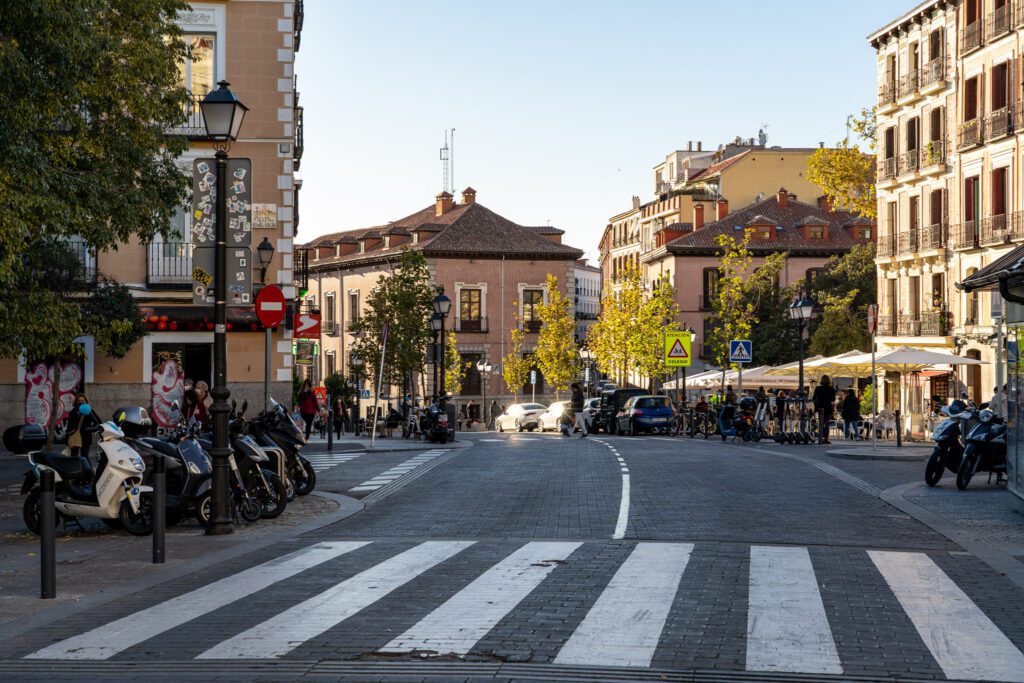
If we had to pick a second-favorite neighborhood after Malasaña, it would be La Latina. The second we crossed over its boundaries from the historic center our eyes lit up.
Generally, there’s a strong correlation between a neighborhood that has plazas with young kids running around and the amount we like the area.
La Latina is a neighborhood that is named after Beatriz Galindo, a beloved teacher of Queen Isabella of Castile (and various other famous royals).
She was named “La Latina” because her grasp of Latin was prolific, and the neighborhood here bears her name because of her contributions to the neighborhood and city, where she founded a hospital and was one of the most prominent women in public life at the time.
There are a couple of things we really enjoyed about La Latina.
First, if you want tapas, go to Calle Cava Baja, which is famously lined with tapas bars on either side of the street for several blocks.
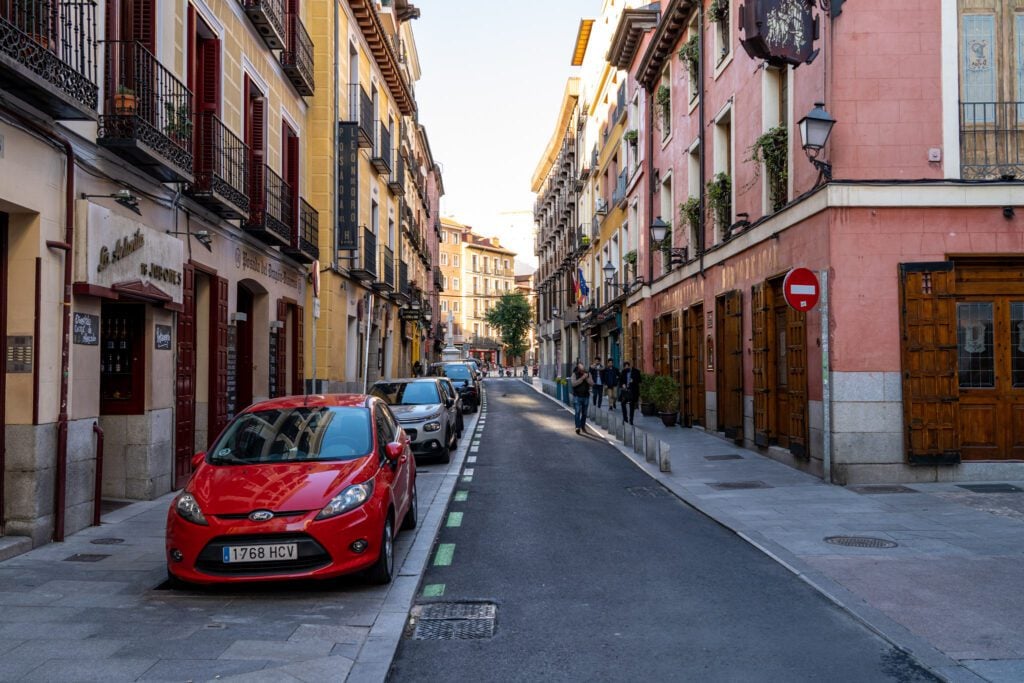
Second, the bustling plazas.
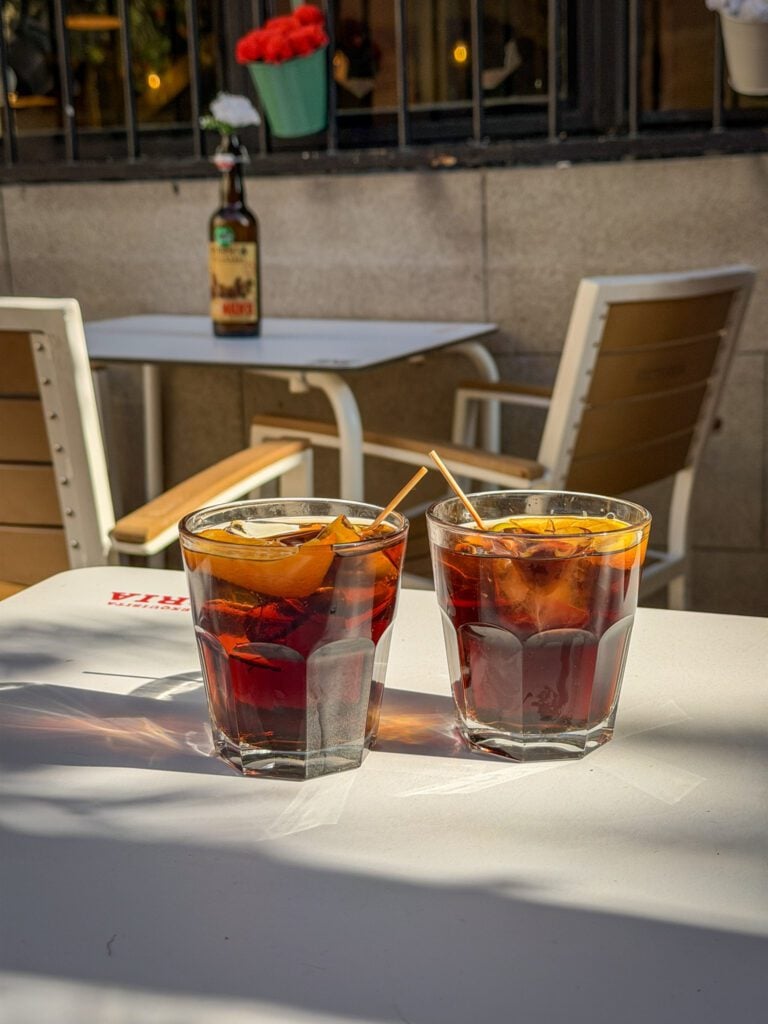
We were here multiple times at various points in the day and at all of those times, the open plazas were full of people either grabbing their morning coffee with friends, taking a break before going about their day, or eating tapas and drinking wine, beer, and vermouth in the warm sun.
Of course, it should definitely be noted here that this neighborhood, like most places in Madrid and around the world, has seen rising rents displace local families in service of short-term rentals meant for tourists. Don’t stay in a vacation rental here, if you can avoid it.
The big challenge with La Latina is the fact that it’s residential, and there are very few places to stay.
Pros and Cons of Staying in La Latina
Here is our take on the pros and cons of using La Latina as a home base for exploring Madrid.
Pros of Staying in La Latina
- Charm Charm Charm. This area is endlessly charming, with tons of energy and people milling about at all hours. Tapas bars spilling into the streets. Open plazas with people sitting around catching up or taking a break after dropping their kids at school. The neighborhood takes up a portion of the oldest part of Madrid, and is full of narrow winding streets that feel like a maze.
- It’s a central location. The other nice thing about La Latina is that it’s walkable to most of the city. You’ll be able to walk to El Prado and the Royal Palace, and if you don’t feel like walking, there’s a very convenient metro station right in the heart of the neighborhood.
Cons of Staying in La Latina
- There aren’t many places to stay. This area is a bit more residential than some of the others in this guide, so there aren’t as many places to stay. Since we do not recommend staying in an Airbnb in Madrid, which has helped contribute to a housing crisis where locals who have lived here for decades can no longer afford it, the choices are relatively slim. However, there are still some cool places to stay here, so don’t discard it altogether!
- It can get loud and boisterous. This area is very popular, and as a result it can be loud and filled with a frenetic energy. Particularly on weekends and at night.
Our Recommended Places to Stay in La Latina
Here are a few places that caught our eyes as we were browsing the options of places to stay in the neighborhood.
One Shot La Latina (Mid-Range Hotel – $$): This is a nice, affordable option on the southwest edge of the neighborhood, which puts you a bit outside the nightlife zone, but still plenty close to walking everywhere.
Really nice, well-designed, modern rooms, and some of them have their own private terrace overlooking the city.
The hotel is very modern (and very new, at the time of writing it has been open for less than a year in its current iteration) and stylish, and they have an onsite gym and sauna that you’ll be able to use.
Posada del Dragón (Mid-Range Hotel – $$): There are two hotels almost right next to each other right on Calle de Cava Baja (the street full of tapas bars), and this is the more affordable of the two.
Great location (though it might be a little loud at night), and you’re a few blocks away from Plaza Mayor.
Rooms are standard and don’t have many of the fancier touches that you might find somewhere more luxurious, but given the price and location, we think this is a great value.
Posada del León de Oro (Boutique Hotel – $$$): The more upscale of the two hotels right on Calle de Cava Baja. This is a 17th Century building that was an inn for more than a century before it was renovated from the ground up and reopened as the hotel it is today.
It has the original structure of the inn, with an interior courtyard surrounded by rooms, though it has all been updated and redone to be very modern and stylish.
There’s a chunk of the 12th Century wall of Madrid visible under the floor of the restaurant, which is pretty cool.
Their rooms are bright, white, and modern, and they have a few family rooms with two beds in them.
L&H La Latina Selection (Mid-Range Hotel – $$): This mid-range hotel is towards the southern edge of the neighborhood, which means it’s going to be significantly more quiet and relaxed than the places up near Calle Cava Baja.
The rooms are nicely laid out, and more importantly, have a microwave, mini fridge, and stovetop in the room!
They have standard hotel rooms of various configurations and sizes, plus a couple of deluxe attic rooms with a private terrace, and suites with a little more space, including a living area.
The decor is stylish and simple, with big gray headboards and two pieces of artwork hanging above the bed, and big rainfall showers.
They also have parking, which is a plus if you’re going to be driving in Spain.
Barrio de las Letras: Central, Walkable, and Charming
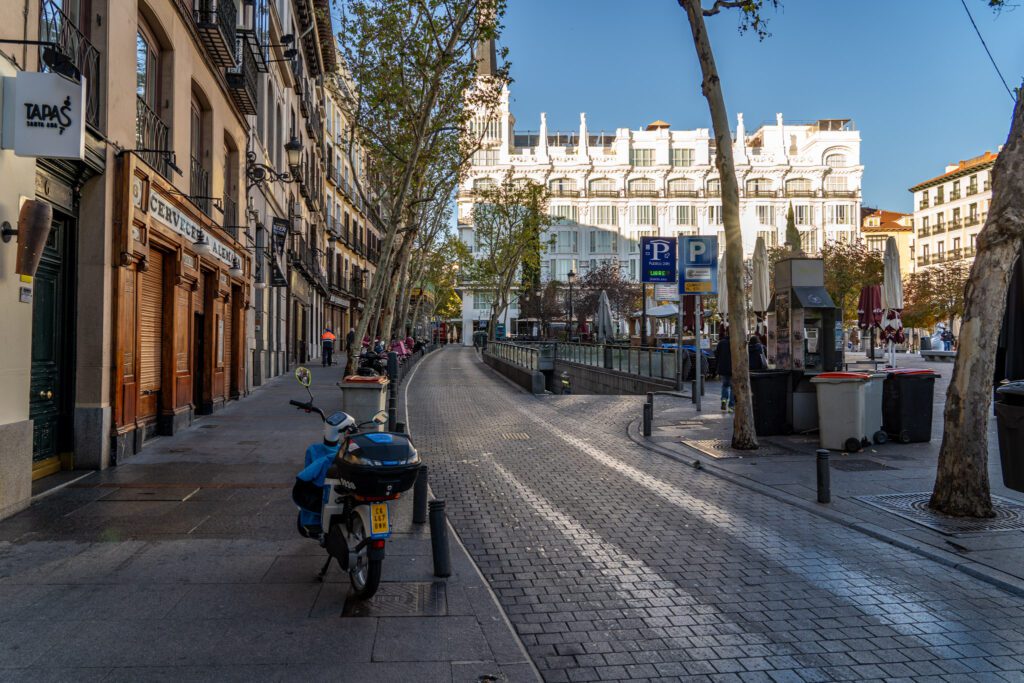
Barrio de las Letras is so-named because of its history of famous writers taking up residence in the neighborhood.
It’s very central – tucked between Puerta del Sol and the Prado Museum – but it has a distinct feeling from the more commercial parts of town immediately adjacent to it.
Las Huertas is the main street, running west to east towards the Prado and Parque El Retiro, and the offshoots branching off of it are full of great restaurants and bars.
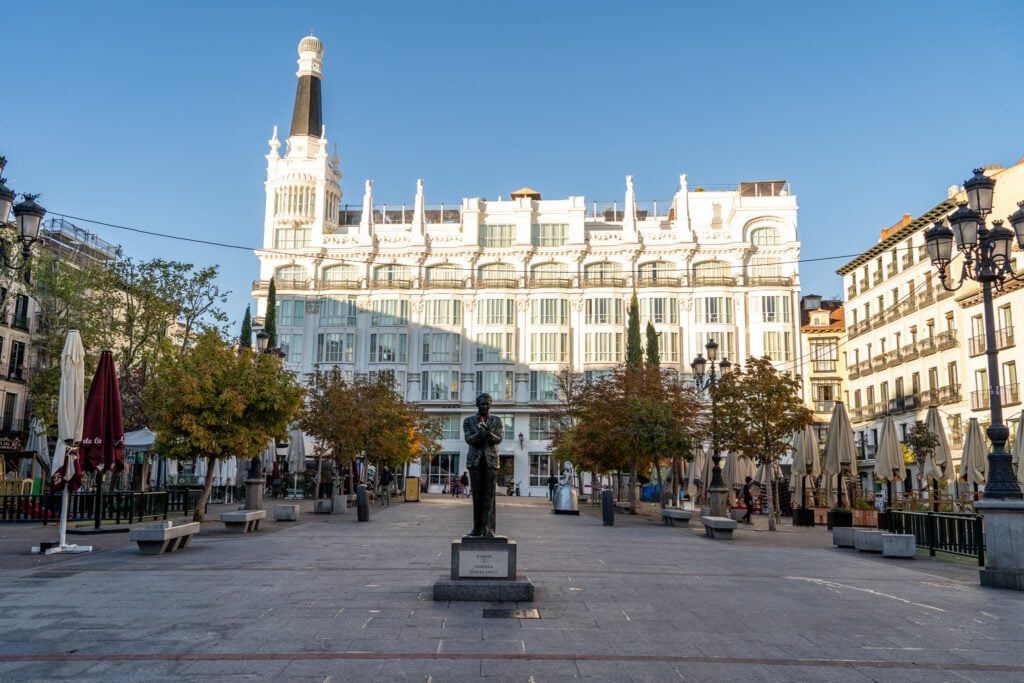
Plaza Santa Ana is the center of the neighborhood, serving as a welcome open space in a neighborhood of dense housing, bars, and restaurants.
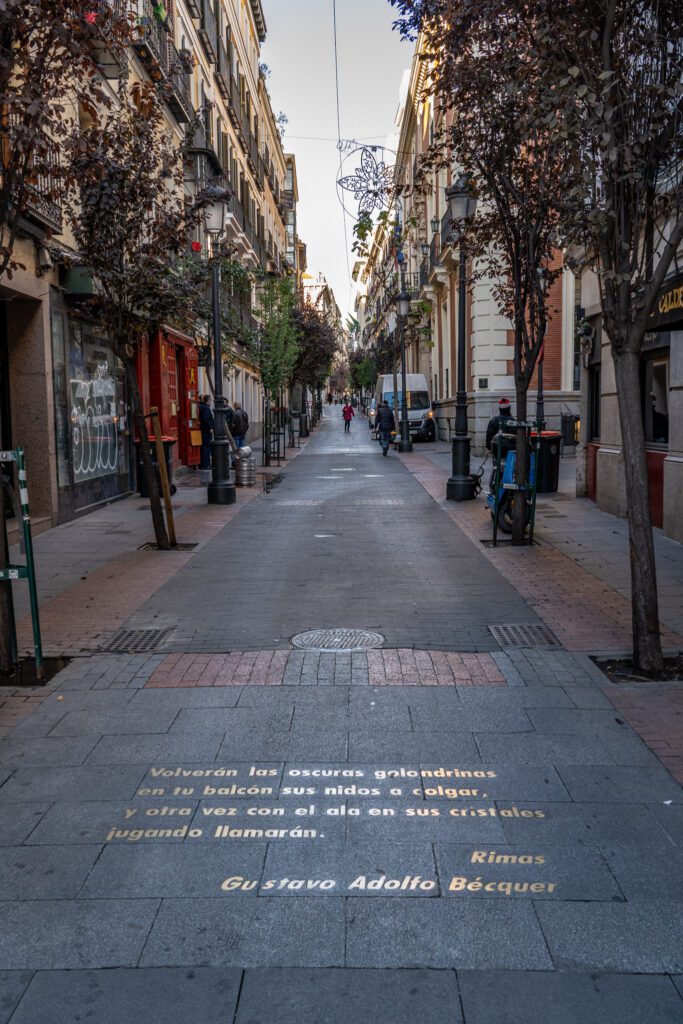
The streets of Barrio de las Letras are adorned with gold letters spelling out famous passages and quotes from the many writers who called this area home.
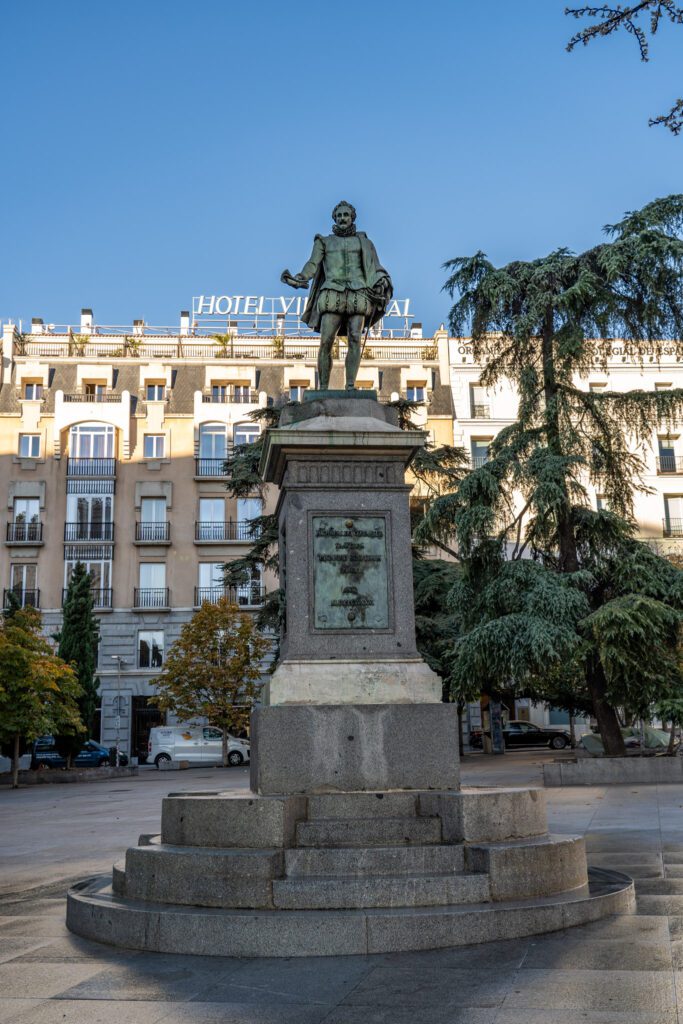
As you walk its streets, you’ll find statues of Cervantes and Federico García Lorca (a famous poet), among others.
This neighborhood is also full of (or adjacent to? We aren’t quite sure where exactly the border of the neighborhood falls) several of Madrid’s cultural marvels.
The Prado Museum and the Reina Sofía, two of the best museums in Madrid, are right along the edges of Barrio de las Letras, as is the CaixaForum Madrid, which we were immediately drawn to as we strolled by on a cold November morning thanks to its cool garden wall that climbs several stories with dense greenery, even in the late fall.
Pros and Cons of Staying in Las Letras
Here are the pros and cons of staying in Barrio de las Letras, at least as we see them.
Pros of Staying in Barrio de Las Letras
- It’s full of bars and restaurants. Along with the other neighborhoods on this list, this area is a great place to explore for foodies. We think the moral of the story is that Madrileños love food, which we’re on board with.
- It’s a hub of culture. From renowned art museums to music venues and statues of famous Spanish literary heroes, this neighborhood is the place to be for art lovers. You’ll be near the best art in Madrid, all the way from famous 15th Century paintings to modern day musical performances, and just about everything in between.
- It’s super central. Walkable to the art museums and El Retiro park, and a hop, skip, and a jump away from the Sol metro station (near Puerta del Sol), you’ll be well connected to the rest of the city.
To be completely honest, we don’t have a whole lot to say on the cons front.
If we were nitpicking, we’d say that there’s not many options in terms of places to stay and that they’re a bit more expensive than in other parts of the city, but that’s a little harsh, we think.
Our Recommended Places to Stay in Las Letras
Here are four places that caught our eyes as we were browsing the options of places to stay in the neighborhood.
Armesto Rooms (Great Value – $/$$): This beautiful guesthouse (it was recently renovated) is in the heart of all the action, just a block away from the famous statue of Cervantes that is emblematic of this neighborhood’s history (and a few blocks from Parque El Retiro and the Prado Museum).
The first thing you’ll notice here is that the rooms are absolutely gorgeous, with colorful tiles and nice design touches, like the analog clocks (we love a good analog clock).
Rooms are relatively compact, and you’re not getting a whole lot of extra luxury amenities (think bathrobes and fluffy slippers), but the tradeoff is that you’re also not paying for those touches in the price you’re paying for the room.
If you’re someone who generally spends most of your time out and about exploring the city and just need a comfortable (and relatively affordable) place to sleep, this would be a great option.
Note that the layout of the rooms with the open shower probably doesn’t work for anyone but couples.
Room Mate Alba (Nice Boutique Hotel – $$$): Room Mate is a fairly well known hotel brand that we’ve found all over Spain and the rest of Europe. Not as well known as, say, Hilton or Marriott, but they have a presence on multiple continents.
They have a mix of hotels and apartments around the world, and this particular property – Room Mate Alba – falls squarely into the hotel category. And it’s a nice one, at that.
Rooms are relatively spacious, starting with the standard rooms at more than 200 square feet and increasing in size from there. Rooms are beautifully decorated, particularly the bathrooms with their intricate tilework that caught our eye.
The hotel’s location couldn’t be better. It’s on Calle de las Huertas, about four blocks west of the Prado Museum, and within a couple of blocks of all the food and drinks in the neighborhood, and also the metro station at Antón Martín.
Catalonia Puerta del Sol (Solid Mid-Range Hotel – $$): This highly rated boutique hotel is on the side of the neighborhood closest to Plaza Mayor and the hustle and bustle around Plaza del Sol.
If you’re planning a trip to Spain, you’ve almost certainly come across a Catalonia hotel in your research because they have hotels all over the country.
Which makes sense because it’s a Spanish hotel chain that started in Barcelona (hence the name) and has expanded across Spain (and even into other markets in Europe) over the past 40 years of their existence.
Their whole thing is about comfortable hotels with great service at a good value (note that this does not mean the cheapest option, but that you’re getting a lot for what you’re paying).
Nothing terribly flashy here. The rooms are comfortable, above average in size, and they have options with street views and more space and seating.
Overall, a very solid choice as hotels go, but nothing about the experience is likely to blow you away.
Worth noting that there are two additional Catalonia hotels within a few blocks of each other in Barrio de las Letras – Catalonia Plaza Mayor and Catalonia Las Cortes – with similar style and amenities.
Limehome La Bolsa (Modern Apartments – $$): These modern serviced apartments are in a great central location, about three blocks east of Plaza Mayor on the western border of Barrio de las Letras. We’ve stayed at Limehome properties before in Spain, and generally like their approach.
They’re serviced apartments, which basically means you’re combining the convenience and amenities of a hotel (like luggage storage and staff available to help) with the space and kitchen amenities of an apartment.
This particular property has smaller apartments, studios and one bedrooms, which can flex to serve groups of 1-4, but might not work for larger groups or people who want separate bedrooms.
It’s a modern process – everything from providing ID and getting check-in instructions happens through their app (or online) – and they’re good for self-sufficient travelers, but might not be right for everyone (it’s similar to Sonder, if you’re familiar with them, RIP).
Barrio de los Austrias: Great for First Timers
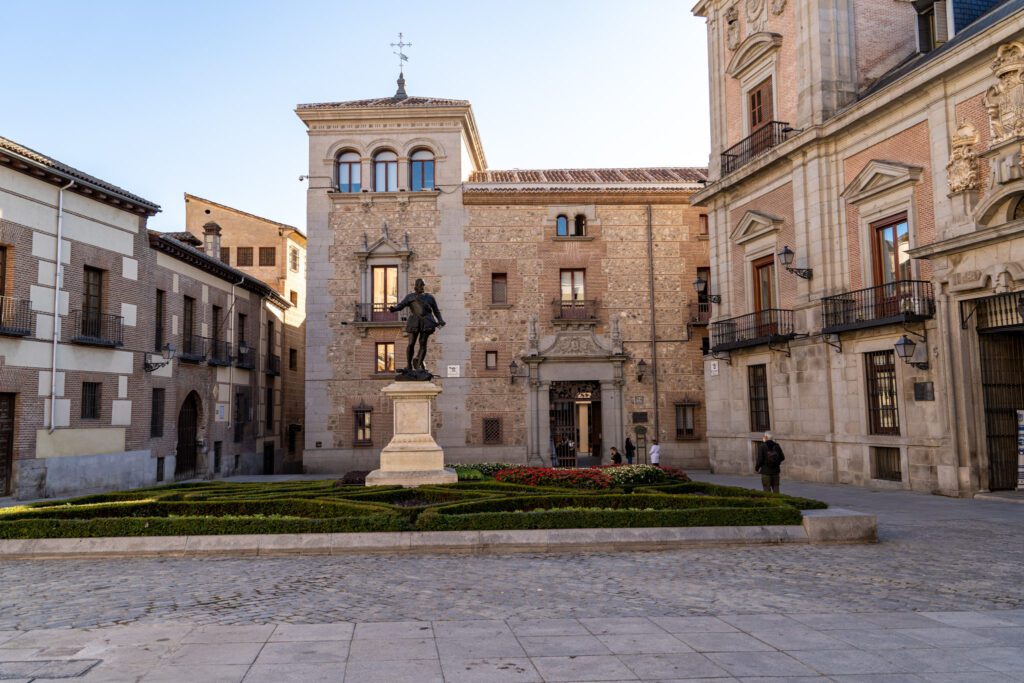
This neighborhood is the most interesting part of the historic center of Madrid (we think), which was largely built out in the 16th and 17th Centuries under the Hapsburgs, who ruled Spain for a few hundred years and hailed from Austria, hence the name.
Staying here puts you in the middle of all the action, both from a historic perspective and a modern one.
Spain’s history is fascinating, and is something we never really learned about in history class in the USA (apart from the whole Christopher Columbus saga).
Between the 800 year war among Christians and the Islamic Caliphate on the Iberian Peninsula (known as the “Reconquista”) and the drama-filled fights for control of the Spanish empire post-Reconquista, it’s quite the story.
Funny enough, despite the fact that it’s the capital, Madrid’s history doesn’t really start until the 16th Century, when it became the capital more or less overnight, and started to rapidly expand.
Now, the neighborhood here is a little amorphous, and we’re combining a few different neighborhoods that overlap (Sol, Gran Vía, and Barrio de los Austrias) into one bigger neighborhood that covers the historic center of Madrid.
The middle of that original city is centered around the area between the Royal Palace and Plaza Mayor today, which were encircled by a city wall. The northern and southern borders are roughly Gran Vía and Calle de Segovia, respectively.
Generally speaking, we prefer the part of this neighborhood that is further south and west.
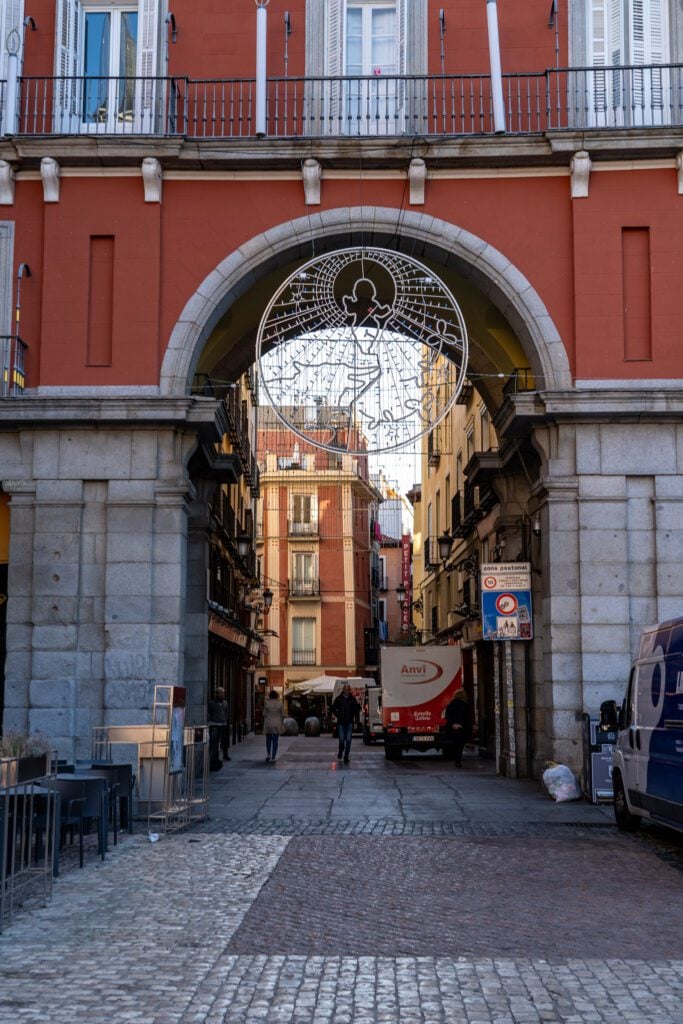
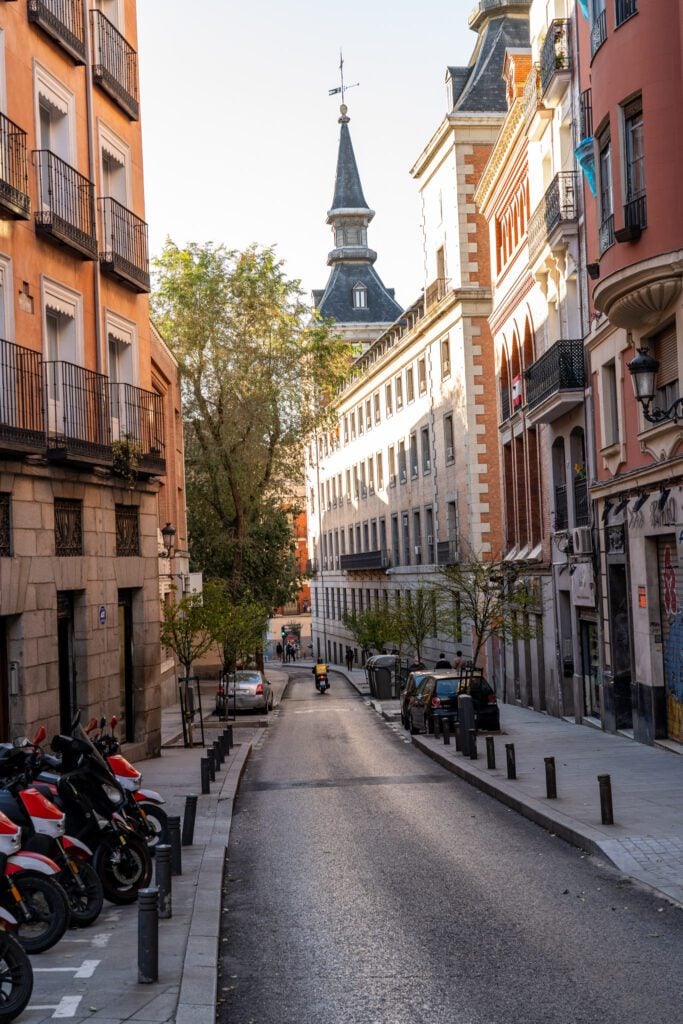
As you get closer to Gran Vía and Puerta del Sol, it starts to get more commercial, with wide, pedestrian-only streets lined with chain stores like Foot Locker and Levi’s, and it feels a little bit like Times Square in New York City, or Union Square in San Francisco.
We stayed here, right on Gran Vía, which is about as central as it gets. We were within walking distance (15 minutes or less) to everywhere we wanted to go in Madrid, and as a result we ended up using the metro a lot less than we had initially planned.
However, being right on that main, modern boulevard kind of sucks (in our opinion, anyway), and we’d recommend that you stay further south (or in another neighborhood entirely).
It’s also well-connected to the train station (Atocha train station, which is where you’re likely to arrive if you’re traveling to Madrid by train) and airport thanks to the “Sol” regional train stop.
It’s one stop and €2.20 to the train station (the transfer to or from the regional trains is usually included with long distance train tickets), and it’s an easy journey to the airport.
Pros and Cons of Staying in Barrio de los Austrias
Here are the pros and cons of staying in the Barrio de los Austrias as we see them.
Pros of Staying in Barrio de los Austrias
- It’s as central as it gets. Puerta del Sol and Plaza Mayor are in the neighborhood, and just outside of it you’ll find La Latina (great tapas and full of charm) and Malasaña.
- It has good shopping. If you’re looking to do some shopping, this is probably the place to do it. There’s an incredible variety of shops selling everything from clothes to electronics, and just about anything else you can think of. If you need a new pair of jeans or a pair of Spanish-crafted Espadrilles, head here.
- There are plenty of hotel options. There are a lot of places to stay in this corridor, as you might imagine. From hotels to apartments, you’ll have your choice of style and budget.
Cons of Staying in Barrio de los Austrias
- It feels relatively lifeless. As you cross Gran Vía coming from Malasaña, you’ll trade the charming locally-owned boutiques for chain stores that exist all over the world. Instead of a wide variety of small restaurants, you get Five Guys and Burger King. This is a generalization, of course, but it’s just not that charming. You’ll end up spending most of your time outside of the neighborhood, which isn’t a bad thing especially considering you’ll be able to walk anywhere you want to go. I will say that the southern end of the neighborhood – around Plaza Mayor and to the south – is a little more fun and charming.
Our Recommended Places to Stay in Barrio de los Austrias
Here are a few places to stay in Barrio de los Austrias that caught our eye.
Palacio Conde Miranda (Beautiful apartments – $$/$$$): These apartments are in a restored 16th Century palace in the heart of Madrid’s historic center, and we stayed here on our latest trip to Madrid.
The location is great, particularly for first timers because it’s a block and a half away from bustling Plaza Mayor (though it’s on a quiet smaller plaza), and about four blocks to both the Royal Palace and Calle Cava Baja in La Latina.
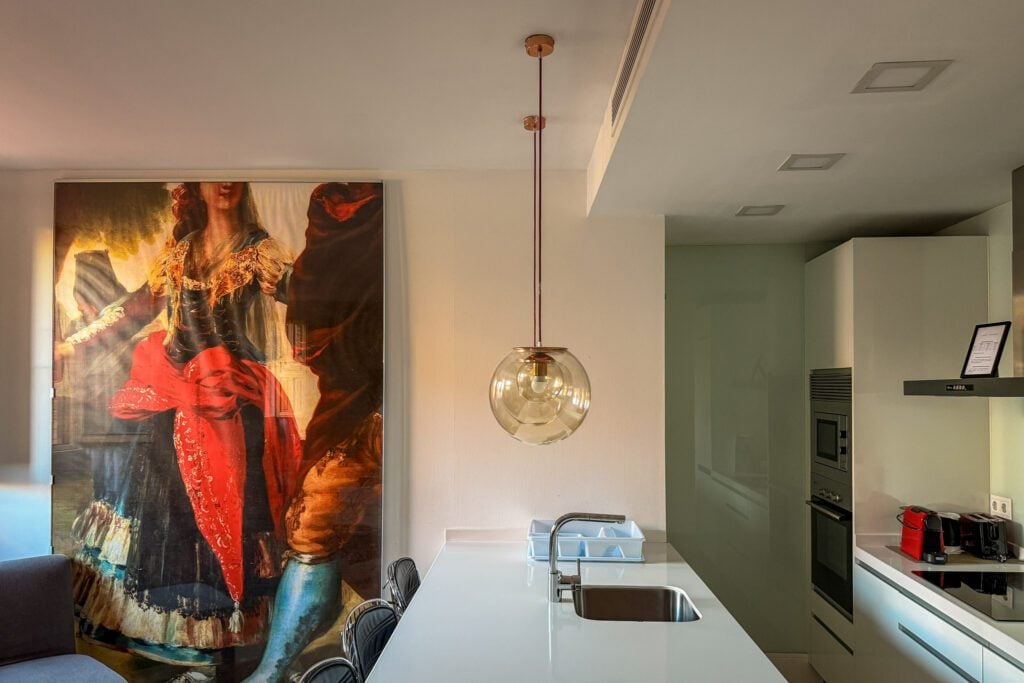
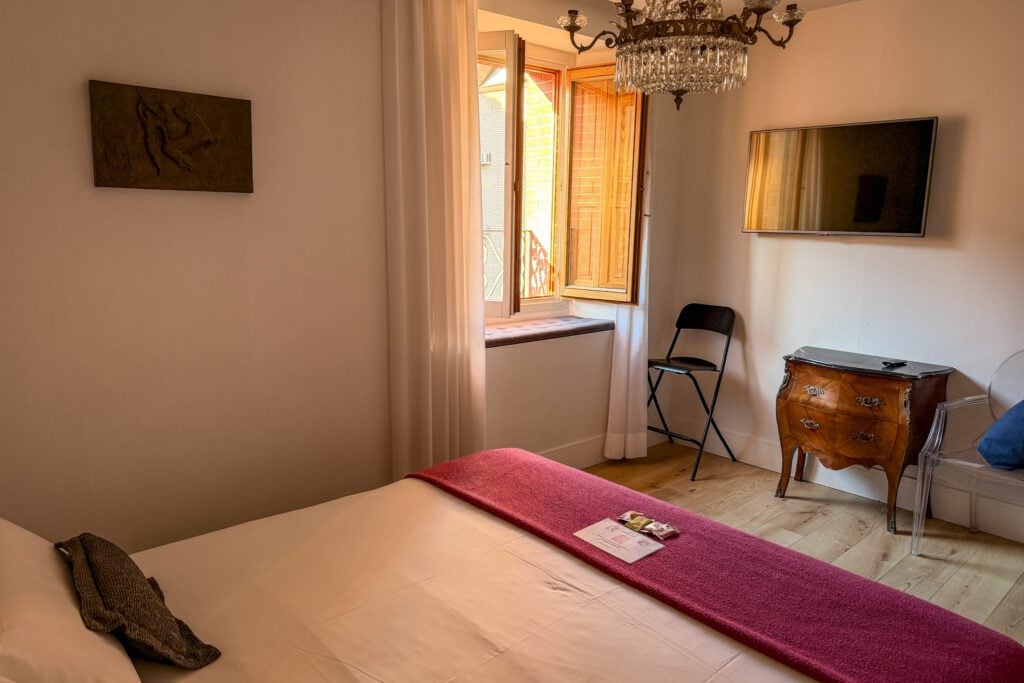
They have a range of apartments split between one and two bedroom units. Each apartment is unique, and the theme of each is focused on famous pairs of lovers, like Ross & Rachel from Friends or Han & Leia from Star Wars.
The units here are very spacious, with thoughtful details (like plenty of comfortable seating) and modern kitchen appliances in every unit (including ovens!).
It’s not the cheapest place to stay, but between the location, the size of the apartments, and the design and modern touches, you’re actually getting a lot for your money here.
ByPillow Citadel (Great value – $/$$): This solid hotel option is a few blocks west of Plaza Mayor, roughly equidistant to the Plaza, the Cathedral and Royal Palace, and Barrio La Latina.
It’s about as central as you can be to the main tourist attractions, though you’ll need to use transit to get to places like the train station and Museo del Prado, which are on the other side of the historic center.
ByPillow is a hotel chain with locations all over Spain (and now one in Florence, Italy!) known for their modern, affordable rooms primarily in the big cities.
There are only 10 rooms at this location, split between more traditional double rooms and more spacious triple rooms (with a bed and a sofa bed) for smaller groups traveling together.
Overall, a good option in a nice location where you’ll get a comfortable room with modern design and amenities without some of the more luxurious touches you might get at a more expensive place to stay.
Numa Sol (Modern Aparthotel – $$): Admittedly, this modern aparthotel is on the north side of Plaza Mayor (we prefer the more historic area south and east), but it’s too good an option to not include in this section.
Numa is a chain of aparthotels across Europe, and they consistently provide a good value for people who want the benefits of a hotel – luggage storage and helpful staff (which you might not get in a vacation rental) – and the space and kitchen facilities of an apartment.
We stayed at one of their locations in Granada and it was perfect as long as you’re okay forgoing the traditional front desk of a regular hotel.
The apartments here come in a few configurations; studio, one bedroom, and two bedroom. There are a couple of additional options to choose from, like apartments with a terrace or a sofa bed.
All of the units have a kitchenette (with a refrigerator and stovetop), along with some seating, both of which will make a longer stay in Madrid far more pleasant and comfortable.
I will say that the apartments are the most spacious – the studio is basically a bed, a kitchenette, a small table, and a bathroom – but they do have apartments with plenty of beds to accommodate groups of 4-6, which is fairly rare in the historic center of Madrid.
Chamberí: Where to Stay to Feel Like a Local
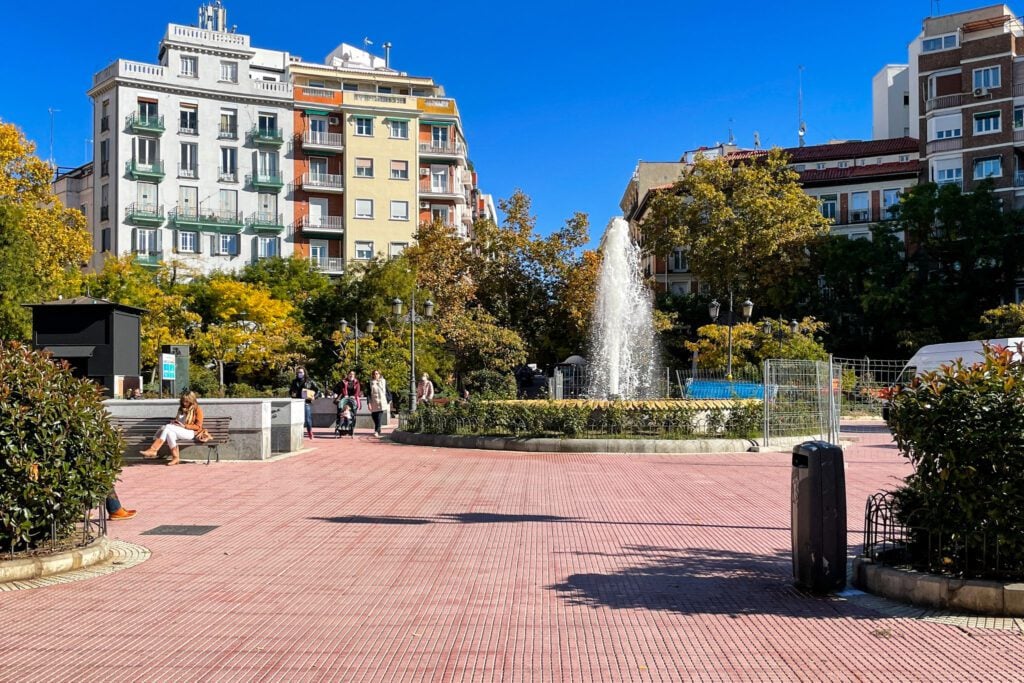
Chamberí is the place that I would stay if you have more than a couple of days (which means you don’t necessarily need to stay in the middle of all the action to maximize your time) and want a neighborhood where you’re going to find more residents than tourists.
I found myself up in this direction as I was seeking out a couple of coffee shops on my list (we both love Naji Specialty Coffee, and went there twice on our last trip), and I was immediately enchanted by Plaza de Olavide, a charming little public square with a fountain that was absolutely bustling with young families on a sunny weekend morning.
From that plaza, the streets fan out in all directions and are lined with bars, restaurants, and coffee shops.
True, there are no major tourist attractions in this area, but that’s kind of the whole draw of staying here; you’ll be surrounded by people going about their daily lives rather than visitors rushing from sight to sight.
Some might argue that Chamberí, which begins on the northern border of Malasaña and stretches north, is too far out for most people.
I’d argue that Madrid’s excellent metro system means that you’ll be able to get anywhere in the city center pretty easily from here.
We would make sure that you’re within a 5-10 minute walk of one of the neighborhood’s main metro stations – Bilbao or Quevedo – and we’d say that the area around Plaza de Olavide is our favorite part of Chamberí (so we’d try to stay somewhere in that vicinity if you can).
Pros and Cons of Staying in Chamberí
Here are the pros and cons of staying in Chamberí as we see them.
Pros of Staying in Chamberí
- It’s charming. Narrow streets, lots of plazas and outdoor terraces, and a constant stream of people going about their days (versus tourists bustling from one attraction to the next) make this a very pleasant place to be.
- It feels like people actually live here. A lot of people say things like “I want to feel like a local when I travel,” which totally resonates with us. We think this comes down to the fact that we generally prefer businesses – shops, restaurants, coffee shops, etc – that cater to local residents rather than tourists, which you only really find in places where people actually live. Take a walk through Plaza de Olavide on a sunny weekend morning, where you’ll find locals out and about strolling and sunning with their families on the cafe terraces, and you’ll see what we mean.
- Great places to eat and drink. Several of my favorite coffee shops and gluten free restaurants in Madrid are up here, including the aforementioned Naji and the 100% gluten free location of Pinks. Unlike some neighborhoods where we’d suggest you plan on eating elsewhere, you’re going to eat well if you stay here.
Cons of Staying in Chamberí
- There are no major tourist attractions. This is not necessarily a terrible thing – in fact, we’d say it’s directly inverse to the pros we went through above – but it does mean a bit more travel time to get to places like La Latina and the Museo del Prado. Plan on extra transit time, which means it might not be best for shorter stays.
- It’s not as walkable. On a related note, while you’ll be able to walk to a bunch of great places to eat and drink, you’ll need to take the metro to other parts of the city like the Prado, La Latina, and Plaza Mayor. Lucky for you, there are good metro connections nearby.
Other Areas in Madrid that We’d Consider
There are a couple of other neighborhoods that we’d consider, but they form a pretty clear second tier below the five we’ve already covered.
The main issue is walkability. None of these three neighborhoods are particularly walkable, and the real issue is that we personally wouldn’t trade the lack of walkability for the charm, food scene, or other benefits that they offer.
Chueca: Adjacent to Malasaña, Chueca has a similar vibe, but is slightly more upscale. It’s the neighborhood where the LGBTQ+ community in Madrid is most prominent, and you’ll see rainbow flags all over the place.
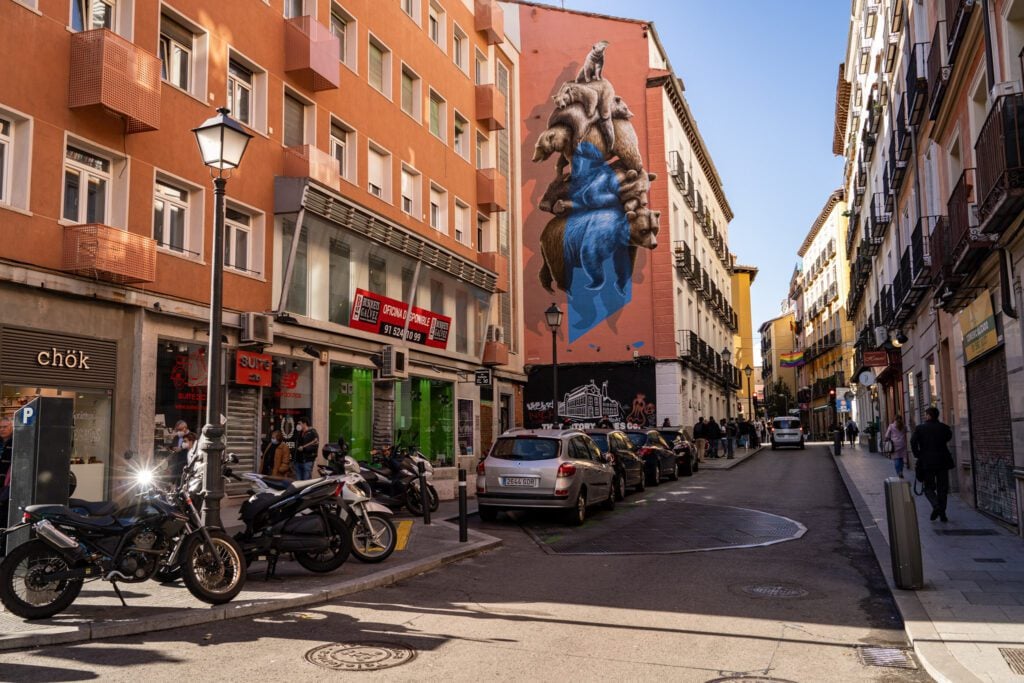
The eastern side of Malasaña and the western side of Chueca are a big nightlife hub, so it can be loud.
We strongly prefer staying on the western end of Malasaña, which is a little quieter and more low key.
Lavapiés: This is a neighborhood between Atocha (the main train station in Madrid) and La Latina that is well connected to the metro system and somewhat walkable.
It’s more residential, which means fewer hotel options and some great food and drink options that are less geared towards tourists.
Overall, we’d only stay here if you’re really on a budget because there are some nice options at a reasonable price point.
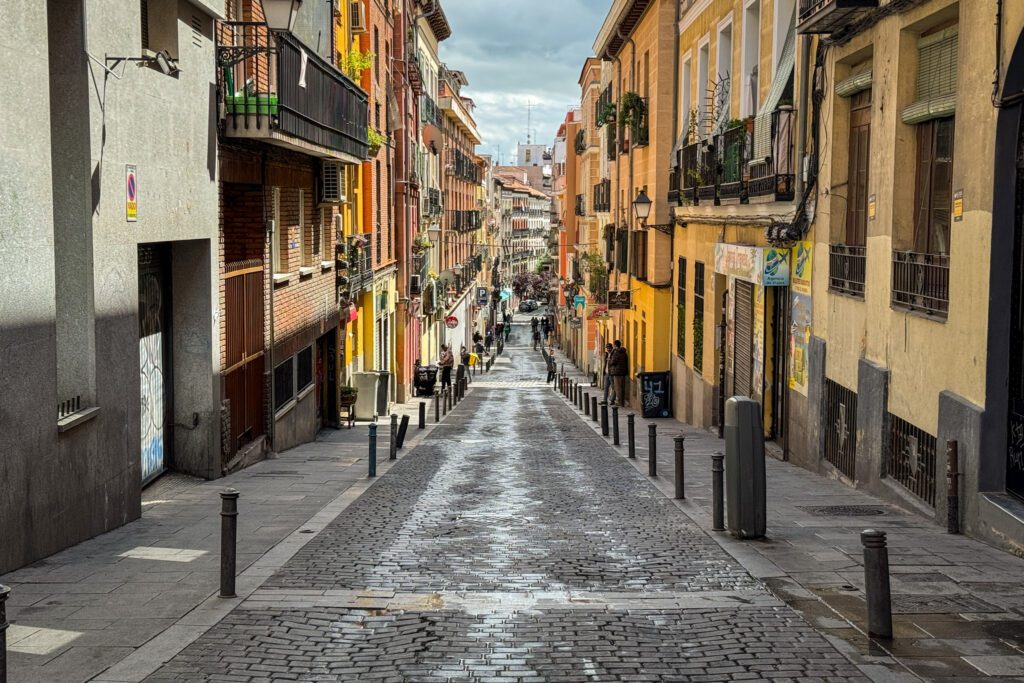
Salamanca: The most upscale neighborhood in Madrid’s center, this is where you’ll find the 5-star hotels and the luxury shopping (you’ll find Louis Vuitton, Coach, and Hermes here). If you’re into shopping, you’ll be right in the middle of it all here.
That’s not really our vibe, so we wouldn’t really consider staying here, especially because the accommodations tend to skew towards the expensive side of the spectrum.
All that being said, we do like the northern end of the neighborhood where it gets more residential and low key, but there aren’t many hotels in that section.
Planning a trip to Spain? We’d love to help!
Here are our other Spain travel guides to help you plan an incredible trip (even if you have to eat gluten free!).
If there’s no link below, it means we’re still working on it – long, in-depth guides take time! We’re working on it, though, we promise.
The first place to start, if you haven’t already found them, is with our detailed itineraries. We have one shorter version for 7 days in Spain, one version that covers 10 days in Spain (a good middle ground, we think), and one longer version for two weeks in Spain (with ideas for more and less time in both guides).
Our Barcelona Guides
- What to do in Barcelona (as a First Timer)
- How to Plan an Amazing 4 Day Barcelona Itinerary
- Where to Stay in Barcelona: A Complete Guide for First Timers
- 12 Things to Know Before You Visit Barcelona
- Gluten Free Barcelona: A Complete Guide to GF Restaurants + Bakeries
- Where to Find the Best Specialty Coffee in Barcelona
- How to Plan an Incredible Day Trip to Montserrat (from Barcelona)
Our Madrid Guides
- What to do in Madrid (as a First Timer)
- How to Plan an Amazing Madrid Itinerary (2 Days)
- Where to Stay in Madrid: A Complete Guide for First Timers
- 12 Things to Know Before You Visit Madrid
- Gluten Free Madrid: A Complete Guide to GF Restaurants + Bakeries
- Where to Find the Best Specialty Coffee in Madrid (for Coffee Nerds)
- How to Plan an Amazing Day Trip to Toledo (from Madrid)
The Rest of Spain

Hello, thank you for your very comprehensive guide to Milan! I noticed that you mentioned about air bnb prices driving locals out, I wondered why you write specifically not to air bnb in the Latin Quarter? Is this for the same reason? Many thanks! Emma
Hey Emma! While Airbnb being a problem for housing for locals is more or less true about every neighborhood in central Madrid (and every other major city in Europe and North America, really), it’s more pronounced in La Latina, which hasn’t really been zoned or designed to be a neighborhood for tourists. Unfortunately, the rise of short term apartment rentals has caused rents in La Latina to rise at a rate that is unsustainable for the people who actually live there.