
Our Favorite Things to Do in Madrid: A Complete Guide
If there was one big European city that we, two self-employed Americans with a decent handle on Spanish, would move to without thinking too much about it, it would be Madrid.
The reason is pretty simple: of the European capitals, Madrid feels the most lived-in of the bunch.
When you’re walking around the historic center of, say, Rome, you tend to hear far more English, Spanish, or French than you do Italian. Same with a place like Amsterdam or Paris.
However, in Madrid, we hear a LOT of Spanish.
As visitors, we’re always searching for a slice of local life when we’re traveling (I’m using “we” in the royal sense here), and the tragedy of the wave of unsustainable tourism over the past decade or so is that it has hollowed out the historic centers of many of the cities we love.
Century-old bars are replaced with shops selling magnets and t-shirts for tourists, and by the end of the cycle you’re walking around the neighborhood realizing that you’re hearing nothing but languages other than the one locals speak, and there’s not a single local within ten blocks of you.
To us, at least on our last trip this year, that’s not at all how it feels walking around Madrid.
Sure, there are signs of globalization (a huge increase in the prevalence of matcha and bachelorette parties, for example), but the soul of Madrid is still there. It has vibrant nightlife, all of the art and culture you could possibly want, and an extremely underrated food scene.
Madrid is a massive city (the biggest in Spain), and making sense of it all can range from difficult to downright overwhelming.
Lucky for you, we’re here to help you make at least a little sense of it all and make the most of your time in the Spanish capital.
In this guide to our favorite things to do in Madrid, we’re not going to give you a list of every single museum, park, and viewpoint that you could possibly see in Spain’s capital city.
Instead, we’ll give you a blend of the main attractions in Madrid – what they are, some brief (ish, I’m not known for brevity) historical context, and how to see them – but we’ll also give you some of our other favorite things to do in Madrid that a lot of people just skip altogether.
Which, to be honest, is mostly walking, eating, and drinking, with a few magnificent views sprinkled in for good measure.
Armed with that (and our guide to planning your Madrid itinerary), you’ll be ready to plan a trip that will go a level deeper than most and learn about the different aspects of Madrid’s history and culture that have shaped the city as we know it today over the several centuries it has been in existence.
Learning is our favorite part of travel, which you’ll probably realize as you read this.
Sound good to you? Let’s get into it.
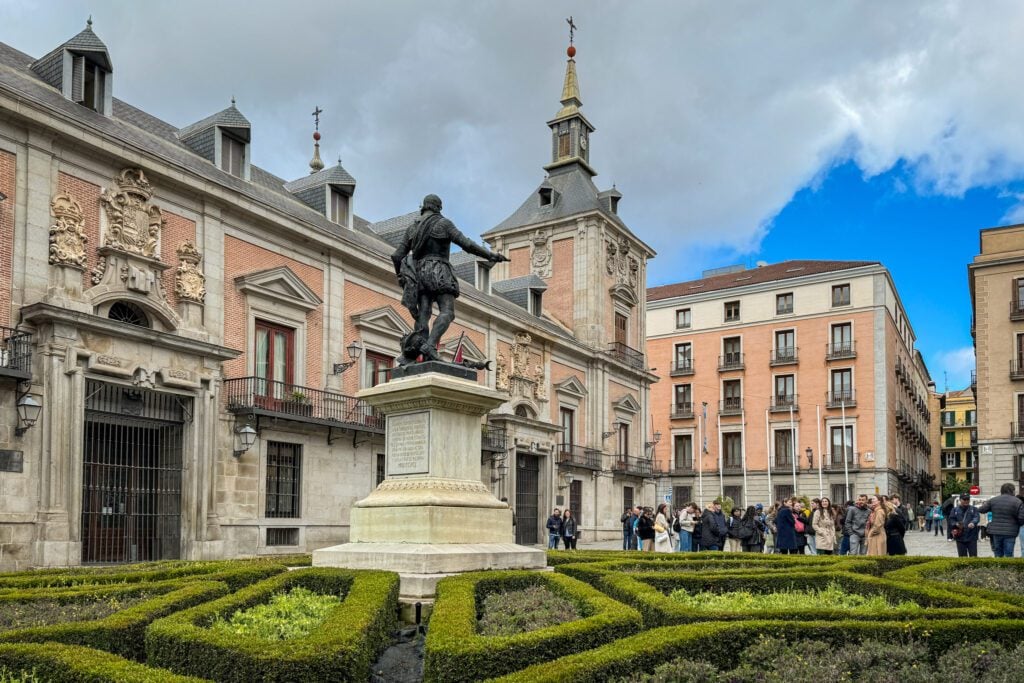
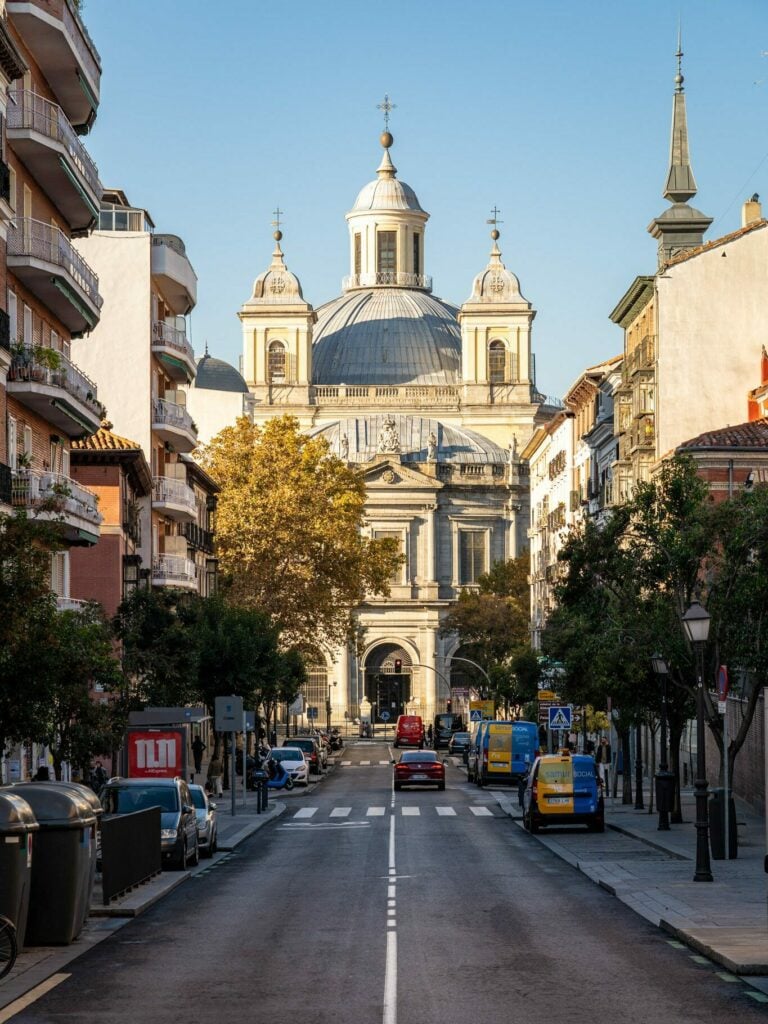
Disclaimer: Some of the links in this post, like hotel links, are affiliate links, meaning at no additional cost to you, we make a little bit of money if you click through and book. That being said, we would never recommend something to you that we don’t stand behind 100%.
Explore Spanish History Through Art at the Museo del Prado
As we’ve said many times before in this corner of the internet, we’re not huge art museum people.
We’re especially not art museum people when it’s a large, sprawling collection with very little rhyme or reason for existing (the National Gallery in London, for example).
If we are going to take the time out of our visit to a city to do an art museum, it has to be one that says something about the place it’s in.
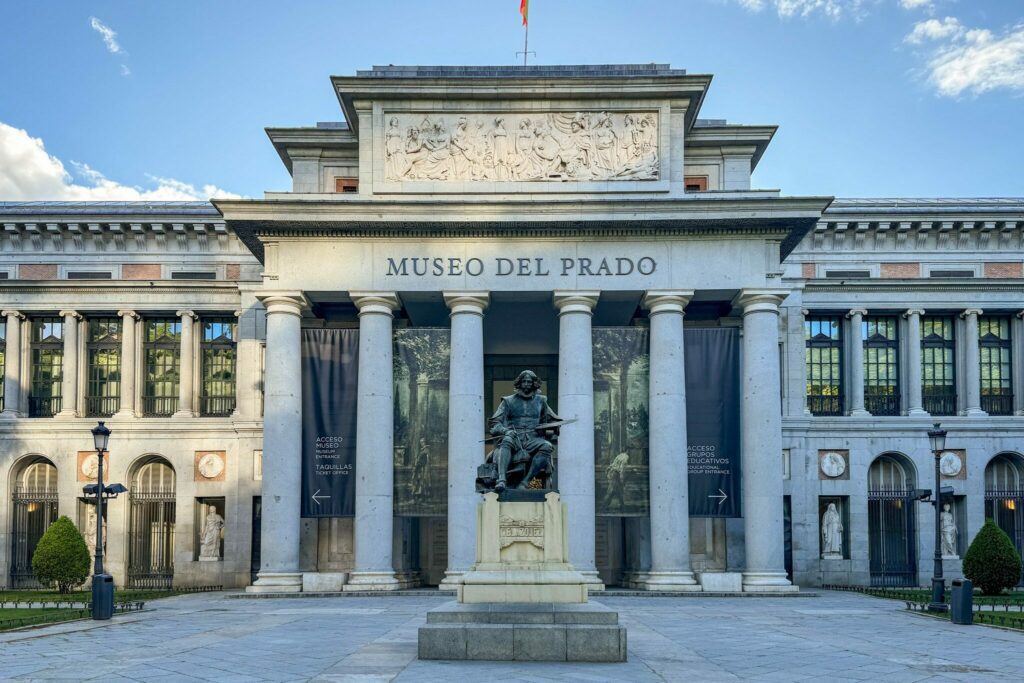
The Prado Museum checks that box multiple times over because it is, in fact, a collection accumulated by the Spanish Royal Family, and the Spanish Empire stretched across most of Europe and the Americas at its peak.
The Prado Museum is an extremely impressive collection mostly owed to the fact that Spain was filthy rich for several hundred years starting in the 15th Century, and they were able to either acquire art from across Europe or commission it here in Spain.
On a tour we did (this one with Jaime, which Matt has now done twice and LOVES), we learned that the Prado not only has the highest number of paintings by Spanish artists like Goya and Velázquez, but also some of the Italian masters, Flemish art, and plenty more.
It’s an impressive collection and we would definitely not recommend trying to see it all, which would take several days.
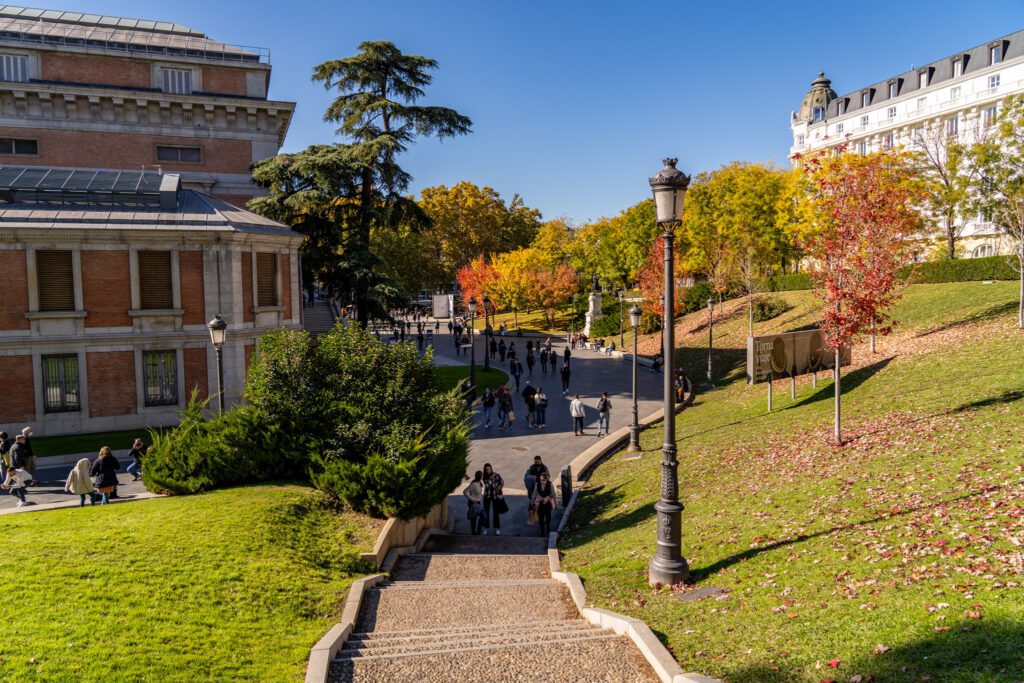
Here are a few of our favorite works or concepts on display at the Prado that we wouldn’t miss.
- The work of Flemish painter Hieronymus Bosch: Particularly the Garden of Earthly Delights, which is a mind-bending, imaginative, dark, and colorful masterpiece.
- The statue of Charles the III, one of the most famous characters in Spain’s history. The armor he’s wearing (or isn’t – it was off when I was there) is REMOVABLE. So cool!
- Tintoretto’s play with perspective in Christ Washing the Disciples’ Feet (make sure to look at it from both sides!).
- The Work of Francisco Goya: Especially the “black paintings,” which are really, really dark (and were painted on the inside walls of his house – what a creepy thing to have on your bathroom wall).
- The copy of the Mona Lisa: We don’t know who painted this identical painting to the one in the Louvre. Was it Michelangelo? Was it an apprentice? We do know it was painted at the exact same time, and this one is actually in better condition than the more famous version.
I, Matt, did this excellent tour of the Prado Museum with Jaime (an art historian) on my first trip to Madrid years ago, and loved it so much that I did it again, this time with Alysha in tow, on our most recent trip (and it was as excellent as ever).
Similar to Lexi (more on her in the next section), Jaime is both extremely knowledgeable about art history and also an excellent storyteller, the two main things you need in a great tour guide.
He takes you on a chronological walk through time that starts in the Middle Ages (roughly 500 – 1,500 C.E.), when Spain was still in the throes of a war against the series of Muslim Caliphates to unify Spain as a Catholic kingdom (plenty more on this later!), through the Spanish Golden Age when they were the most powerful empire on earth, and ends in the 19th Century.
Along the way, you’ll move through both the important styles, like Renaissance and Baroque, and also see the work of the Spanish Masters like Velázquez and Goya (among plenty of others).
It’s a great tour and I cannot recommend it highly enough.
Heads up: Jaime’s tour DOES NOT include tickets to the Prado, which you will need to book on your own (more information on this in a second).
I (Matt) have also done this VIP Early Entry tour with Walks, my favorite tour company in Europe, which enters the museum an hour before it opens to the public, which means you have the whole space to yourself.
The Prado is extremely busy, and while 90 minutes is not quite enough time to really see the entire collection, it is nice to have that time where it’s quiet and you can get up close to the paintings without having to fight your way through a big tour group.
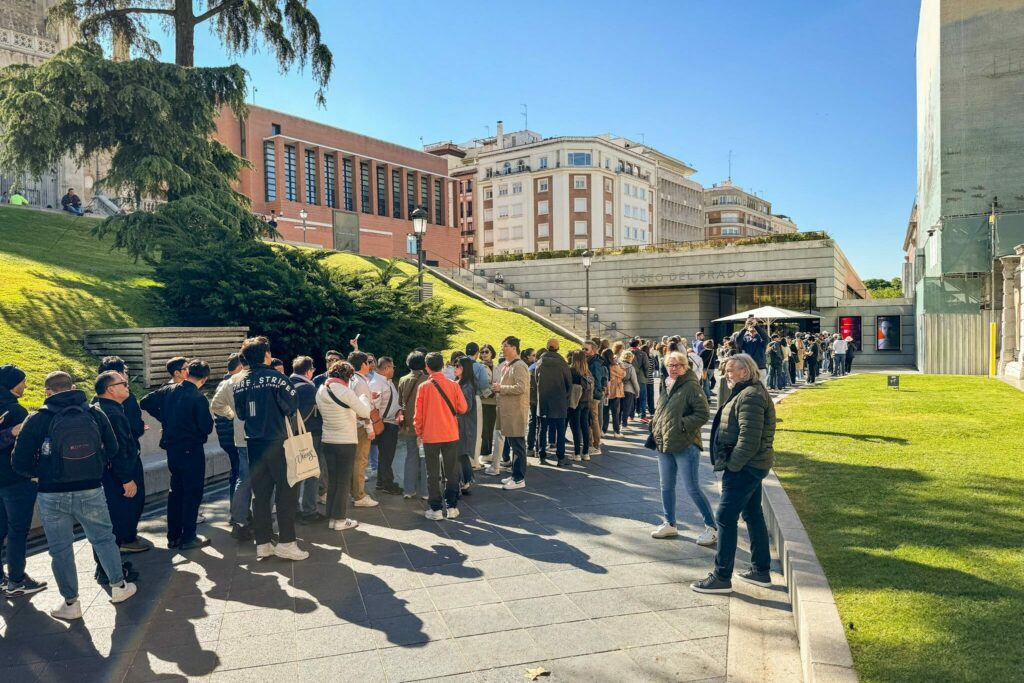
We’d especially consider this tour if you’re in town on a Saturday or Sunday in the spring or summer, when the museum is at its busiest.
You can stay inside the museum after the tour and continue exploring the collection.
If a tour isn’t in the budget or isn’t your style, here are a few tips for visiting the museum independently.
- Book your tickets in advance. Tickets will sell out, especially for peak tourism months (which is basically spring through fall at this point), particularly on weekends. They go on sale 60 days in advance. Information on tickets can be found on the official website.
- No backpacks or water bottles allowed. They have a coat check, which is perfectly safe to leave stuff at, but the lines are long. Better to just leave bigger bags at home. No food and drinks whatsoever.
- No photos allowed inside the museum. This seems to be somewhat controversial with visitors, but we absolutely love it. Instead of everyone crowding around the most famous works trying to take a selfie a la Mona Lisa, everything runs significantly more smoothly.
- Consider an afternoon or evening timeslot. The crowds are concentrated in the first half of the day, from opening to about 2pm, give or take. For a quieter experience, consider visiting in the late afternoon.
Learn About Madrid’s History on a Walking Tour (with Lexi)
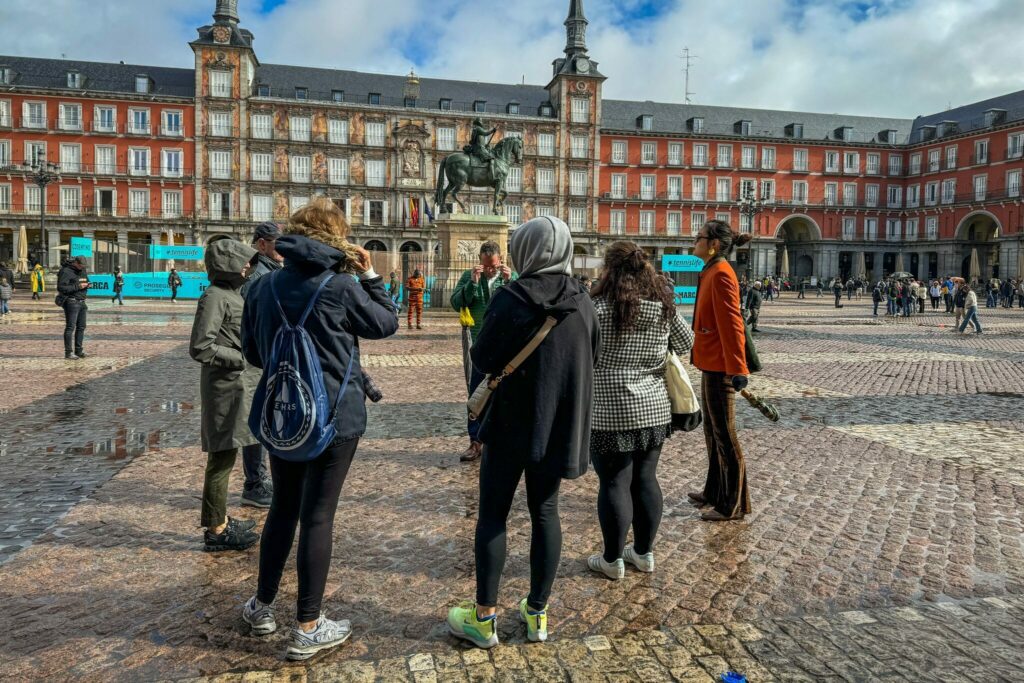
There are multiple reasons why we strongly recommend a walking tour as the very first thing you do in a new city.
First, it’ll help you get oriented to the new city and figure out where everything is and how it all fits together.
Second, you’ll get a quick and dirty history lesson with all the context you need to set yourself up for a much richer, deeper experience on the rest of your trip.
Last, and arguably most importantly, you’ll get to connect with a local who can help you figure out where to eat and drink (and what to see and what to skip) so that you can make the most of the rest of your trip.
We have done A LOT of walking tours around Europe over the past decade or so of building this corner of the internet, and we’ve come to the conclusion that the best walking tour guides have a combination of subject matter expertise and a certain flair for storytelling and drama to make it all fun and digestible.
I am not exaggerating when I say that Lexi’s history-focused walking tour of Madrid is quite possibly the best walking tour I have ever done.
Remember, I always do one, sometimes two or three walking tours in a place to help build an understanding of a city. I have, in fact, done multiple walking tours in Madrid, and it’s not even close – Lexi’s is a 10/10.
I loved it so much a few years ago, when I was traveling solo in Madrid, I told Alysha that next time we were in Madrid together, we had to do it again.
Sure enough, fast forward a couple of years and we found ourselves spending another somewhat wet and stormy morning learning about Madrid’s history with Lexi, and it was once again a spectacular performance (and I do think it’s a performance, Madrid is just Lexi’s stage).
She studied Spanish (and Portuguese) history and was a teacher in Spain before starting to do these history-focused walking tours, and she has that je ne sais quoi that keeps everything fun and approachable while still covering a lot of the facts and players in the story of Madrid (and Spain more broadly).
It’s perhaps my top recommendation for your time in Madrid. You should book the tour for your first morning in Madrid because Lexi will give you her super useful map of all her favorite spots in town for eating, drinking, shopping, and plenty more (plus she’s more than willing to answer your questions about the city).
At the time of writing, Lexi usually runs the morning tour, which is a little more expensive than the afternoon tour, but we think having Lexi as a guide is worth the premium).
If, for some reason, Lexi’s tour doesn’t work for your trip, the other recommendation we have is this walk through Medieval Madrid with Jaime, who we’ve done multiple guided tours of the Prado Museum with and is another great combination of expertise and storytelling.
The dates and times of his tour haven’t quite worked out for us yet, but we’d book it in an instant if it did!
Don’t Sleep on Madrid’s Other Museums
While the Prado Museum is both Spain’s most famous collection and quite extraordinary, there are several other museums in Madrid that might be worth your time, depending on what you’re into.
See Picasso and Dalí’s Work at the Reina Sofía
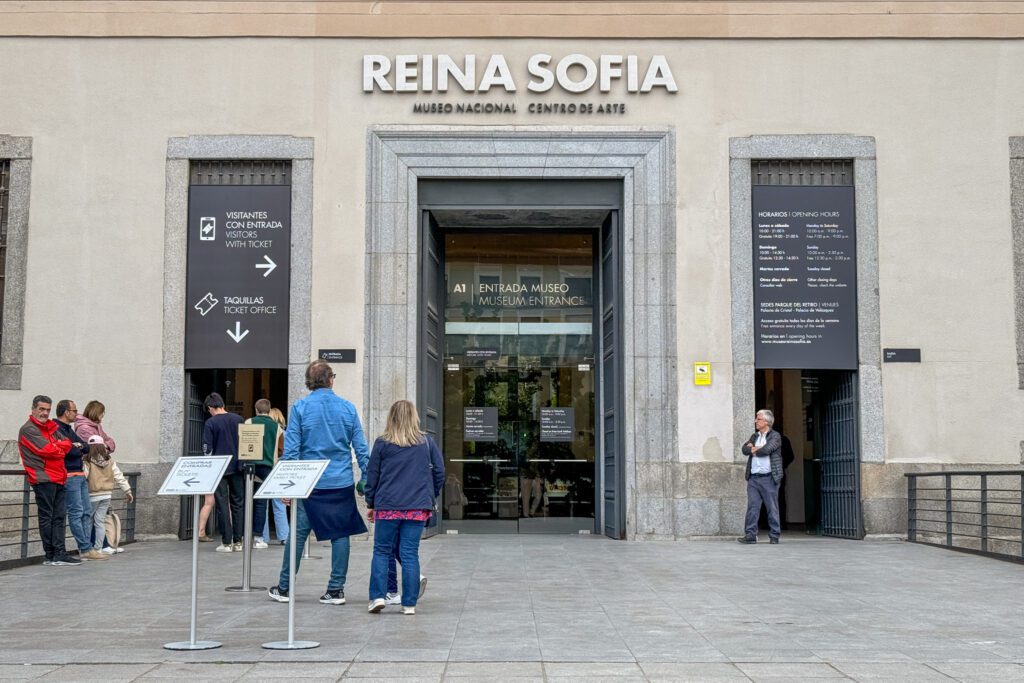
If I had you list five famous Spanish artists, there’s a really good chance you’d name someone like Picasso or Dalí, who are two of the most famous artists in modern art history.
However, if you go to the Prado, you’ll notice that they are conspicuously absent despite the Prado being THE place to see the work of Spanish artists.
There’s a simple reason for that: the Prado houses art up until the mid-19th Century. All of the more modern art lives across the street at the Reina Sofía Museum.
I’m not a huge modern art person, especially when it’s the type of modern art that’s just kind of a canvas painted white or a lightbulb over a chair.
As I realized (and later articulated to Alysha) at the Guggenheim in Bilbao, the type of art that draws me in is the kind where you can see the thousands of hours of work that went into it, and the hundreds of scrapped canvases and sketches that came before that one, magnificent masterpiece that’s on display.
And, to be honest, I can’t always see that time and effort in some of the modern art at the world’s most famous galleries (and don’t get me started on the descriptions, which border on absurdity).
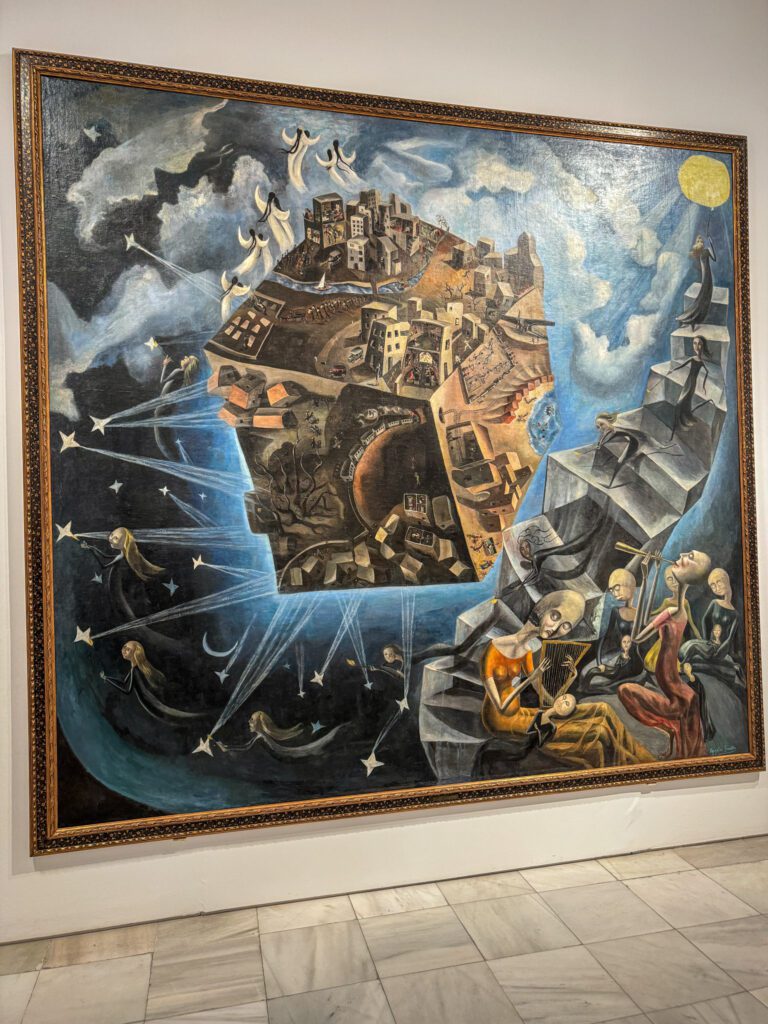
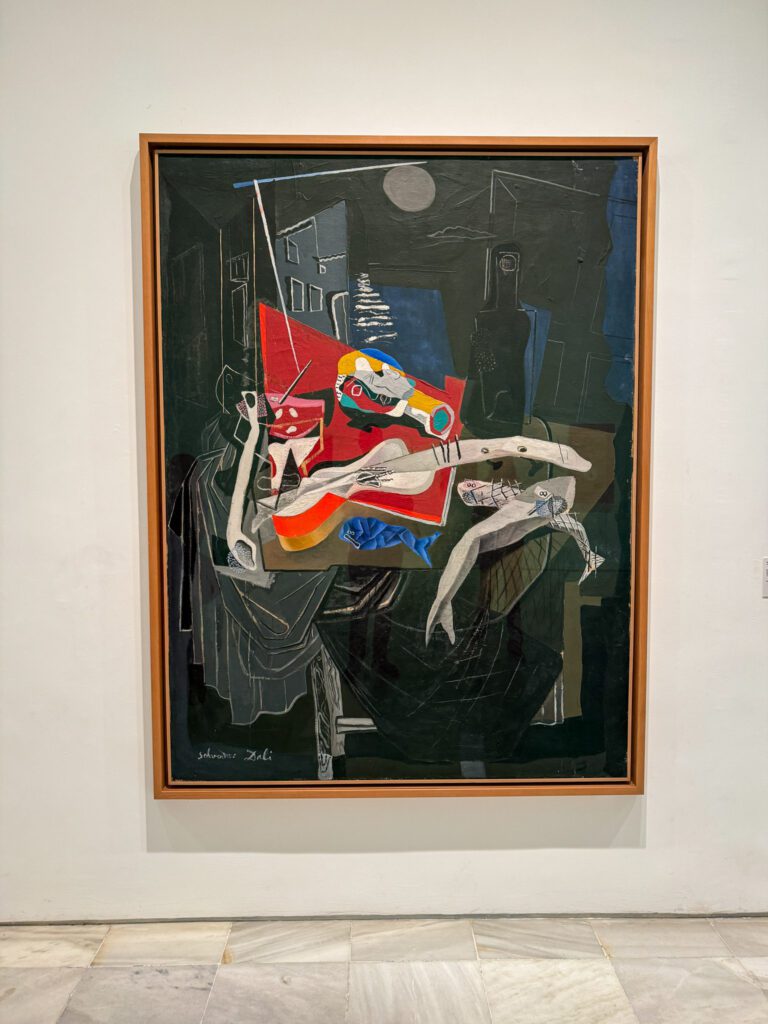
I took this guided tour of the Reina Sofía because I wanted to see some of the works by Picasso and Dalí and get a deeper understanding of their work, what drove them, and all the influences that came together to create their unique styles.
I enjoyed it, and if, like me, you have a hard time understanding what you’re looking at when it comes to modern art, I’d recommend it if you want to make the most of your visit.
Learn About Spain’s History at the National Museum of Archaeology
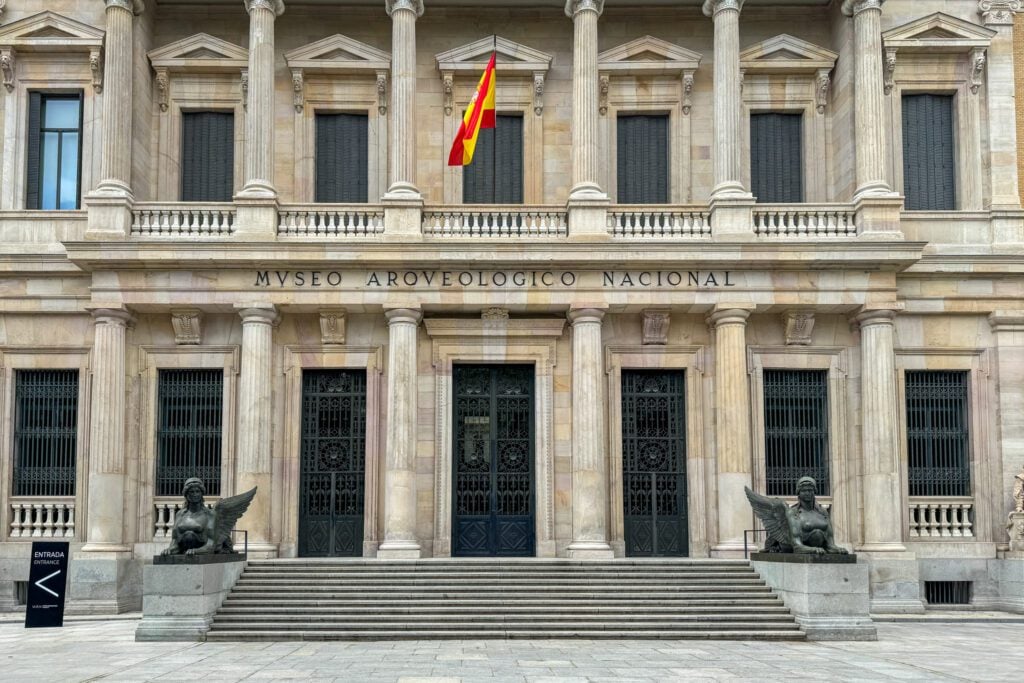
Housed in a beautiful museum at the northwest corner of Parque El Retiro, the National Museum of Archaeology was a very pleasant surprise for me, a person who is fascinated by the history of the Iberian Peninsula.
What I learned here is that, basically, every big Mediterranean power has spent time in Spain, from the Phoenicians, Carthaginians, and Romans, to the Visigoths and the Muslim Caliphates of North Africa.
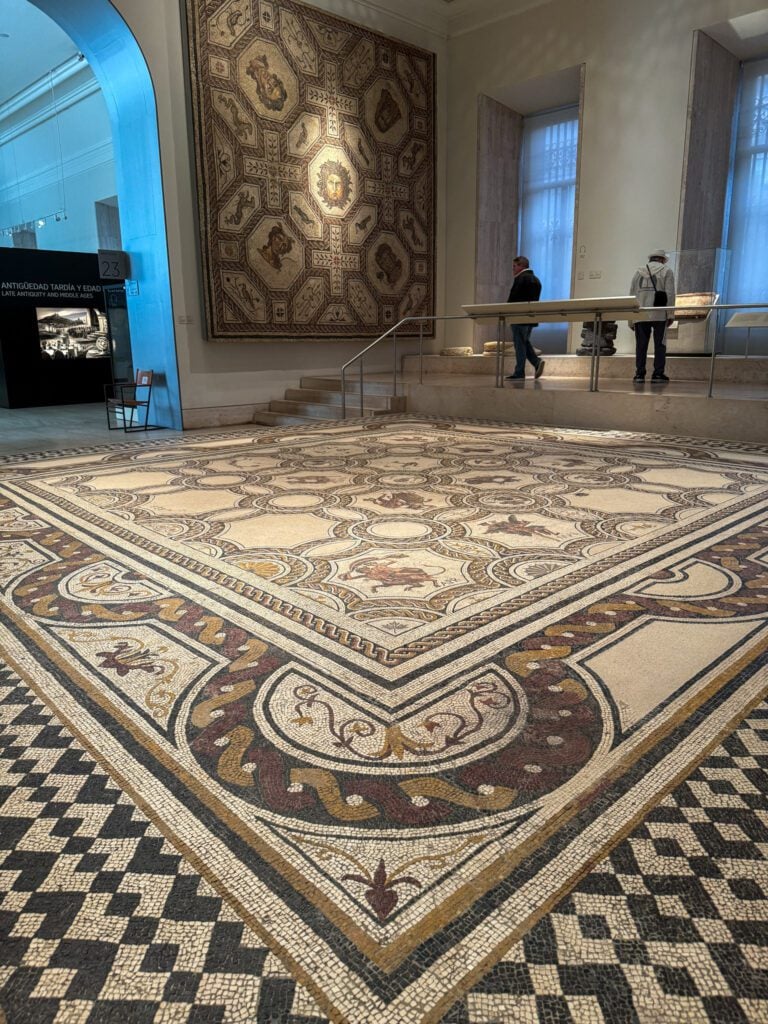
Spanish identity and culture is inherently influenced by all of those people who spent time here, particularly the Muslim Caliphates who crossed the Strait of Gibraltar in 711 C.E. and spent the next 700+ years controlling pieces of the Iberian Peninsula in modern day Spain and Portugal.
Flamenco, the food (is there anything more North African than paella?), the language (many Spanish words are simply mispronunciations of Arabic words).
There are so many things that are stereotypically Spanish, but are actually rooted in that complex mixture of cultures and peoples that spent so long fighting for control of Spain.
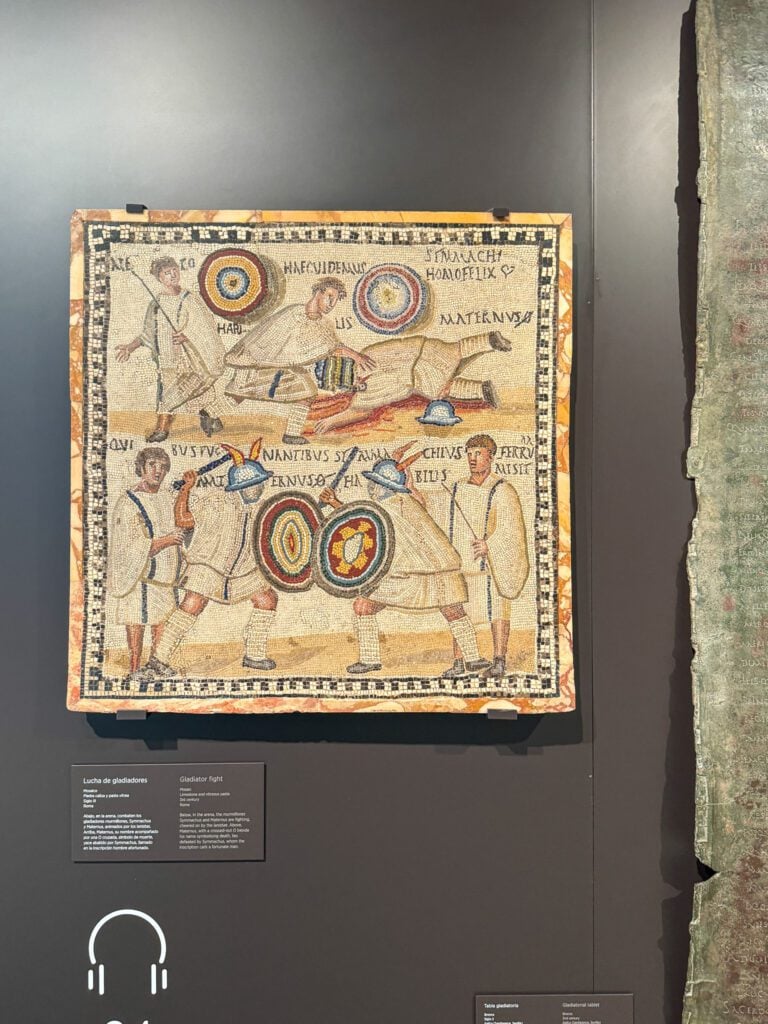
This museum has a great collection of pieces from across those time periods, and weaves a nice narrative about the history of Spain from the native Iberian tribes through the Middle Ages and into the 19th Century.
It’s another good way to learn about the history here, especially considering the visual aids they have (like reconstructed Roman mosaics found in Spain, and pieces of Mosques and other Muslim buildings).
The cost (a few Euros) means you can come here and spend as much or as little time as you want without feeling like you need to see it all to get the most bang for your buck.
Do a DIY Tapas Crawl in the Historic Center
Madrid’s food scene is fairly dynamic. It’s a huge city with people from all over the world, so the food options are more diverse than, say, Sevilla.
That being said, there are tons of options for tapas, which is the name of the game in Madrid (and many other parts of Spain).
We think you should spend one afternoon putting together a little DIY tapas crawl through the area around Plaza Mayor, where there are a few good historic bars and restaurants to experience.
What is a tapa, you ask? Good question, because it’s a little different from what you’re probably used to.
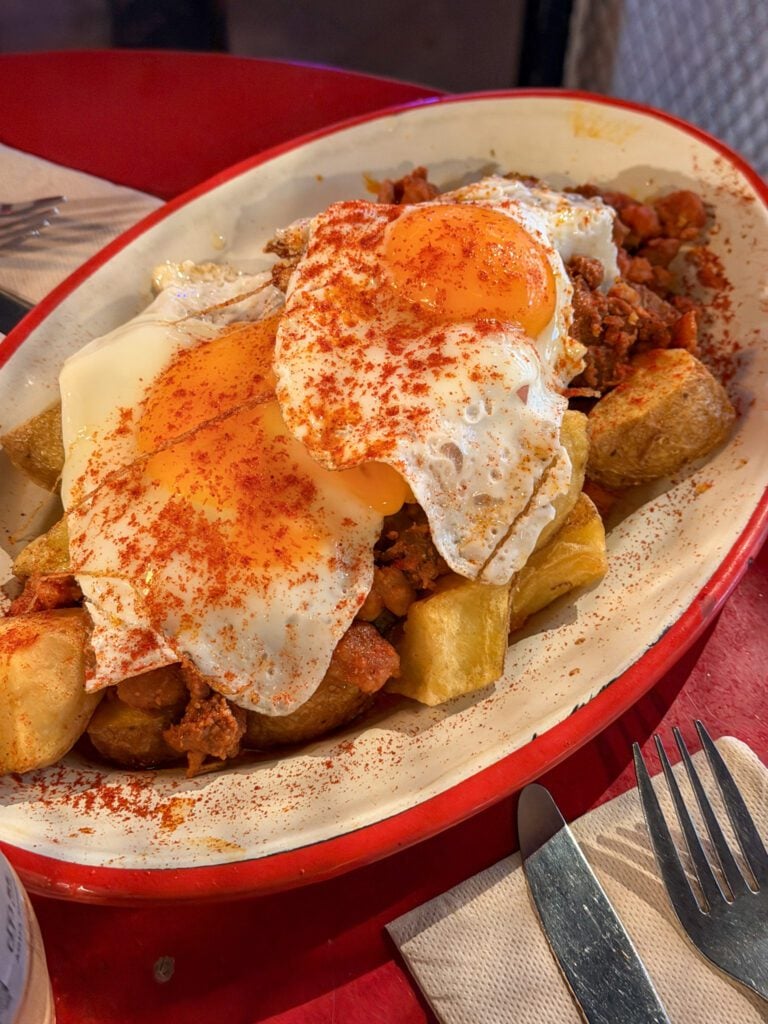
Traditionally, a tapa (the singular form of “tapas”) is a small plate of food that is served to you when you order a drink. You don’t get to choose, you just order the drink and the bartender hands you a little plate of food with it.
That tradition has sort of gone by the wayside at this point (kind of like how the days of eating a full meal for aperitivo in Rome are long gone), and now it’s usually more similar to other places where you order from a menu.

A reminder here at the top: meal times in Spain are very different from what we’re used to in the Anglosphere.
Lunch, the biggest meal of the day, is somewhere between 1pm and 4pm, and dinner is LATE (9pm at the earliest).
It throws us off every time we’re in Spain, but the only restaurants open at our “normal” meal times are likely to be restaurants you probably don’t want to eat at because they cater to tourists (a generalization with exceptions, but directionally true).
An important note: Matt has Celiac Disease, which means the way we experience a city’s food scene is almost certainly different from the way you will.
It’s worth noting that Madrid is an elite gluten free city (here’s our gluten free guide to Madrid if you also need to eat gluten free), and there are SO MANY great gluten free options around the city.
If you don’t, we wanted to take a second to link you to resources we’d use to figure out what to eat and where to eat it (aside from booking this food tour with Devour, which we’ve done a version of elsewhere in Spain and loved).
The first place we’d turn to is the Eater guide to Madrid, which is a look at the essential places that local food writers recommend.
It’s not the end-all, be-all, but it’s a great starting point (we look at the Eater guide to Portland often as a sort of gut check, and generally agree with their recommendations).
Another place we like to look for food recommendations is Reddit threads, mostly because on Reddit, you’re usually getting crowd-sourced information from locals or fellow travelers that have actually experienced the things they’re mentioning.
Check out this thread and this thread as a starting point.
Some combination of the places below would make an excellent option for lunch on a day when you find yourself in the center (like the day you do Lexi’s walking tour or the Prado Museum).
Cervecería La Campana: Go here for the fried calamari, specifically the fried calamari sandwich (un bocadillo de calamares), which is a surprising staple of Madrid’s cuisine that goes back to the days of the Franco regime. Long lines to eat it there, but you can order from the to-go window and find a place to sit down and eat it. Find it here on Google Maps.
Mesón del Champiñón: Go for the champiñones al ajillo (this was a recommendation from Lexi, the walking tour guide). Find it here on Google Maps.
Casa González: A nice little meat and cheese spot over in Barrio de las Letras that is a good spot for a glass of wine and some tasty cheese and jamon. Find it here on Google Maps
Casa Revuelta: Stop here for their famous fried cod and gildas (our favorite discovery in Basque country – it’s two olives, a vinegar-y pepper, and a salty anchovy on a stick)! You want the taberna (here on Google Maps).
If you’re looking for a fancier, more traditional sit down lunch, there are two places on the south side of Plaza Mayor that have been recommended to us and get pretty good reviews.
Both are in atmospheric caves under the hill the Plaza Mayor sits on top of, which is pretty unique.
The first, and arguably the most famous restaurant in Madrid, is Botín.
It is often heralded as the oldest continuously operating restaurant in the world (how would you really know that, though?), and it has been in this location since 1725 (okay, that’s pretty old).
It’s a very hard reservation to get, and I was told that it’s sometimes easier to show up 30 minutes before they open for lunch and wait for one of their “standby” tables. Though even that is a little risky.
They’re probably most famous for their roast suckling pig, though they do a bunch of pretty classic Spanish dishes.
If you can’t get a reservation there, a good alternative would be Las Cuevas de Luis Candelas, another atmospheric, old restaurant under the hill of Plaza Mayor.
This one has only been around since 1860 (which is older than just about anything in our home city, Portland, Oregon).
Finally, the next thing we’d seek out is churros con chocolate. It’s worth noting here that the churros you’re going to get in Madrid (or elsewhere in Spain) are more savory than what you’re picturing if you’re from North America.
They aren’t usually dusted with cinnamon sugar like they are here, they’re typically just long, thin pieces of dough, fried and served with a side of thick hot chocolate that doubles as a dipping sauce.
The order here is a ración of churros (usually six, sometimes four) and a “chocolate tradicional” (though we prefer dark hot chocolate, if they have it).
There are three places we’ve either been to or had recommended to us for churros (including two gluten free options!).
Chocolatería San Ginés is the famous one that everyone goes to because it has been there for more than 100 years. No gluten free options here, so we skipped it. It’s just north of Plaza Mayor (here on Google Maps).
Maestro Churrero was recommended to us as a less famous but better quality churro spot, and they do have gluten free churros prepped separately in a way that’s safe for Celiacs like Matt. However, they weren’t great (though the chocolate was pretty good). They have a location two blocks east of Plaza del Sol (here on Google Maps).
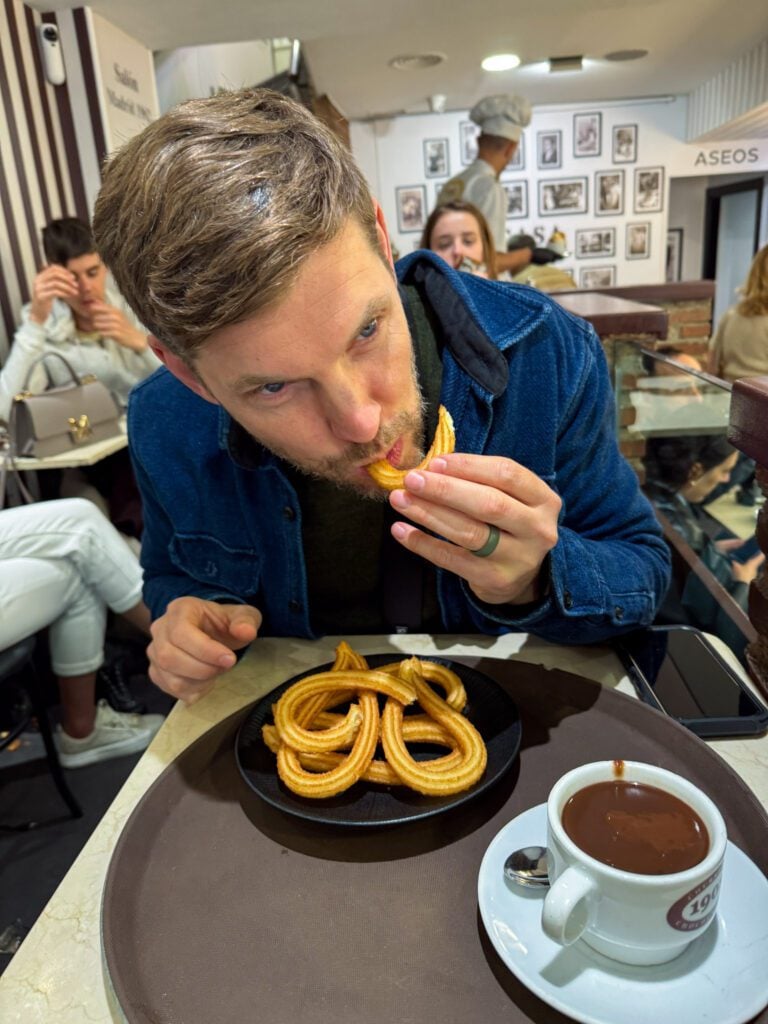
Churrería Chocolateria 1902 is a block north of San Ginés and is by far our favorite gluten free churros (they also have regular churros). The gluten free churros come out on a different colored plate from a completely separate kitchen.
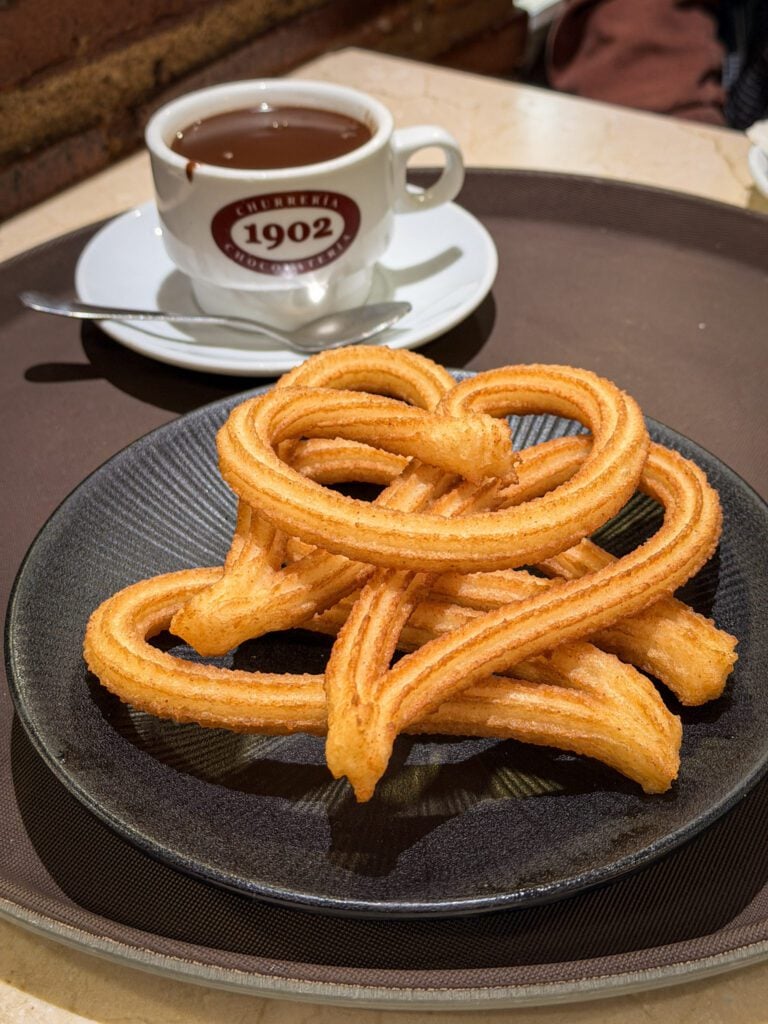
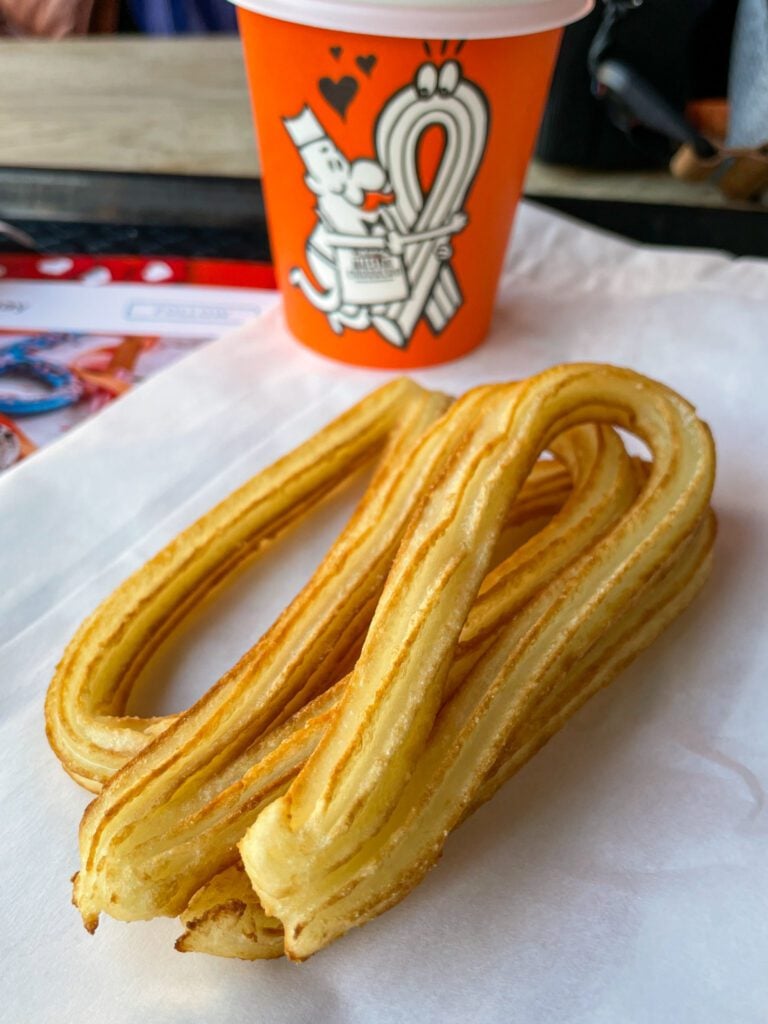
I can’t comment on the quality of their regular churros, but we liked their gluten free version way better than Maestro Churrero.
What NOT to Eat in Madrid
We do want to briefly (ish – brevity isn’t our strength) cover a fairly important topic here: what NOT to eat in Madrid.
Most people don’t fully appreciate this, but Spain is a big country, which means that the food culture is highly regionalized because the raw ingredients that exist in, say, Barcelona and Madrid, are wildly different.
As much as possible, you should try to eat the local specialties in the place you’re in, rather than trying to seek out the most famous Spanish dishes.
Which brings us to paella. Paella is a rice-based dish that, aside from being so clearly influenced by cuisine from North Africa, comes from Valencia, a city along the coast towards Barcelona.
We have one golden rule in Spain that we have broken a few times and regretted it: do not order paella in a restaurant that is not specifically Valencian or specifically known for paella (often called an “arrocería”).
There are, I’m sure, exceptions, but ordering paella out at a random restaurant is usually not going to be good, speaking from experience.
Another example is sangria. As far as we can tell, sangria is a completely made up concoction designed for tourists.
Which doesn’t mean it’s bad, necessarily, but we believe that you should try to drink what the locals drink, and that’s not sangria.
Instead, when you’re in Madrid, you should drink wine, beer, vermut (we love Spanish vermouth!), or sherry (Manzanilla is the dry version).
After all that food, you’re likely going to need a little nap, so take a few hours to relax before heading back out to explore the Royal Palace and cathedral (and get ready to eat…again).
Dive Deeper into Madrid’s Food Culture on a Tour
Diving into the food culture in places we’re visiting is one of our favorite aspects of traveling, and we try to include a food tour, cooking class, or market tour in most places we visit.
The food of a place tells you so much about the culture, history, and influences that have shaped it, and exploring a city through its food scene is a unique perspective that a lot of people don’t even consider.
If you are really interested in going deeper on food culture in Madrid, we would highly recommend booking a guided food tour while you’re in town.
Unfortunately for us, the reality is that because Matt has Celiac Disease and can’t have even a speck of gluten without being sick for days, a food tour or cooking class wasn’t in the cards for us in Madrid (though we did one up in San Sebastián that was one of the highlights of our entire recent three week Spain trip).
HOWEVER. That does NOT mean it shouldn’t be for you!
We’d highly recommend it because it gives you a local’s perspective on the city’s food scene – what and where to eat and drink – and you get to connect with fellow travelers and try some amazing food.
Our recommendation is Devour’s Tapas, Taverns, and History Tour, which is a three hour food and drink extravaganza that takes you to a bunch of different spots around the center of the city to try local specialties, including drinks.
We like Devour, who are in many ways the O.G. of this style of food tour in Spain, and their sister company (Walks) is our favorite tour company in Europe (we’ve done 8+ tours with them across Europe over the past few years).
We actually did a Devour tour up in San Sebastián on this latest trip to Spain and it was arguably the highlight of the entire trip to Spain.
We got to try a bunch of the local specialties, learn about WHY those foods ended up here, and how they fit into the bigger cultural landscape (which is what I would expect here).
For example, how did a fried calamari sandwich become one of the most famous food items in a huge city that is landlocked and almost exactly in the center of the Iberian Peninsula, hours from any big body of water?
In short, politics (in longer form, a combination of a dictator wanting Madrid to have all the nice things and then tough economic times where the way to avoid going hungry was to put it on some bread).
Highly recommend a food tour while you’re in Madrid if you want to understand the city from a different perspective.
Take a Stroll Through Parque El Retiro
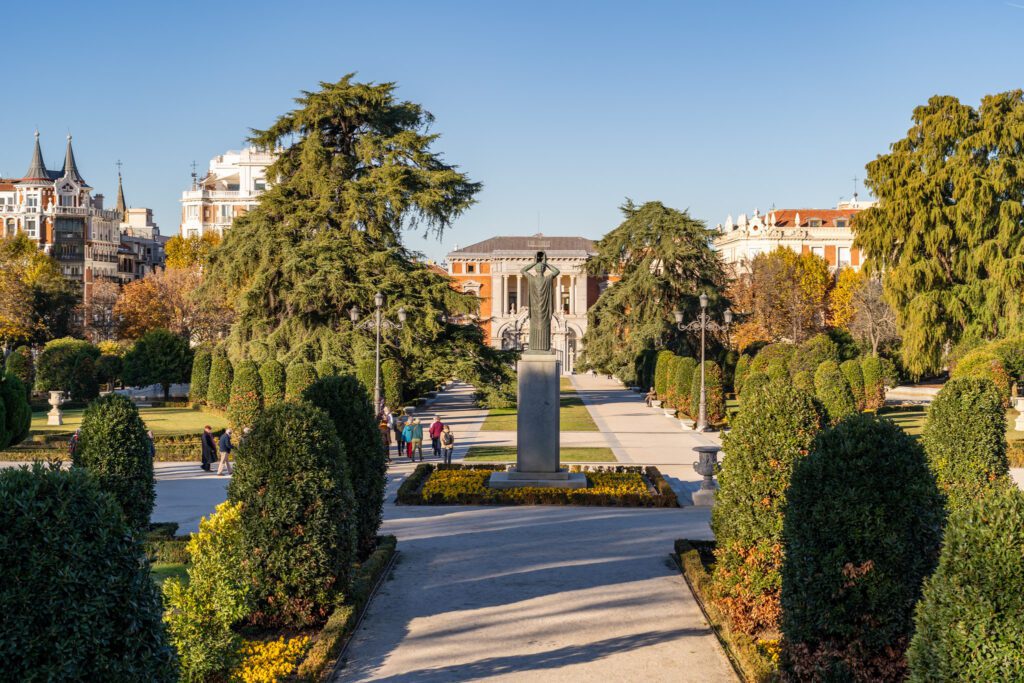
We love a good urban green space, and there are few better green spaces in Spain than Madrid’s Parque del Buen Retiro (which is generally called “El Retiro”), which sits directly east of the historic center of Madrid.
We have two contradictory thoughts on this park.
First, Madrid’s climate (hot, dry) makes it seem like this very green park should not be here because it seems like it’s more trouble to maintain it than it’s worth.
Second, it absolutely makes sense that this park is here when you consider that it was built as a summer palace and hunting ground for Madrid’s nobility, who clearly care very little (if at all) about the time, effort, and cost that goes into maintaining something.
The park is a really nice retreat after a visit to the Prado, where you can get some fresh air and make sense of what you just saw.
There are three parts of the park that we really love:
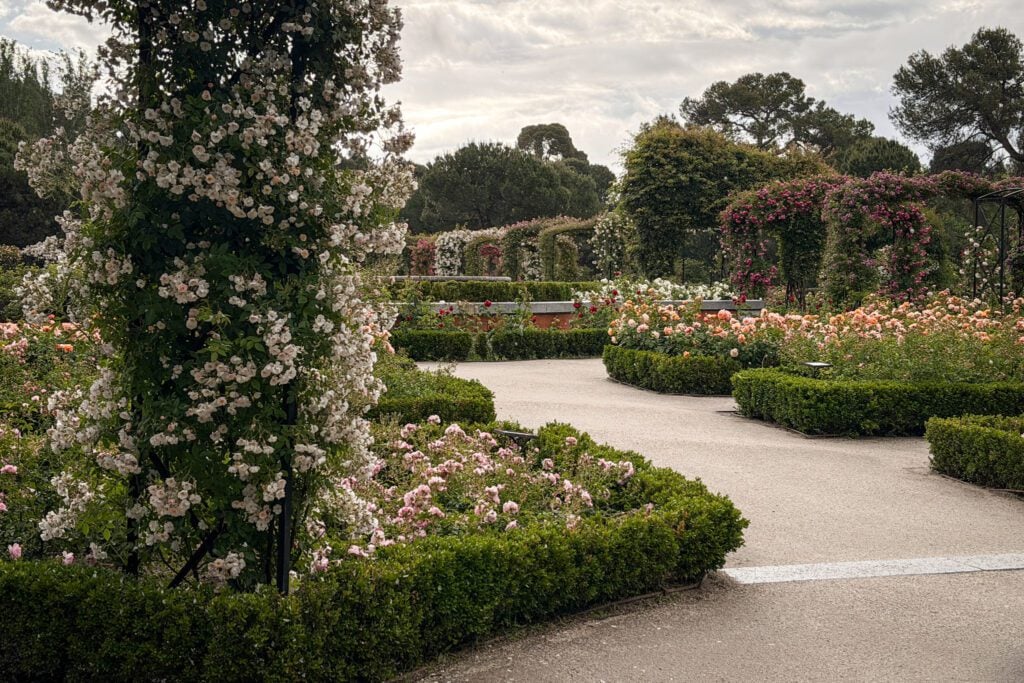
- The (very French) rose garden: Being from Portland, the City of Roses, we love a good rose garden. Ours has 10,000 roses of all different varieties and colors, and we go there often when it’s in bloom. While the number of roses is lower here, it makes up for that in its opulence, with a maze of manicured gardens and fountains that make it feel like you’re at a Royal Palace like Versailles. Find it here on Google Maps.
- The Palacio de Cristal: Inspired by the Crystal Palace in Hyde Park in London, we were struck by how much this looks like a giant greenhouse with its metal structure and glass paneling. Turns out, it was built for an exhibition on the colonization of the Philippines to display tropical plants (hence the greenhouse look). It’s free to go inside, though it has been under construction recently. Find it here on Google Maps.
- The Estanque Grande del Retiro: A big manmade pond in the center of the park, and we saw people rowing back and forth across the water on our early morning walk through the park on a recent trip. Guess there really isn’t any other water to speak of around Madrid! Across the pond on the eastern end, you have a big monument to King Alfonso XII with big, Roman-esque columns topped with a bronze statue of the king on a horse (surprise!).
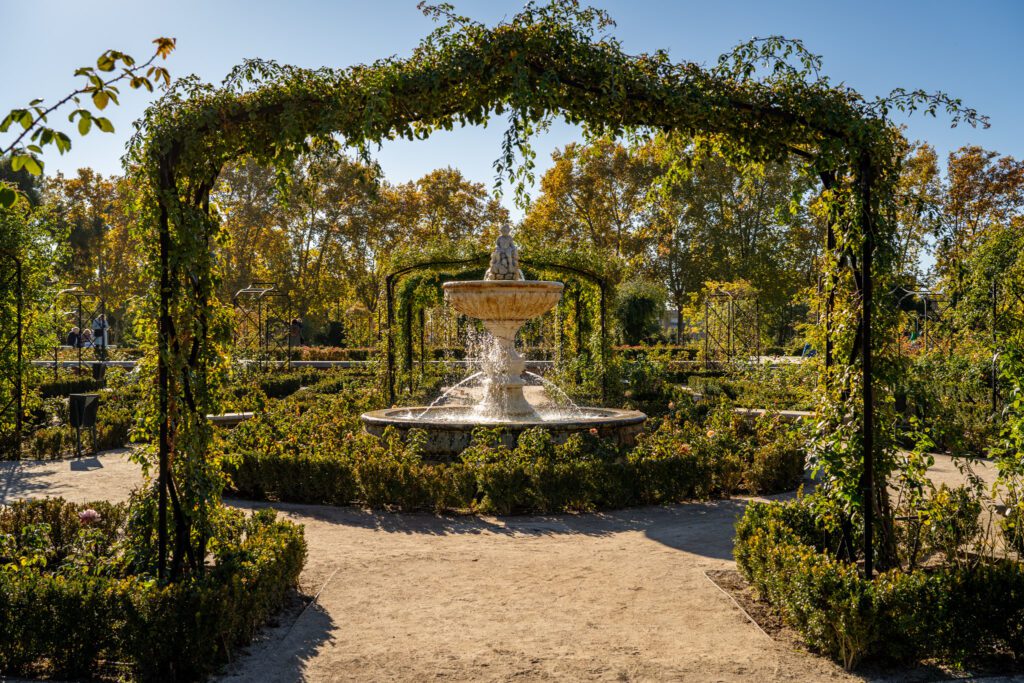
There are, obviously, many more things to see at the park, and it’s the perfect place for a good wander (or post-dinner passeggiata, if you will).
Walk Through Europe’s Largest Royal Palace
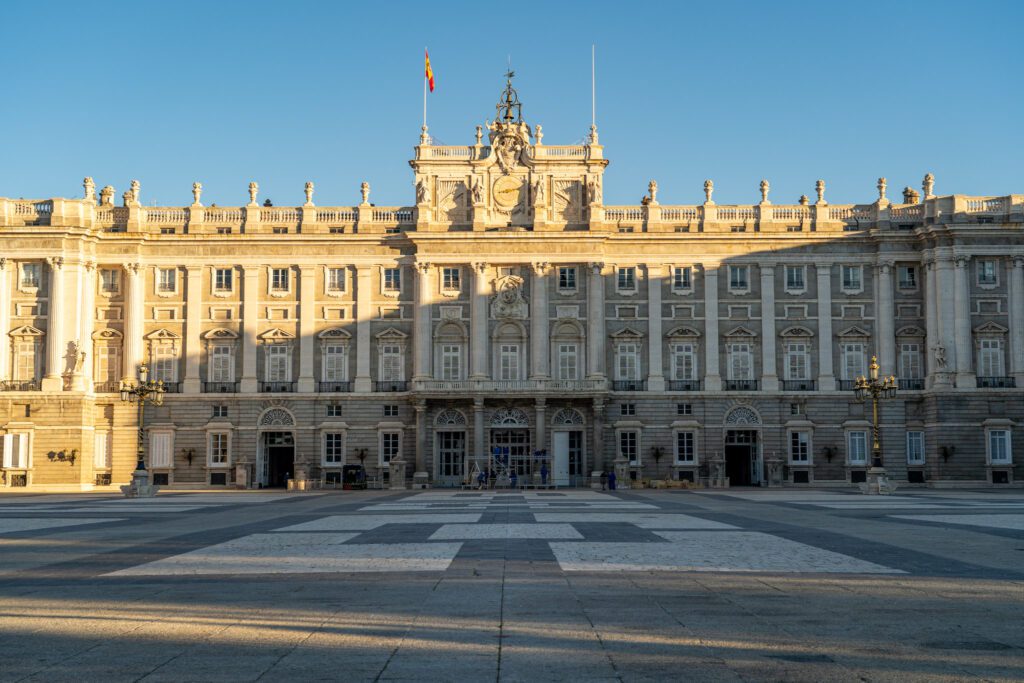
First of all, it’s worth noting at the top here that we have never actually set foot inside Madrid’s Royal Palace, which is the largest operating Royal Palace in Western Europe.
On paper, it’s the official residence of the Spanish Royal Family, though they’re rarely there at all these days.
The only time they’re in Madrid is when they’re hosting foreign dignitaries or holding state events.
Allow us to explain why we haven’t felt the need to go inside this monstrosity of a palace.
First of all, we’re not really “royal palace people” (just like we’re not “go inside every church” people).
That is especially true when the royal palace in question is, essentially, a bigger version of a palace we’ve been inside many times (Versailles, in this case).
Essentially, the brief for the current iteration of the palace (it has burned down multiple times) was “Versailles, but make it bigger.”
Which is not at all surprising when you learn that the person who ordered that construction was part of the Bourbon dynasty, a noble family that descends from…France.
Today’s Spanish king is, at his core, French, which is always funny to me.
They are descendants of the Duke of Anjou who won the Spanish crown after a brief war of succession in the early 18th Century, and has been on the throne ever since.
Anyway, back to the palace.
It is worth noting that this palace sits at the oldest part of the city, the site of the fortress (built in the 9th Century) that the Muslim Caliphates that inhabited Madrid in the Middle Ages used to watch over the road to Toledo.
After the Reconquista, it was consistently renovated and expanded until the 18th Century, when the new Bourbon king ordered the existing (very Hapsburg) palace demolished and a new, grander, French-er palace be built.
Unfortunately, the law said he couldn’t do that.
That is, until the existing palace mysteriously burned down on Christmas Eve while literally everyone inside was across the road at mass, leaving zero casualties and a very happy king who got to build his dream palace (though he died before it was completed).
Today, it’s essentially a museum, and is open to the public except when there’s an official state ceremony happening (which isn’t often).
Only a portion of the rooms are open to the public, but you can see the throne room, banquet hall, and royal apartments, among other things.
If you do want to visit the inside, make sure you buy your ticket in advance! The line to enter gets pretty gnarly, often wrapping the building and taking up to two hours to make it through.
You can easily skip this line with a little advance planning – all you have to do is go to the official website and book your tickets ahead of time. Do this as far in advance as you can – they do sell out.
If you’re not inclined to go inside, we would recommend a walk around the Jardines de Sabatini (here on Google Maps) on the backside, which are very pleasant.
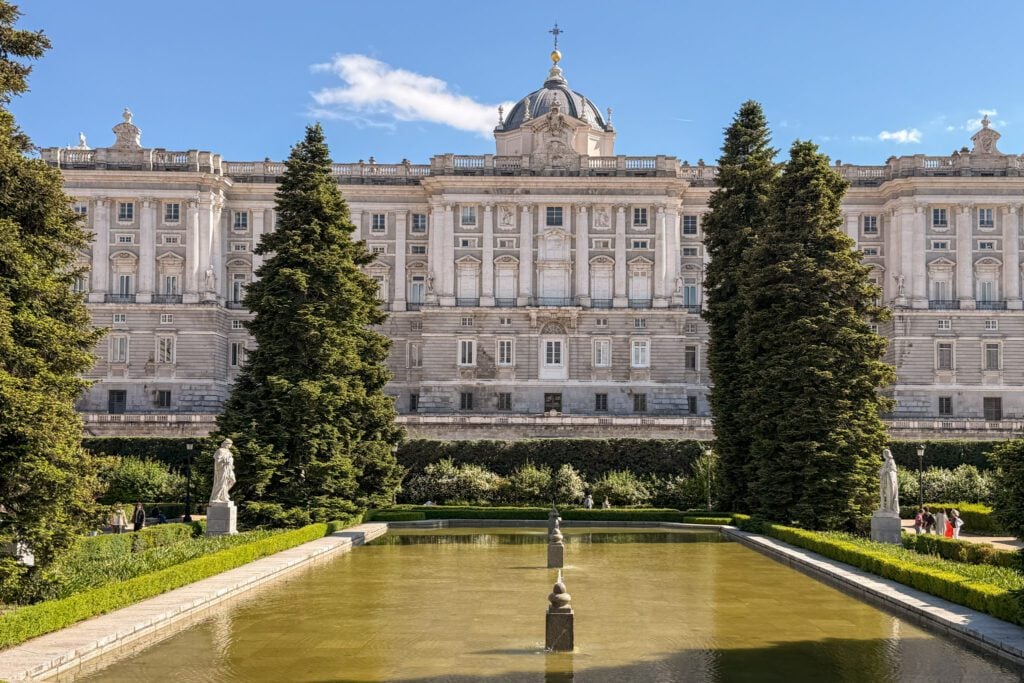
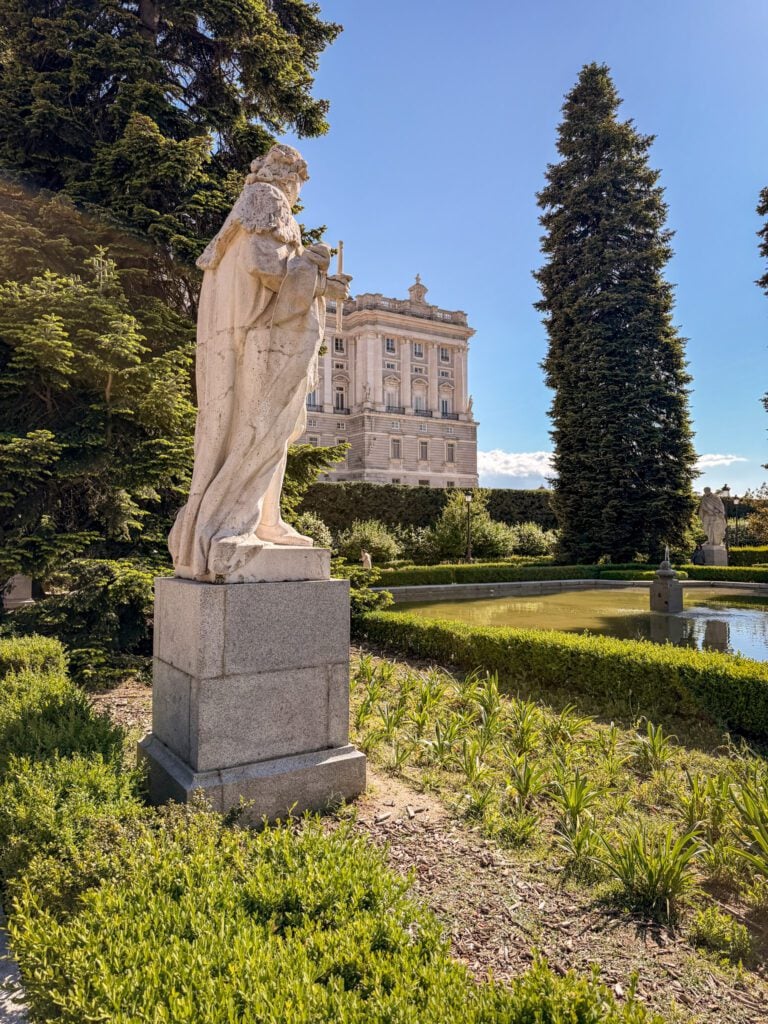
Pro-tip: It’s free to visit from Monday to Thursday between 4pm and 6pm, but lines are LONG, it’s packed, and the last entry is at 5pm. If you want to visit for free, you’ll need to show up around 3pm or so.
Take a Day Trip to Toledo, the Original Capital
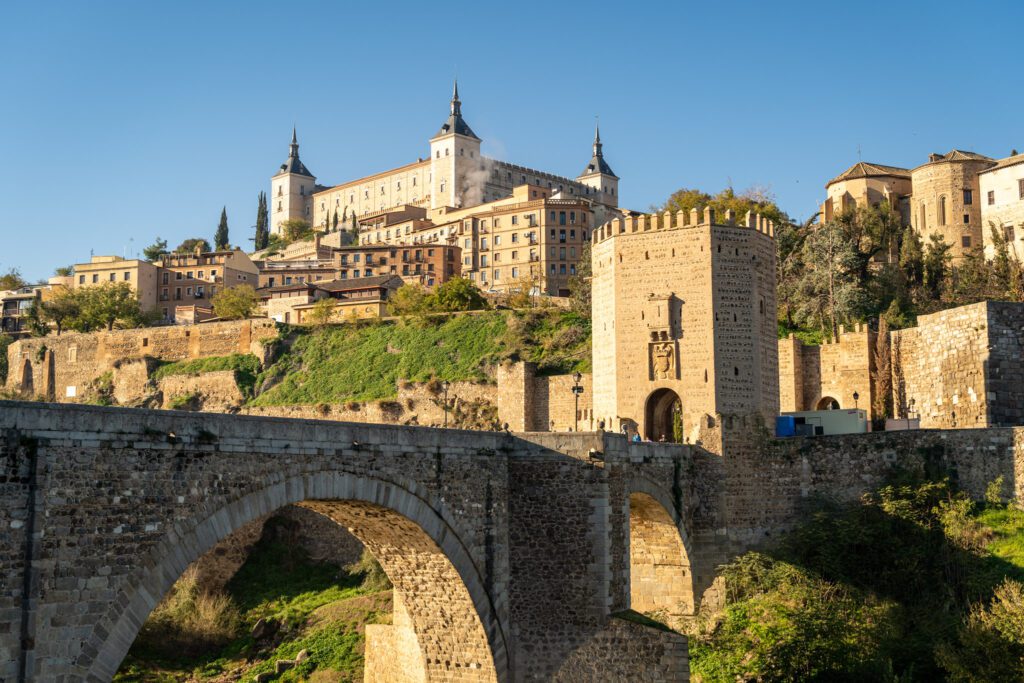
If you happen to find yourself with an extra day in Madrid and you’re not exactly sure what to do with it, I have a strong recommendation: take the short high-speed train ride to Toledo.
As we’ve already covered, Madrid was not a big city before the 16th Century. There were people around this area, sure, but only, like, a thousand of them.
The major city in the region was Toledo, which is in a much more strategic location on top of a hill right on the Tagus River (that’s the same river that hits the Atlantic in Lisbon).
At that time, Madrid was, at its core, a military outpost with a castle on the top of the hill (where the Royal Palace is today) built to protect the route to Toledo.
Then, Phillip II became king and had a little spat with the bishop in Toledo and decided to move his court to Madrid. Over the course of about 20 years, the population of Madrid went from a few thousand to almost 100,000 people.
There are multiple reasons to visit Toledo; it’s a gorgeous hilltop city that almost seems like it belongs in Tuscany, it’s one of the few places you can see an intact synagogue and mosque in Spain (thanks, Spanish Inquisition), and it has a couple of good museums (especially if you’re into history.
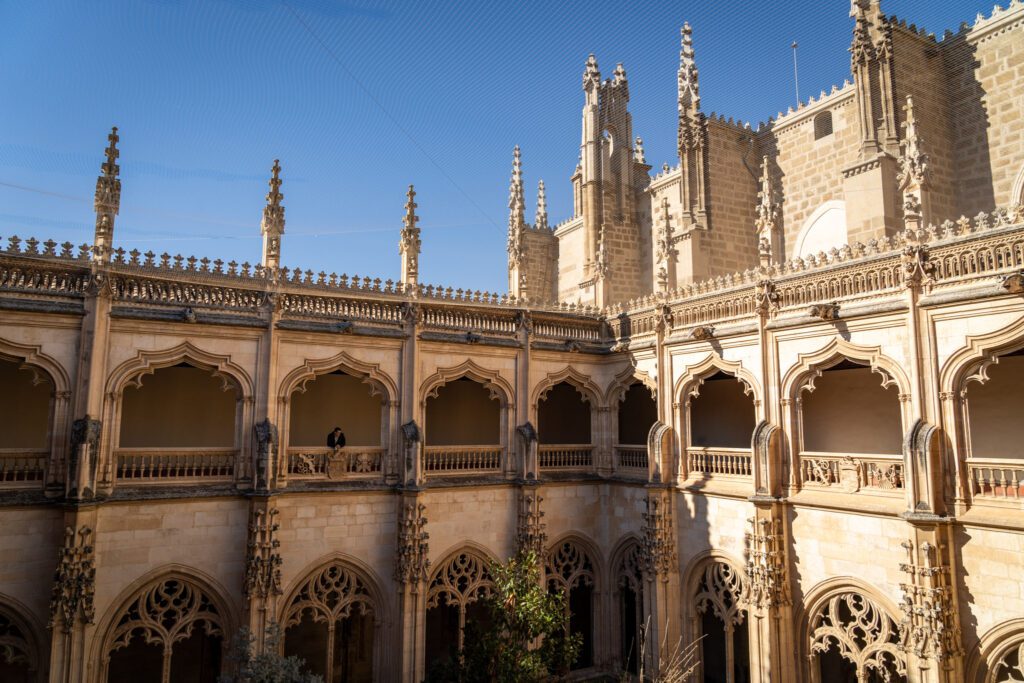
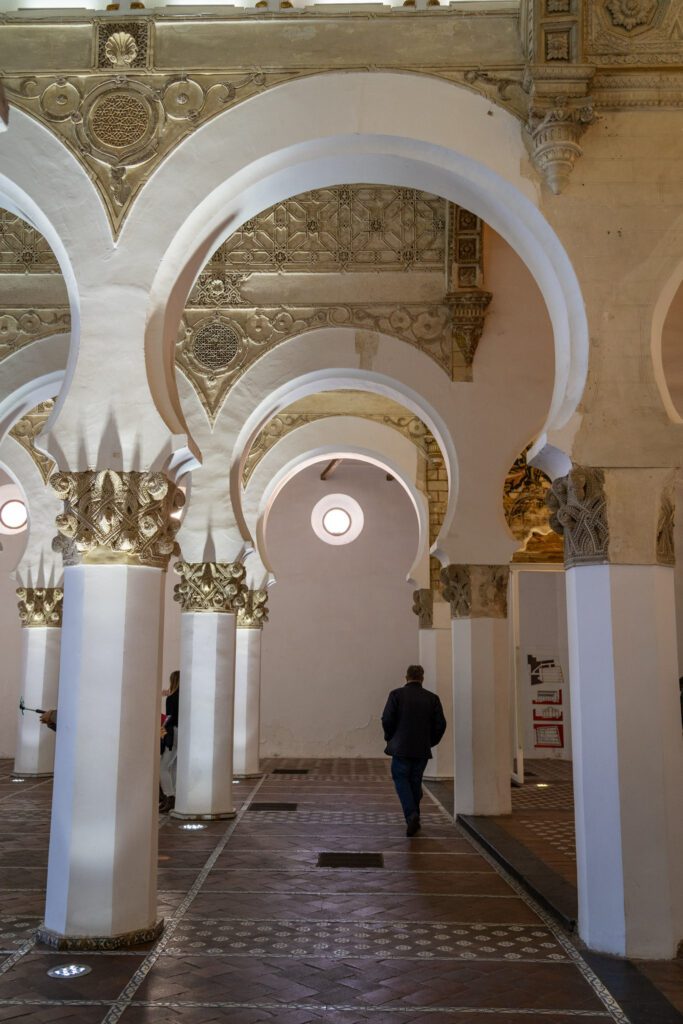
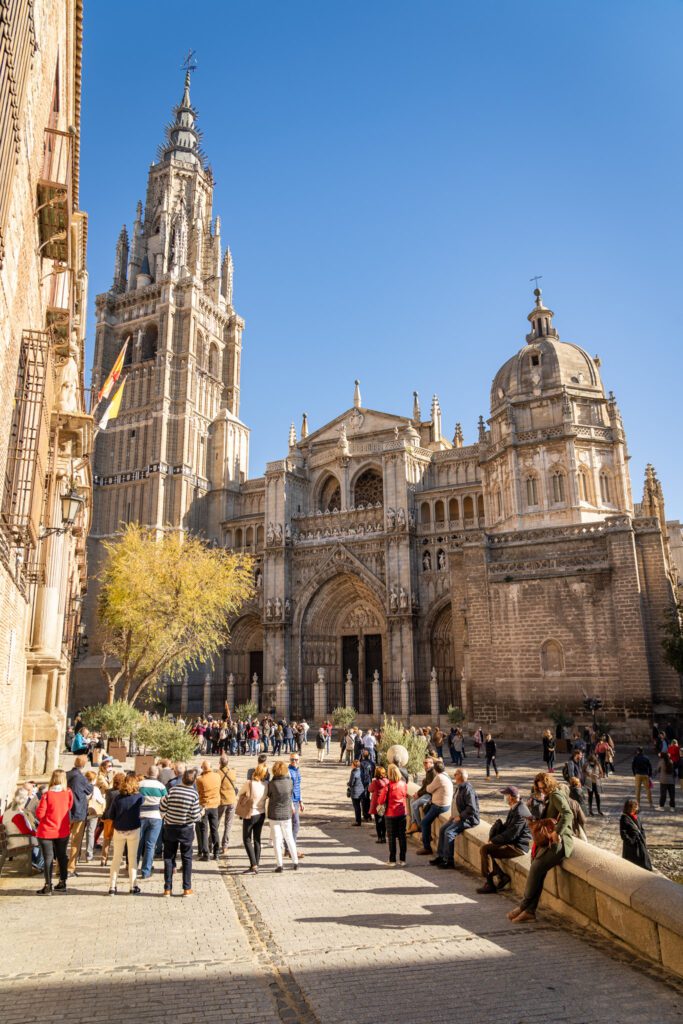
It also happens to be the perfect day trip destination because it has a high-speed train that will get you there in roughly 35 minutes flat from Madrid’s main train station (Puerta de Atocha).
Rather than cover everything here, like how to get there, what to do while you’re there, and more, we’ve put everything you need to know into our guide to planning a day trip to Toledo from Madrid, which you should read if you’re planning to head to Toledo during your trip.
Explore Madrid’s Coolest Neighborhoods
One thing we like about Madrid is the fact that its neighborhoods each have a pretty distinct look and feel to them.
In this section, we want to cover two of our favorite neighborhoods in Madrid – Barrio la Latina and Malasaña – that illustrate the contrast that exists within Madrid’s neighborhoods.
Barrio La Latina feels more overtly Spanish, with tapas bars and terraces packed with people enjoying tapas, vermut, and the sun.
While that also exists in Malasaña, the hip neighborhood just north of Gran Vía is more cosmopolitan and multicultural. If you’re craving some ramen, for example, you go to Malasaña.
Both are worth visiting, and we’re going to use this section to give you our favorite spots and discoveries in each.
La Latina: A Historic Neighborhood with Elite Tapas
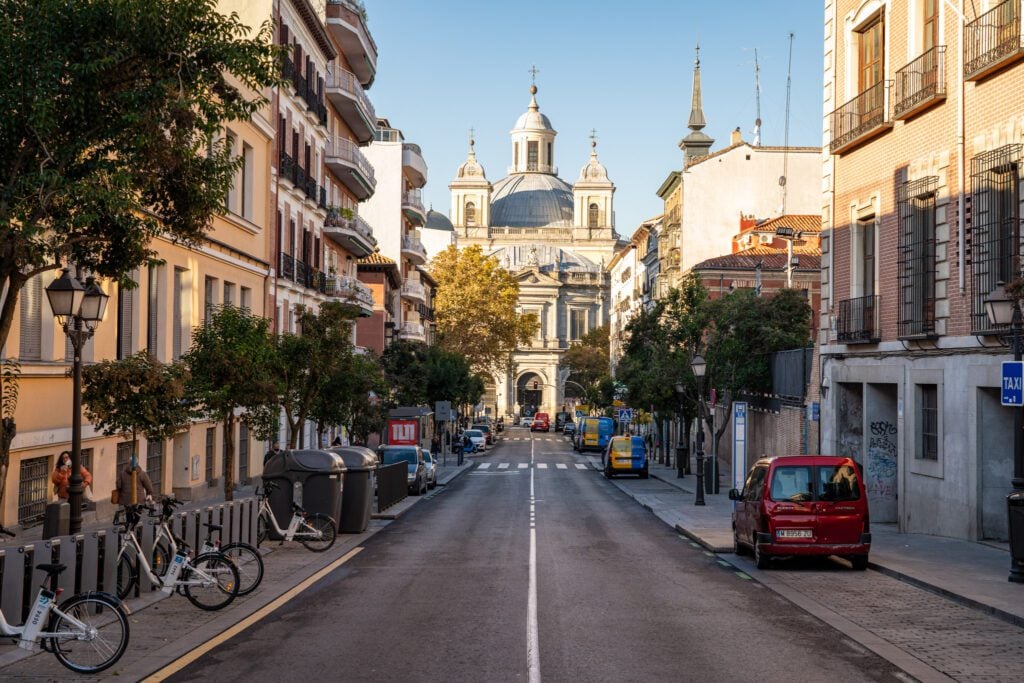
La Latina is a neighborhood on the southern side of Plaza Mayor that is most famous for Calle Cava Baja, the street that is lined with tapas bars (an excellent place for a tapas crawl – more on that in a second), but there is so much more to explore in La Latina.
The neighborhood is named after Beatriz Galindo (known as “La Latina”) who was a teacher of Queen Isabella (of Ferdinand and Isabella, the first Catholic monarchs in Spain, fame) and an important figure in the neighborhood’s history.
She founded a hospital here, and in return she got a neighborhood named after her.
Before we get to food and drinks, we want to quickly point you to the worthwhile Museo de San Isidro, which is free and is worth 30 minutes of your time.
It covers the history of Madrid from the first humans to present, and we enjoyed it.
The plaza just outside – Plaza de los Carros (here on Google Maps) – is also an exceedingly pleasant place to relax in the afternoon sun or on a warm summer evening, in the shadow of the dome of the Iglesia de San Andrés Apóstol.
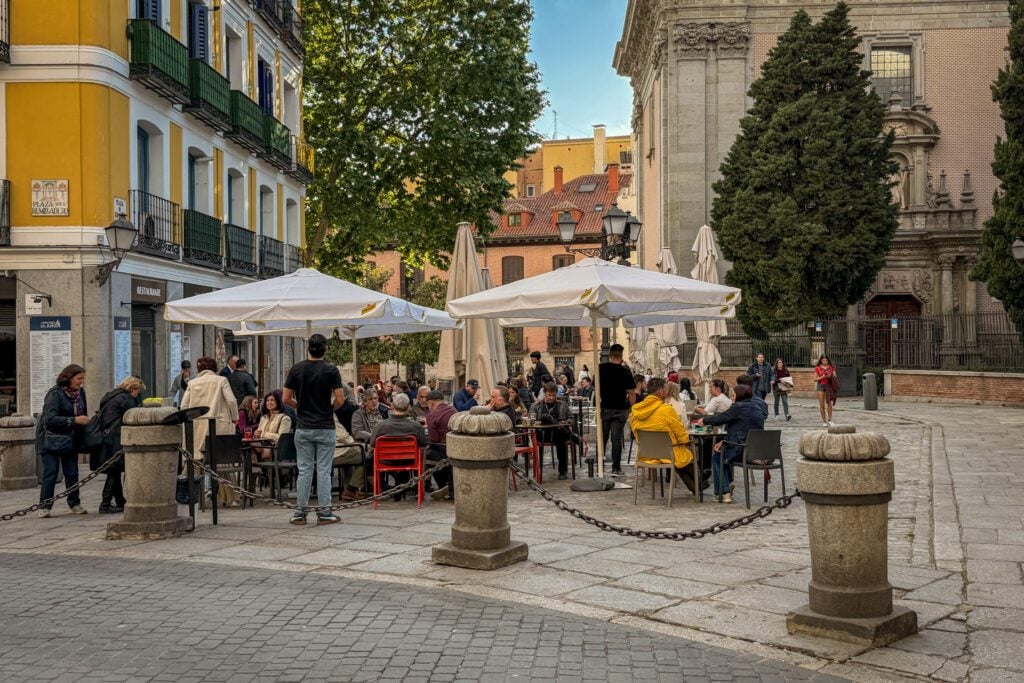
The other non-food activity in La Latina that’s worth calling out is the massive flea market – El Rastro – that takes place on Sundays and holidays. You can find it here on Google Maps.
I do want to say that I was disappointed by the fact that it seems like a bunch of cheap knick-knacks you can buy online for pennies.
Unless you’re really into the flea market vibe, I think there are better ways to spend your time in Madrid. Go early (9-10am) for thinner crowds.
Now, let’s talk about food.
There are two categories we’re going to (briefly) cover here; Calla Cava Baja and Vermut bars.
First, let’s talk about tapas on Calle Cava Baja.
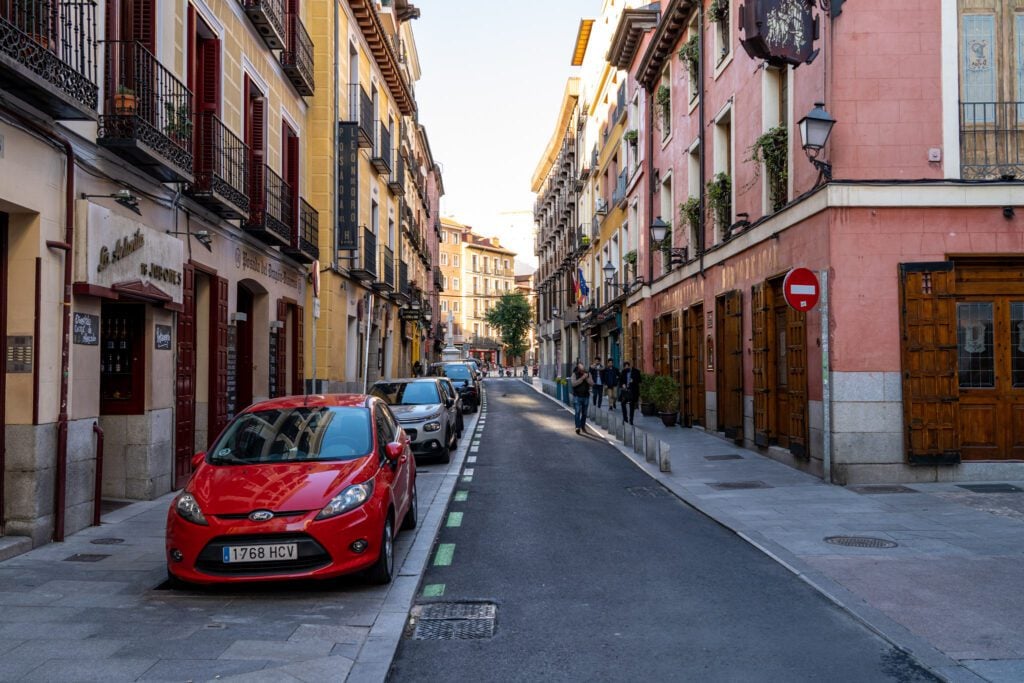
As we already mentioned, Calle Cava Baja has, perhaps, the most famous concentration of tapas bars in the entire country, and you can form a nice little self-guided tapas crawl where you order a drink and a couple of bites at each place.
Here are some spots we’ve gotten specific recommendations for, in no particular order: Casa Lucas, Taberna Tempranillo, and La Perejila.
If you need to eat gluten free (like Matt), head around the corner to Lalina for 100% gluten free tapas (the entire restaurant is gluten free).
Next, let’s talk about Spanish vermut, which was one of our favorite discoveries on our first trip to Spain together years ago (and we still rave about it whenever someone brings up Spain).
Now, you can totally order vermut at any bar around the city. What you usually want is “vermut de grifo” (vermut on tap).
However, what we really like to do is go to a place that specializes in the thing we’re looking for, and in this case there are several good vermut bars in the heart of La Latina.
The one we really liked on our last trip was La Vermudena (here on Google Maps), which we walked by on our way to spend an evening in La Latina and stopped in to bask on their sunny patio with a couple of glasses of vermut.
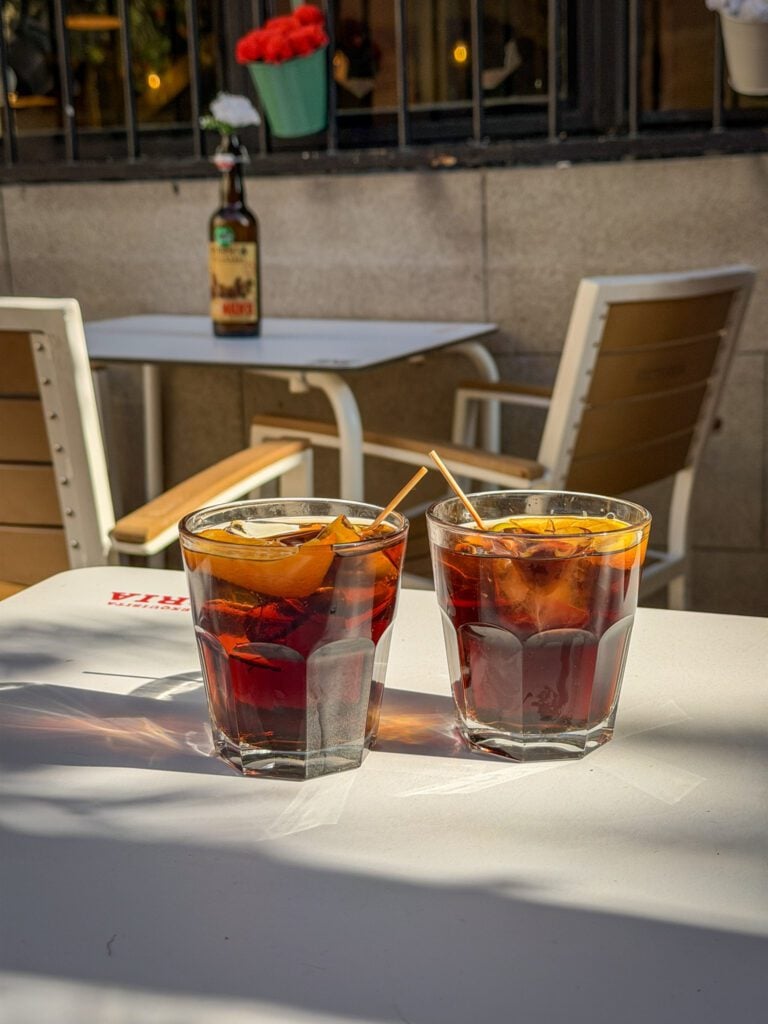
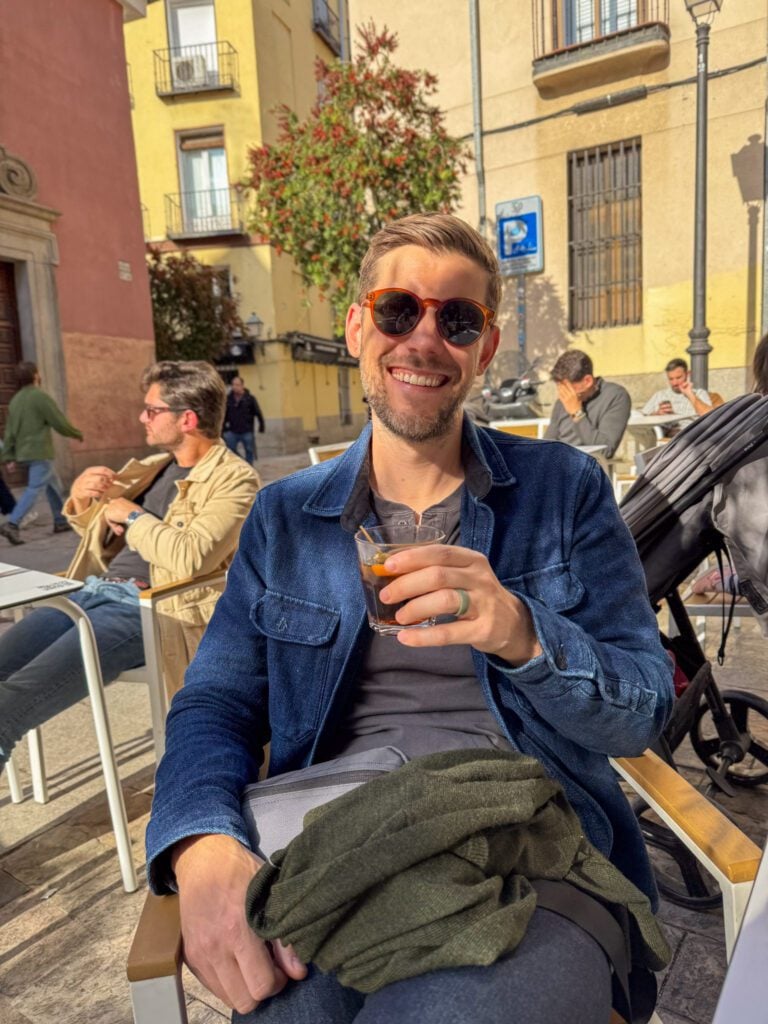
They have a bunch of different vermuts on tap, and some nice small bites to go along with them (including gildas, our favorite discovery in Basque Country on that same trip).
The other one we walked by is Vermutería La Bolita Negra (here. on Google Maps), which is right on Calle Cava Baja and also has an extensive menu of vermut accompanied by small bites.
Malasaña: An Enticing Blend of Hip and Historic
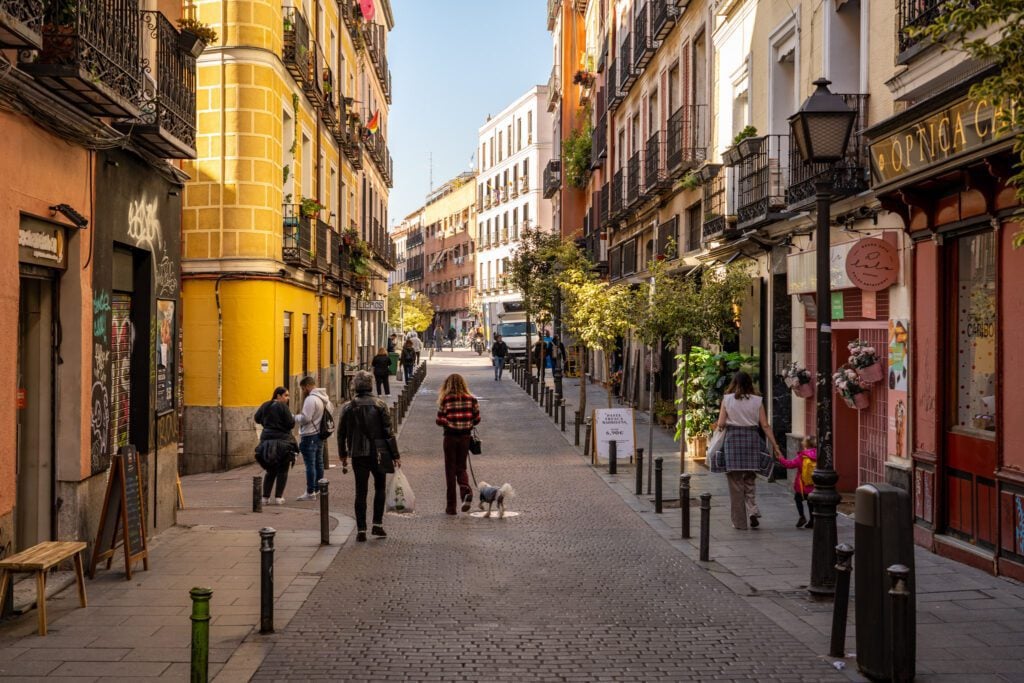
Malasaña is an excellent contrast to La Latina that illustrates the differences between the areas on the north and south sides of Sol and Gran Vía.
The southern side is more historic, mostly because that’s the oldest section of the city that goes back to Madrid’s early history (Plaza Mayor, for example, was the market square of Madrid in the Middle Ages).
The neighborhoods on the northern side of Gran Vía tend to feel more modern, both in terms of architecture and urban design (more regimented grid systems, for example) and in terms of the types of bars and restaurants you’ll find.
That’s not to say that there’s zero history in Malasaña. In fact, the contrast between old taverns and hip matcha bars is part of the thing that we think makes it unique.
If you want tapas, go to the area around Plaza Mayor and La Latina.
If you want sushi, ramen, arepas, matcha lattes, pizza, or anything but tapas, go to Malasaña.
First, like we did with La Latina, we want to point you towards a non-food attraction that’s worth a visit.
In this case, it’s the Museo de Historia de Madrid, which is free to enter and is a nice way to learn about the story of Madrid.
With that out of the way, let’s talk about three things in Malasaña: coffee, food, and drinks on a terrace.
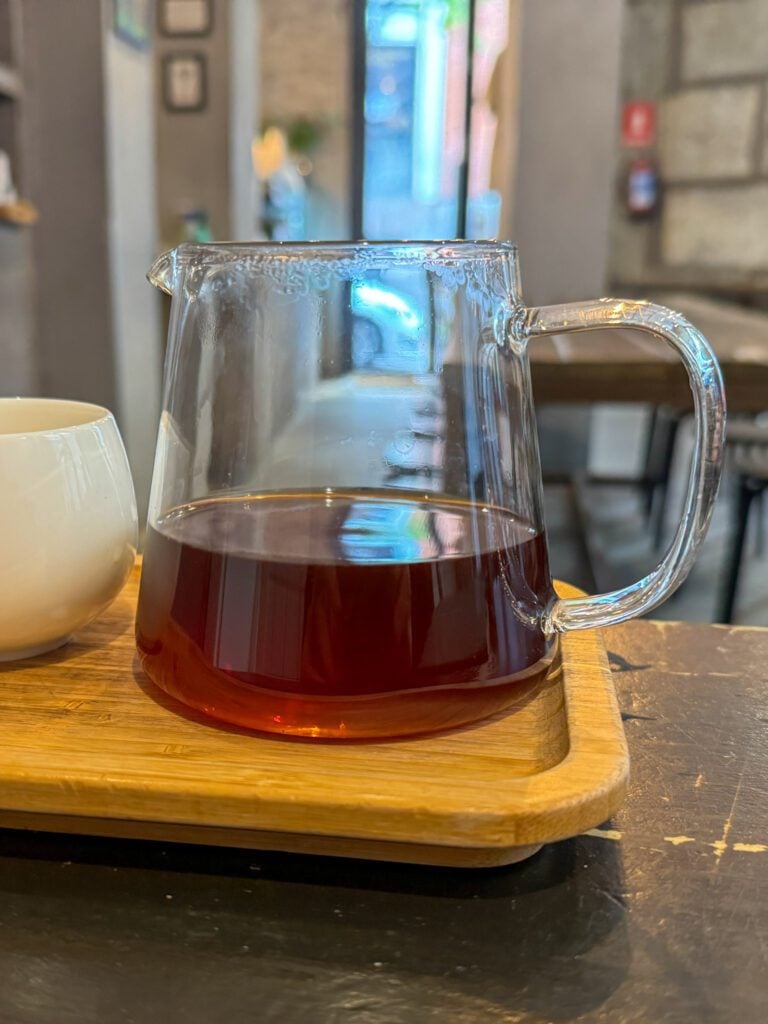
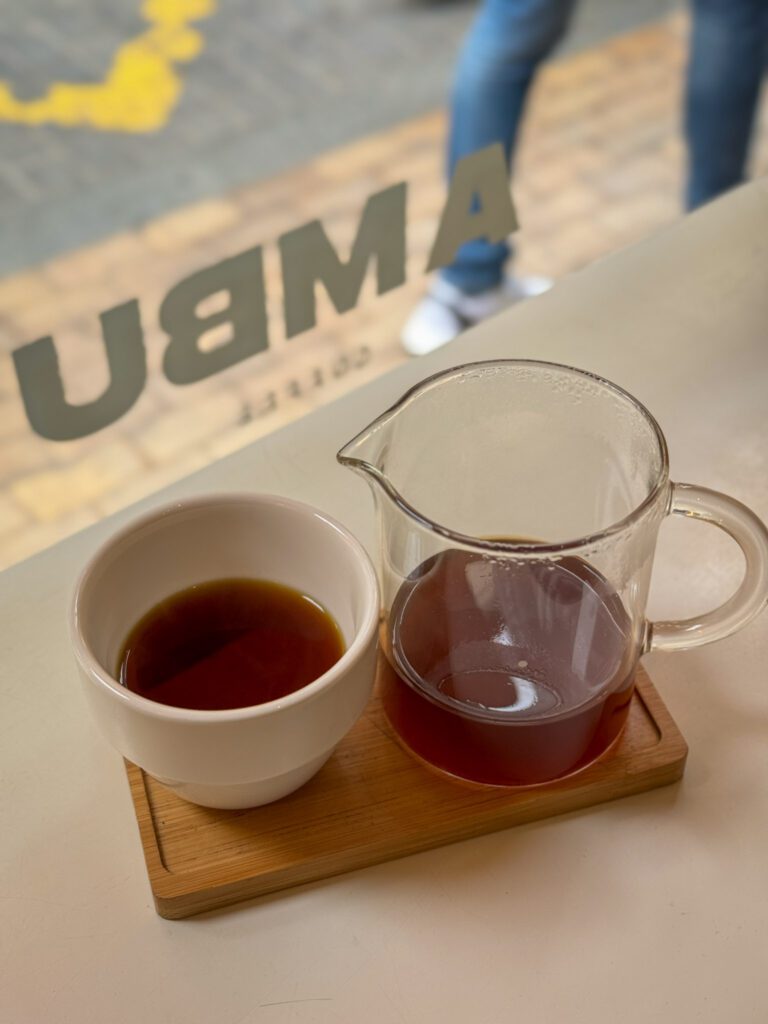
First, let’s talk coffee. Matt is a big coffee nerd, and spends an inordinate amount of time researching and wandering neighborhoods in search of a city’s best coffee.
If you’re into coffee, Malasaña is where it’s at (with a few exceptions). There are three places that are in my top five spots in Madrid for specialty coffee a handful of blocks from each other: Ambu Coffee, HanSo Café, and Masamune.
All three use great beans that rotate, but I saw roasters from all over Europe, including Madrid.
Next, let’s talk food.
Like we already mentioned, the food scene here is significantly more diverse, and we’re going to focus on food other than tapas because that’s something somewhat unique to this area (if you’re looking for a historic bar, go to Bodega de la Ardosa).
If you need to eat gluten free, run (don’t walk) to make a reservation at Okashi Sanda, an excellent dedicated gluten free Japanese restaurant that is my #1 gluten free recommendation in Madrid (if not the entire country). Order the yakisoba.
Other recommendations we’ve gotten (NOT gluten free) are NAP for Neapolitan pizza, Vira Vira for gyros, and La Duquesita (for pastries). For cocktails, go to 1862 Dry Bar.
Last, let’s talk about grabbing a drink or three on a plaza, which is a quintessential Madrid experience.
Part of why we love Malasaña is that between 7pm and 2am, the whole area is absolutely buzzing (it’s a nightlife hub along with Chueca, which is directly to the east).
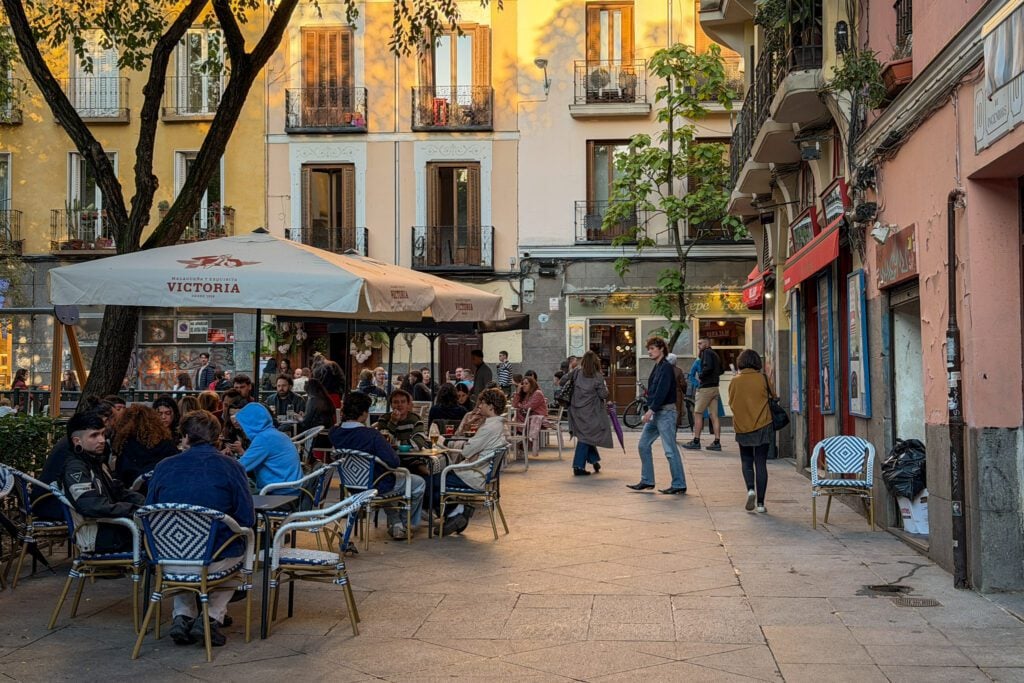
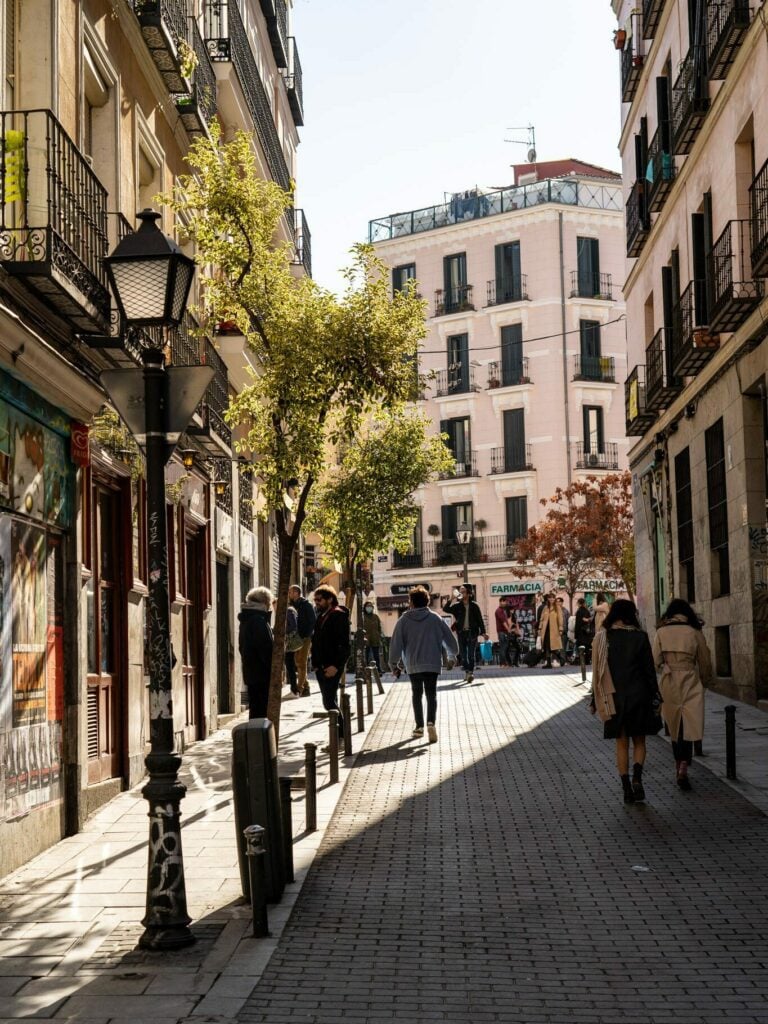
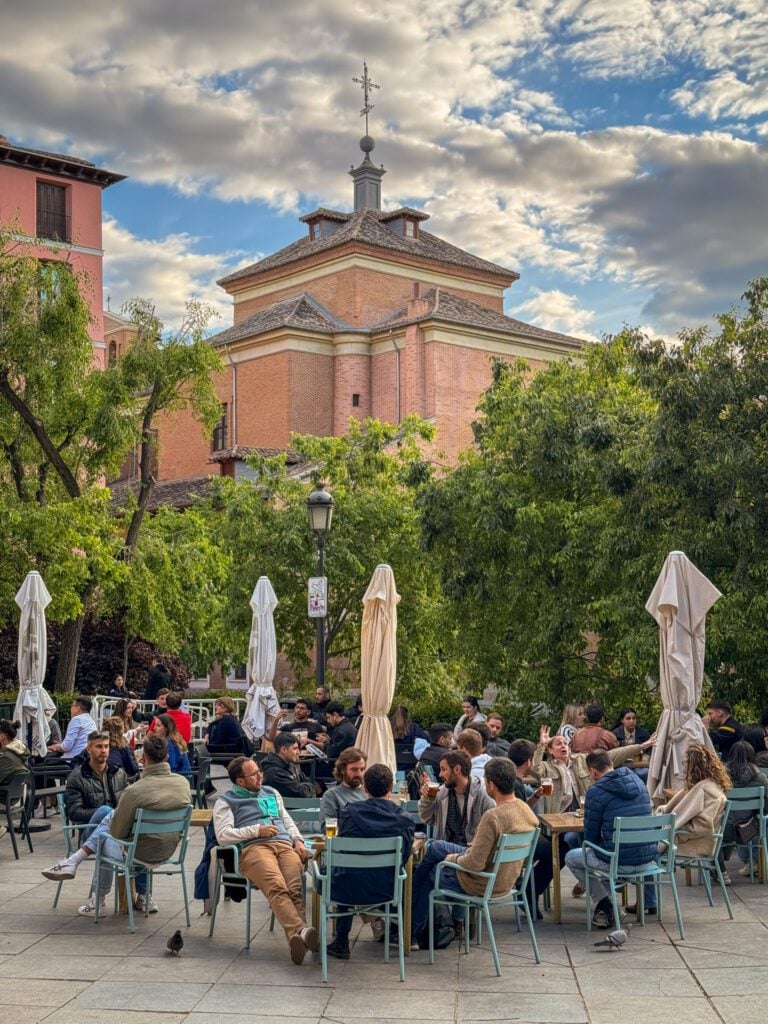
As you walk around, you’re sure to stumble onto a plaza with terraces that belong to the bars and restaurants nearby. Stop, grab a drink, and settle in for some top tier people watching.
In particular, we like the historic Plaza del Dos de Mayo (here on Google Maps) and Plaza Juan Pujol (here on Google Maps), but there are tons of other plazas in the neighborhood to discover.
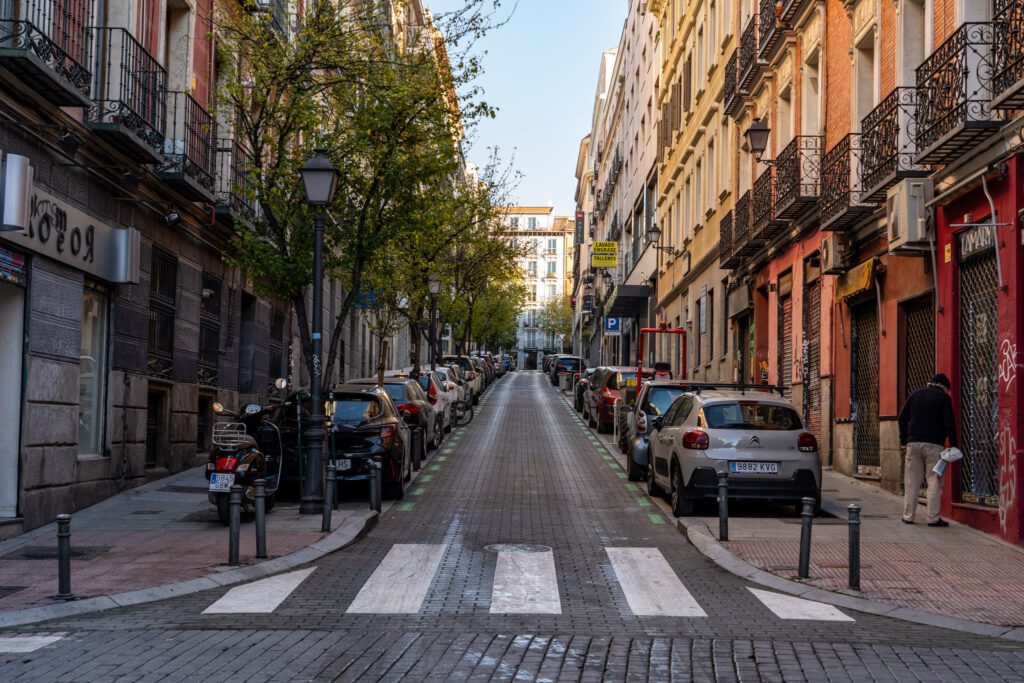
Catch a Football Match
If you didn’t already know, Spain is a fútbol country. Nearly everyone we meet in Spain is crazy about fútbol, which is great news for Matt, who is a big nerd de fútbol.
There are two huge teams in Madrid – Atlético de Madrid and Real Madrid – who both play in big stadiums just outside the city center.
If it were up to me, I’d choose to go see Atlético, the more authentic experience of the two just because Real Madrid is one of the biggest teams in the world.
But the reality is that you likely don’t have a choice because they don’t play that many games at home each season and, in this case, beggars can’t be choosers.
You can check the Real Madrid schedule here, and the Atlético Madrid schedule here.
Getting tickets for a game in Spain is a little more complicated than just hopping on SeatGeek and buying them.
First of all, you’re going to want to avoid third party platforms because they’re often a scam (especially for a team like Real Madrid). Instead, buy them straight from the club.
The challenge becomes the fact that the local fans have first crack at tickets before they ever reach the general public, so big games will sell out before you even have a chance to get tickets.
Lucky for you (and unlucky for normal supporters of the club), bigger clubs also generally have a selection of (very expensive) tickets for tourists that you can usually find.
To get tickets, you’re going to want to go to the ticketing portal directly on the club’s website.
Tickets go on sale in waves, with earlier access for supporters of the club, and tickets are released to the general public only after those phases are complete.
You should know that tickets for the most in-demand matches, like Real Madrid vs. Barcelona (or Atlético) are going to sell out to local fans before they ever get to the phase where you can buy them.
Generally speaking, tickets for matches hit the market about a week before the match, which can make planning a little bit difficult.
I will say that I have found that as you get closer to the day of the match, more tickets tend to become available, so keep checking even if you don’t have luck right off the bat.
If you’ve never been to a match in Europe, it’s quite the spectacle. Singing and chanting all game long, huge cheers, and more than a few shenanigans make it a very entertaining 90 minutes or so, even if you’re not into the sport itself (like Alysha).
If, like us, the dates don’t quite line up while you’re in Madrid, then you can take a tour of the stadium to get a feel for what it’s like.
I, Matt, did this up in Bilbao, and it was a fun way to learn about the fan culture and see all the behind-the-scenes stuff like the media room, the locker room, and get to step on the field (really just the sideline, because they don’t want you ruining the real grass pitch).
Step Inside One of Europe’s Youngest Cathedrals
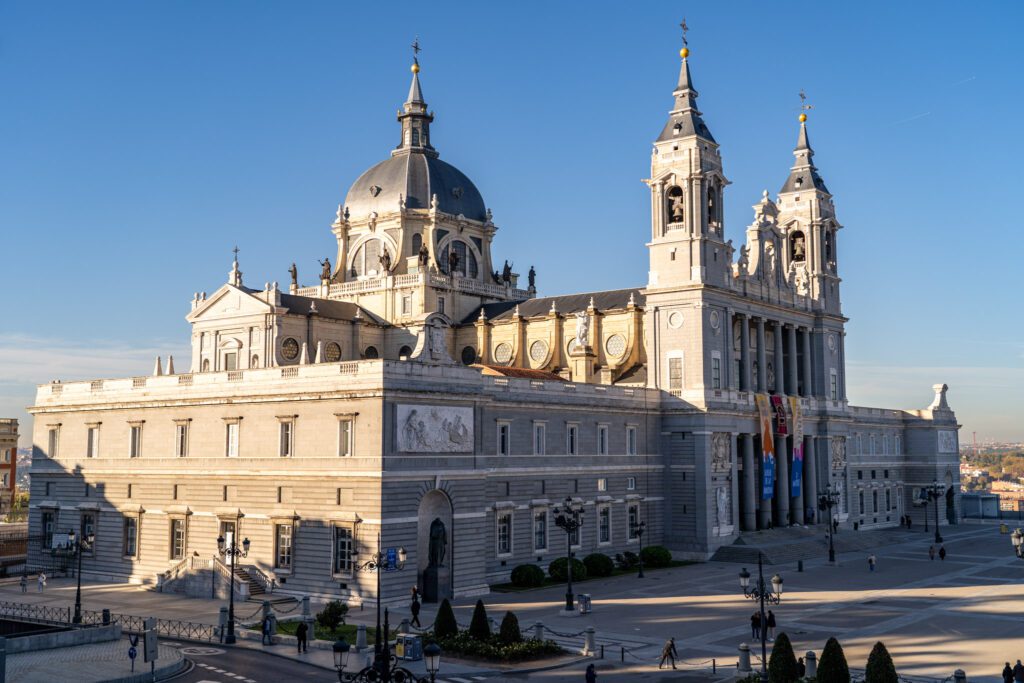
You may have a certain idea in your mind’s eye about what the cathedral in the capital of one of the most Catholic countries in Europe might look like.
Grand. Old. Covered in gold. You know, like all the big cathedrals in places like Italy and France.
Well, this cathedral is, uh, not that.
If you’ve taken Lexi’s walking tour, then you might already know the reason for this.
Spoiler alert: Madrid was not the main city in central Spain until relatively recently (by European capital standards), and even when it became the capital of Spain, the archbishop was still seated in Toledo (the old capital).
This cathedral is almost 35 years old, consecrated in 1993, which makes it one of the youngest cathedrals in Europe.
And the design sort of reflects that. The interior feels very modern, with extremely colorful and beautiful stained glass (thanks modern technology) and an odd, modern, geometric pattern covering the ceilings.
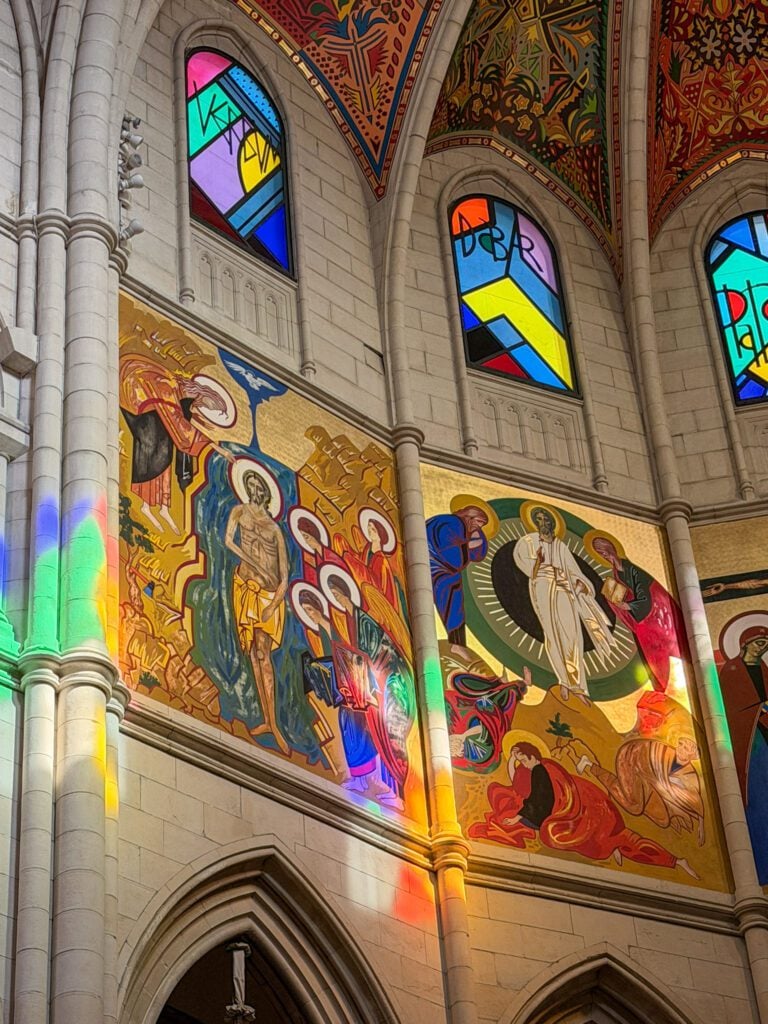
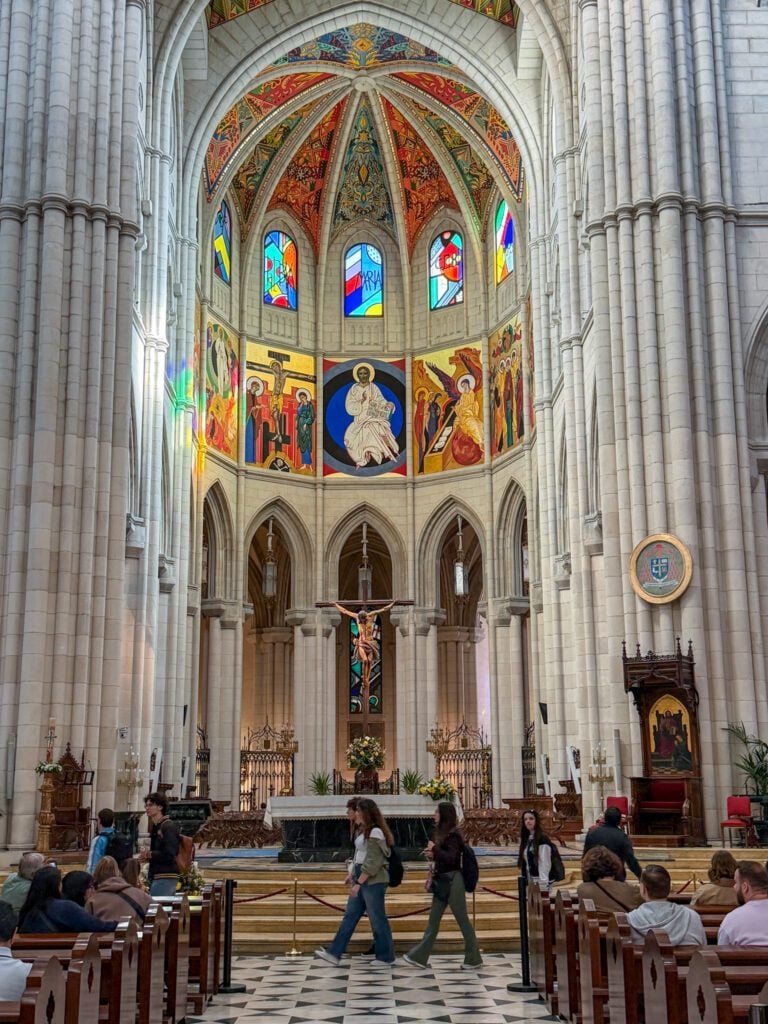
The exterior is a mix of different styles, which is pretty unsurprising given it took more than 100 years to build from start to finish.
The good news is that the interior is free to enter, so the barrier to entry is relatively low. No need to go into the crypt or pay for entry to the other parts, we think.
We did enjoy poking our heads in and walking around the main altar, especially in the afternoon when the sun came through the western side of the cathedral and lit up the stained glass, casting colorful shadows across the interior.
Is it our favorite cathedral in Europe? Probably not, that award goes to either the incredible detail at La Sagrada Familia in Barcelona or the stunning mosaics at Basilica di San Marco in Venice.
Is it an interesting example of the relative youth of Madrid compared to other major European cities? We think yes.
Planning a trip to Spain? We’d love to help!
Here are our other Spain travel guides to help you plan an incredible trip (even if you have to eat gluten free!).
If there’s no link below, it means we’re still working on it – long, in-depth guides take time! We’re working on it, though, we promise.
The first place to start, if you haven’t already found them, is with our detailed itineraries. We have one shorter version for 7 days in Spain, one version that covers 10 days in Spain (a good middle ground, we think), and one longer version for two weeks in Spain (with ideas for more and less time in both guides).
Our Barcelona Guides
- What to do in Barcelona (as a First Timer)
- How to Plan an Amazing 4 Day Barcelona Itinerary
- Where to Stay in Barcelona: A Complete Guide for First Timers
- 12 Things to Know Before You Visit Barcelona
- Gluten Free Barcelona: A Complete Guide to GF Restaurants + Bakeries
- Where to Find the Best Specialty Coffee in Barcelona
- How to Plan an Incredible Day Trip to Montserrat (from Barcelona)
Our Madrid Guides
- What to do in Madrid (as a First Timer)
- How to Plan an Amazing Madrid Itinerary (2 Days)
- Where to Stay in Madrid: A Complete Guide for First Timers
- 12 Things to Know Before You Visit Madrid
- Gluten Free Madrid: A Complete Guide to GF Restaurants + Bakeries
- How to Plan an Amazing Day Trip to Toledo (from Madrid)
Our Sevilla Guides
- Our Favorite Things to Do in Seville (for First Timers)
- A Perfect 2 Day Seville Itinerary (for First Timers)
- Exactly Where to Stay in Seville (The Best Areas + Hotels)
- Gluten Free Seville: Our Favorite GF Restaurants & Bakeries
The Rest of Spain
