
An Amazing Olympic National Park Itinerary (3 Days)
Olympic National Park is, perhaps, the most diverse national park in the entire country.
Within its sprawling 1,400 square miles, you’ve got high alpine environments, rugged beaches on the Pacific Ocean, the best examples of the coastal temperate rainforest, and plenty more.
We’ve been to Olympic National park multiple times now, and each time we discover something new, which is a testament to the vastness and sprawling nature of the park.
That size and sprawl has important implications for planning your trip (where to stay to minimize driving, for example), and we’re going to use our experiences in the park over the past few years to give you the information you need to plan an incredible trip.
In this guide, we’re going to talk about everything you need to know to plan an amazing Olympic National Park itinerary.
Here’s what we’re going to cover:
- A few important logistics to keep in mind as you’re planning, like how to organize your trip to minimize unnecessary driving and seasonal considerations to know before you go.
- Our favorite things to do in the park and how to put it all together to form an itinerary to make the most of your time (in this case, three days).
- Ideas on what to do with more or less time in Olympic National Park.
Throughout the guide, we’ll share our favorite hikes, viewpoints, waterfalls, and more based on our numerous trips to the Olympic Peninsula to help you plan your Olympic National Park adventure.
Sound good to you? Let’s get into it.
Disclaimer: Some of the links in this post, like hotel links, are affiliate links, meaning at no additional cost to you, we make a little bit of money if you click through and book. That being said, we would never recommend something to you that we don’t stand behind 100%.
A Quick Olympic National Park Geography Overview
Before we get into any specifics, it’s important that we take a second to talk about the park’s geography because it certainly has implications for your trip planning.
Remember how we said that the park spans roughly 1,400 square miles AND that those miles aren’t always connected to each other?
Usually when you think about a national park, you think about a section of land with a clear boundary that delineates the park from the surrounding areas.
With Olympic, it’s a little different.
The park is both big and fragmented, with non-park land cutting in and out of the park’s boundaries to form confusing borders and chunks of the park that are seemingly cut off from the other parts.
For example, there’s an entire city – Forks – that is both technically outside the park boundaries, but right smack dab in the middle of where the park should be just based on location.
We like to break Olympic National Park up into five distinct regions; Hurricane Ridge, The Sol Duc Valley (which includes Lake Crescent), the Northern Pacific Coast (up towards Neah Bay), the Central Pacific Coast, and the Rainforests (Hoh and Quinault).
Here’s a map to help you visualize what we’re talking about – you can see that Highway 101, the main road through the park, runs from the northeastern corner in Port Angeles, out to the coast, and then south through Forks to Kalaloch.
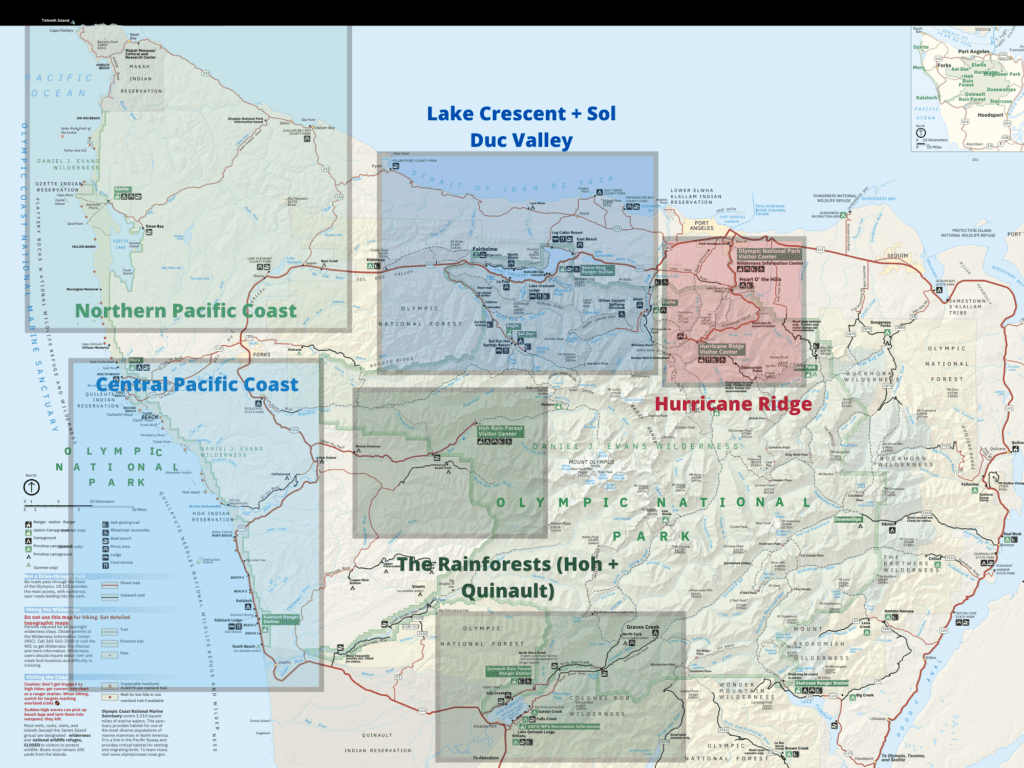
The biggest implication to consider here is the fact that, because of the size and spread out nature of the park’s regions, drive times can be LONG.
For example, the drive between Hurricane Ridge and the Hoh Rainforest – the two most popular parts of the park – takes two hours and 30 minutes, one way.
To avoid spending your entire trip in the car, our strong recommendation is to split your time in the park in half, basing yourself in one part of the park for the first half of your trip, and then moving to another part of the park for the remainder.
The two places we’d recommend basing yourself around are Port Angeles (& nearby) and the small town of Forks, and we’ll cover both in the guide below.
The area around Port Angeles at the northeastern corner of the park gives you good access to Lake Crescent and Hurricane Ridge, while Forks is central for the entire Pacific coast and the Hoh Rainforest.
If you can’t make that work, it’s not the end of the world, but you’re probably going to be spending a little more time in the car to get from place to place.
How Many Days Do You Need?
Another implication of the sheer size and layout of the park is that, unlike some of the smaller national parks (like Bryce Canyon or Arches out in Utah, for example), we think you need a minimum of three days to cover it all.
That recommendation is based on our experiences both exploring Olympic National Park over the past few years (we’ve been multiple times), but also our broader experiences we had over two years when we lived in a Honda Odyssey on a never ending road trip that hit all of the national parks in the western US.
Three days gives you enough time to see all five regions that we talked about by spending one day between Hurricane Ridge and the Sol Duc Valley, one day on the northern Pacific Coast (which requires a lot of driving to access), and one day split between the rainforests and the Central Pacific Coast.
If you have less than three days, the first thing we’d cut is the northern Pacific Coast.
While it’s beautiful, it does require a ton of driving to get up there and we think your limited time is better spent in the other regions.
One other note: We would absolutely not recommend doing Olympic National Park as a day trip from Seattle.
Because of the layout, the only realistic piece of the park you could see with a day is the Sol Duc Valley and Hurricane Ridge. Anything else is going to require around four hours of driving in one direction.
Which is fine – those places are beautiful – but you’d be missing out on the diversity of landscapes that really makes the park special.
Where to Stay in Olympic National Park
Planning out where you’re going to stay is another piece that requires some strategic planning to avoid spending your whole trip in the car.
We have an entire guide dedicated to the topic of where to stay in Olympic National Park, which you should go read for far more detail than we’re able to cram into this brief summary.
The high level summary here is that we think you should take the total number of nights you have in Olympic National Park and split it in half, spending half of your time up in Port Angeles (good access to Hurricane Ridge and the Sol Duc Valley) and the other half near Forks (good access to the coast and rainforests).
If you find yourself with an odd number of nights, we’d allocate the extra night to Forks because there’s a lot more to see within driving distance.
In Port Angeles, you have a choice to make.
If you want to be right in town with the amenities of a big city (like restaurants, grocery stores, and gas stations), look at the Olympic Lodge, which is clearly the best hotel in Port Angeles (we think).
For a more rustic experience, stay at one of the cabins between Port Angeles and Lake Crescent (we like this cozy studio for couples, or this house right on the edge of the park for bigger groups), or one of the houses on the shore of Lake Sutherland.
If you’re camping, you have two options.
Heart o’ the Hills Campground is at the base of the road that takes you up to Hurricane Ridge, though it’s first-come, first-served which makes planning a bit hard.
Fairholme Campground on the western edge of Lake Crescent is another good choice, and you should reserve in advance (in the late spring and summer).
In Forks, you have a couple of options right in town (the best is the cabins at the Woodland Inns), along with some nice cabins along the road out to La Push, which will give you a more rustic experience.
For what it’s worth, we like this cozy tiny home with a hot tub for couples, and this beautiful craftsman in Forks for bigger groups.
If you’re camping, Mora Campground is our top pick near Forks, and we’ve camped there multiple times at this point. Reserve in advance during the summer, it’s popular.
Again, we have an entire guide dedicated to the best places to stay in Olympic National Park with more specifics and details.
If you’re camping, we’d also take a look at the NPS guide to camping in the park, which will give you information on the park’s many campgrounds and their status.
3 Days in Olympic National Park: A Perfect Itinerary for First Timers
Alright, now that we’ve got all the important logistics out of the way, it’s time to get into the specifics on what to do with your time in the park.
For the purposes of this itinerary, we’re going to make a few assumptions.
First, we’re assuming you’re starting at the northeastern corner in Port Angeles (which is the closest access point to Seattle and is where most people are coming from), and making your way counter-clockwise around the Olympic Peninsula to Forks.
Second, we’re assuming that you’re spending your first night in Port Angeles and the next two nights in Forks (which is what we recommended above).
If that’s not the case, you’re going to have to make some slight changes (you can essentially reverse this itinerary if you’re starting in Forks).
You might be spending the night before your first real day in Port Angeles, which will allow you to get a nice and early start at Hurricane Ridge the next morning (which we’d recommend either way).
In that case, you can either spend your first and second nights in Port Angeles and your third night in Forks, or keep it the way we’ve written above (Port Angeles for one night, Forks for two) and plan on heading from Forks up to Neah Bay on your second day (less driving, also less scenic).
Day 1: Hurricane Ridge + the Sol Duc Valley
On your first day, make the climb up to Hurricane Ridge, the highest point in the park that you can drive to, and then descend back into the Sol Duc Valley to explore around Lake Crescent and see our favorite waterfall in the park.
This first day is a great example of the park’s diversity because you’ll start at sea level near Port Angeles, climb 5,000 feet up to Hurricane Ridge to experience the alpine section of the park, and then return back to sea level over the course of a day.
That drive up to Hurricane Ridge is pretty intense.
It takes about 45 minutes to get up to the visitor center (the original visitor center burned down a few years ago, RIP), and over the course of that drive you climb 5,000 vertical feet.
Plan on arriving before 9:00 am, at the latest. That way, you’ll have no trouble finding parking, and you’ll be able to do the hike up to Hurricane Hill with just a few people around.
We arrived here at 7:00 am, and were the only people on the trail up to Hurricane Hill. It was magical.
It’s slow-going, especially when it’s busy during the summer, but Hurricane Ridge is incredible.
A note on the time of year: If you’re visiting in the off-season (winter and spring) Hurricane Ridge and the road up there may or may not be closed.
It’s 5,000 feet higher than the rest of the park, and it definitely gets snow in the winter, which means trails and roads can close or be inaccessible.
Usually, Hurricane Ridge Road is only open on Friday, Saturday, and Sunday (as conditions allow). Check conditions and restrictions here.
Hurricane Hill (or Another Hike)
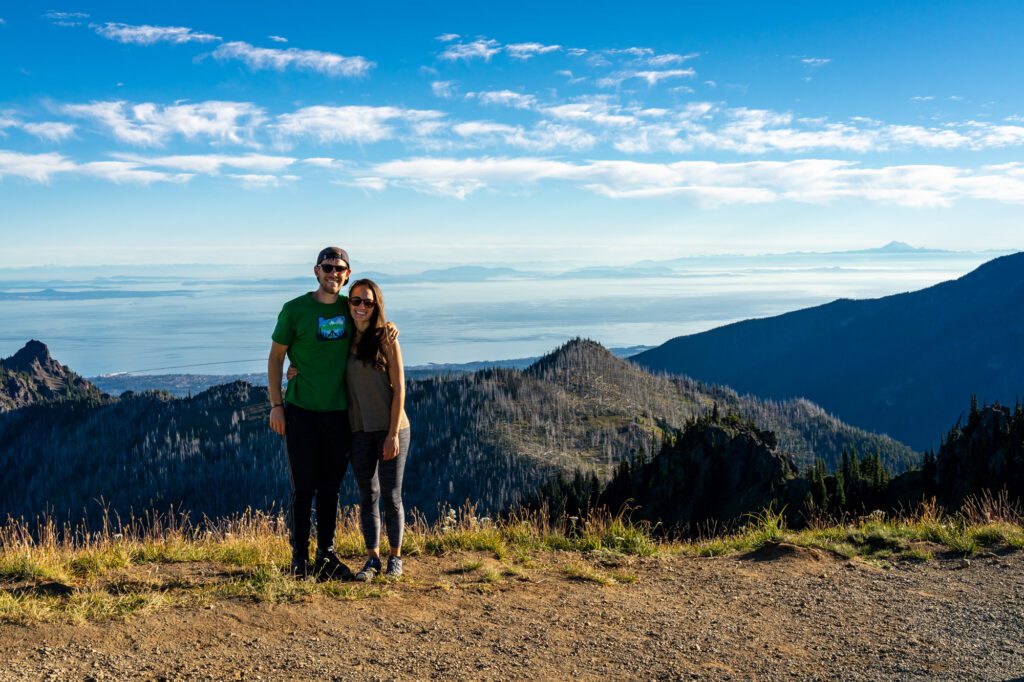
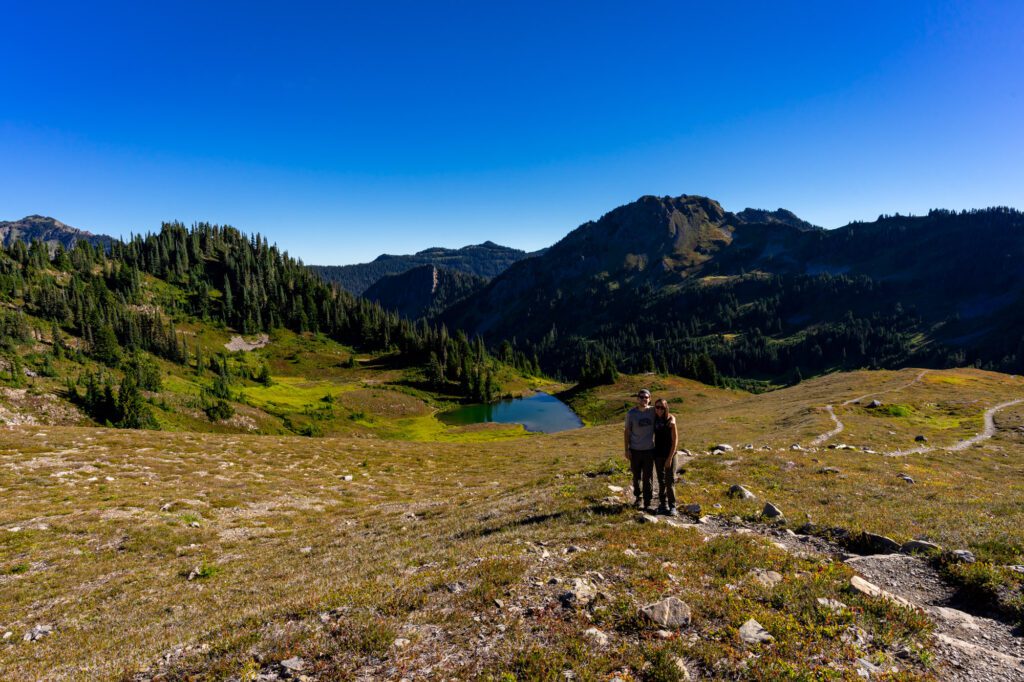
For us, Hurricane Ridge is all about the hiking. There are a bunch of hikes to do (we’re about to talk about five of them), and our suggestion is to pick one (maybe two if they’re the shorter ones) and take in the scenery.
The best bang-for-your-buck hike here is the short, paved climb up to Hurricane Hill.
From the top, you’ll have incredible views of the Strait of Juan de Fuca and British Columbia to the north (you can see Vancouver’s skyline and the city of Victoria), Mount Baker to the east, and the Olympics to the south, with towering Mount Olympus.
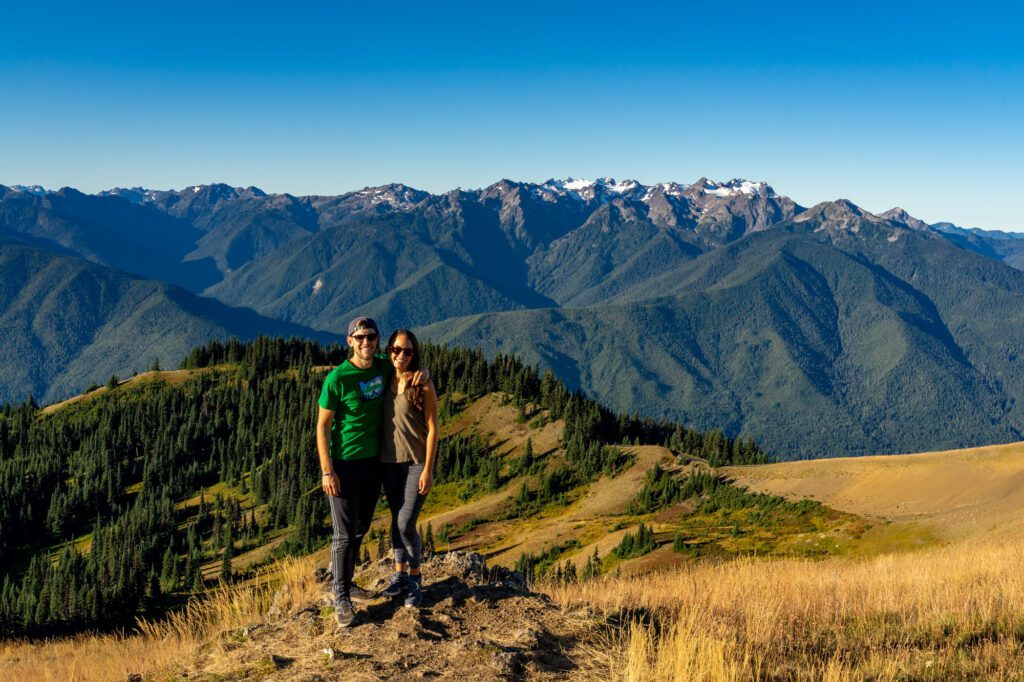

It’s the most popular trail in this section of the park, so unless you come around sunrise (which is what we did), don’t expect much solitude.
There are a few additional hikes that are worthwhile up here. We’re going to cover two of them in this section, and two of them in the Obstruction Point Road section immediately below this one.
All of them would be a worthy addition or swap for Hurricane Hill depending on how much hiking you’re up for.
These first two hikes take you north from Hurricane Ridge towards Klahhane Ridge and Mount Angeles, and the best access points for both of them are from along the road up to Hurricane Ridge (which results in a shorter and less intense climb).
Lake Angeles Trail: The preferred version of the hike to Lake Angeles takes you from just outside of Heart-o-Hills Campground up through the dense forest, and finally to a stunning alpine lake.
It’s a tough hike, gaining almost 2,500 feet of elevation over 7.4 miles.
You could also hike here from Hurricane Ridge, which is a much more scenic route where you hike along Klahhane Ridge with amazing views, but it’s a MUCH longer and harder hike (12+ miles, 4,500 feet of elevation – trail details here).
Klahhane Ridge: If the views I just mentioned sound like something you’re interested in, but you’re not up for the hike all the way to Lake Angeles, do the 5 mile hike along Klahhane Ridge instead.
You’ll gain 1,700 feet along the way, mostly at the beginning in a series of switchbacks through the forest, but once you get up onto the ridge you’ll have sweeping views, including views of Mount Angeles.
Drive Obstruction Point Road
Whether or not you’re going to do a big hike from one of the trailheads along Obstruction Point Road, we think you should probably drive it – if you’re up for a narrow, gravel road – for the views along the way.
Now I’ve seen a bunch of people call this “the scariest road in Washington” and my first reaction is that clearly they have not driven a whole lot of Washington forest roads, especially in the North Cascades near Mount Baker (which can be gnarly).
Still, Obstruction Point Road runs from Hurricane Ridge to the south, and is only eight (ish) miles long, climbing a touch under 1,000 feet or so along the way out.
The road is generally in good condition, so massive potholes and washouts aren’t really a concern here.
It’s definitely narrow and features a few blind corners, but if you’re used to driving some of those forest roads in the state, you’ll probably be fine as long as you take it slow and give plenty of time and space near those low-visibility spots.
Here’s a video of the drive (it’s sped up) so you can get a feel for what you’re getting into.
If you’re looking to do a longer hike away from the crowds at Hurricane Hill, there are a bunch of good hikes that leave from trailheads along Obstruction Point Road (including some extraordinary backpacking trips that are on our bucket list).
There is one hike in particular (with multiple variants) that stands out to us, and that’s the hike to Grand Lake, which leaves from the trailhead at the end of the road.
Ideally, you do the full Grand Lake loop that takes you to Grand Lake and back through Badger Valley, which clocks in at 8.5 miles and 2,700 feet of elevation gain.
There’s a shorter, more direct trail, but it only saves you about a mile of distance and a few hundred feet of climbing.
Another good option that requires a lot less mileage is Elk Mountain (4.5 miles, 1,400 feet of elevation gain). Great views of the Olympics!
Lake Crescent & Marymere Falls
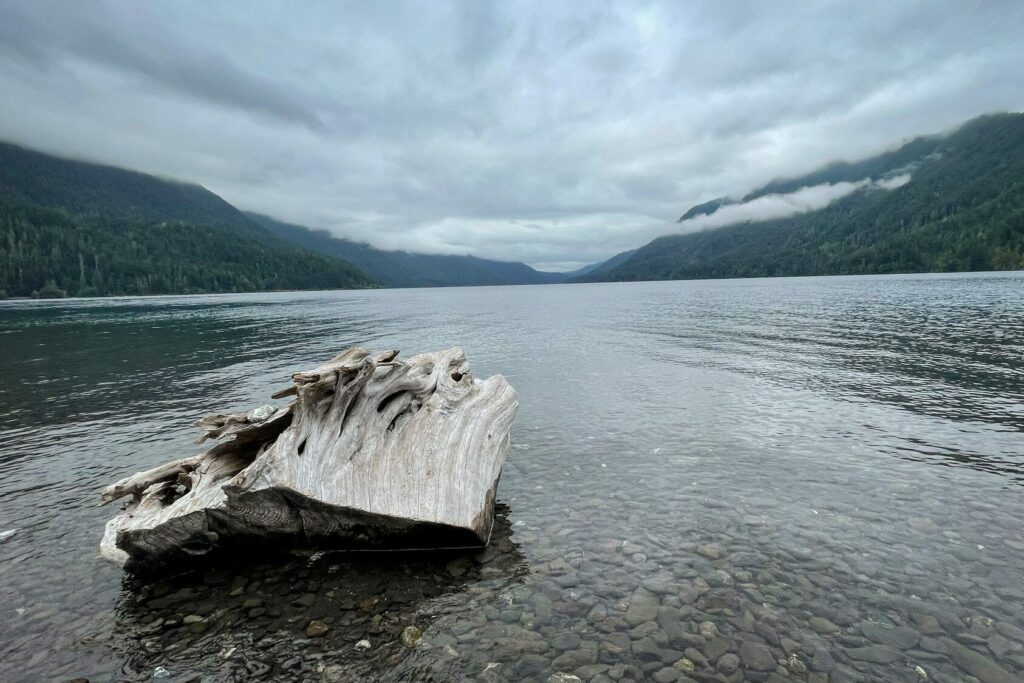
After your time up at Hurricane Ridge, come back down to sea level and head west to Lake Crescent, where you’ll find a few spots that are worth checking out.
If you park in the main parking lot (here on Google Maps), you can access all three places we’re going to cover in this section. This is also where you’ll find the historic and photogenic Storm King Ranger Station.
The first of the stops we like here is the relatively short and easy hike to Marymere Falls.
It’s a nice stroll through the forest, which is ferny and wet, and leads you to a 90 foot waterfall with multiple viewpoints accessible by climbing relatively steep wooden stairs.
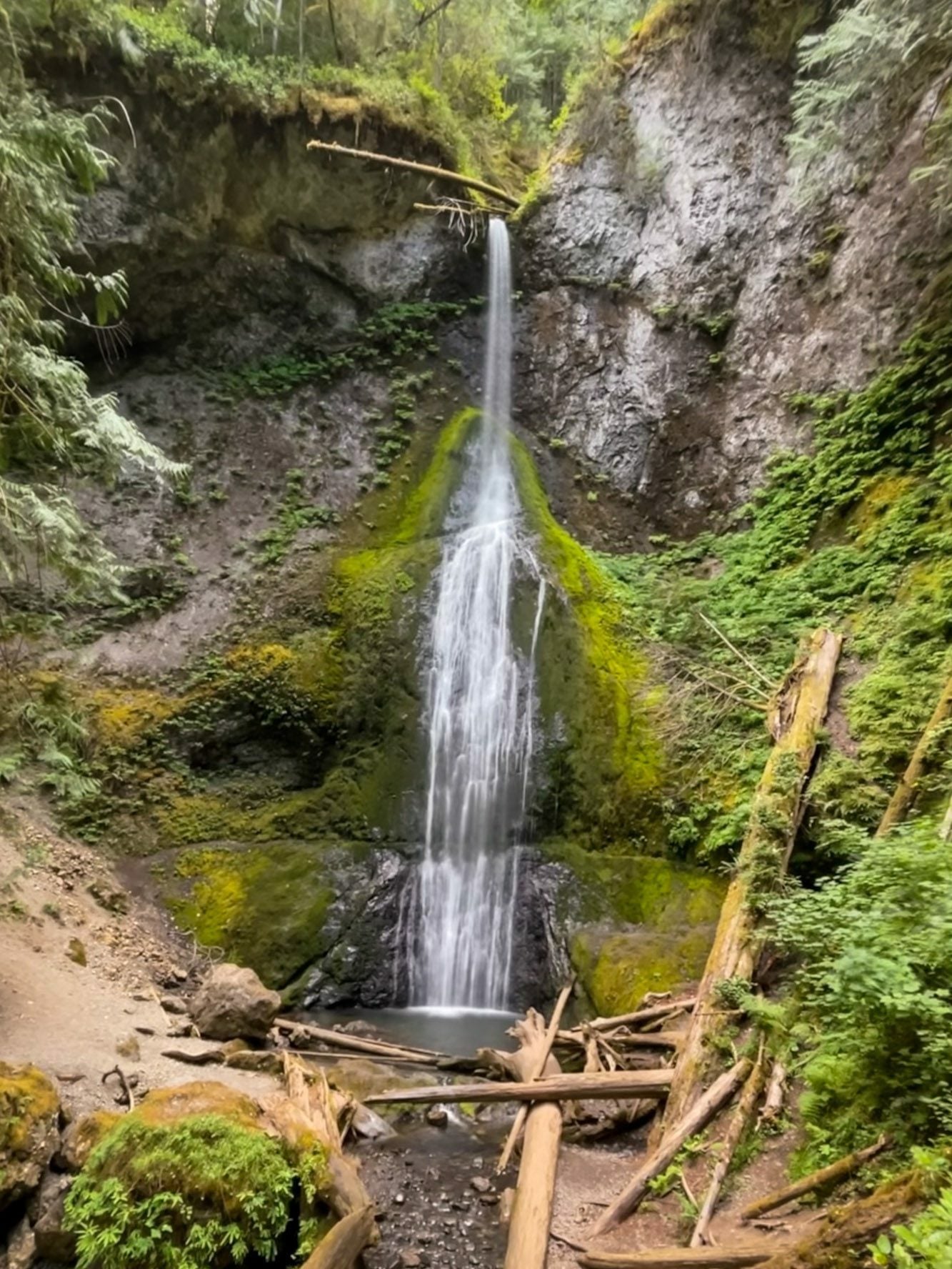
All-in, it’s a 1.8 mile hike round trip, with 500 feet of elevation gain. The end of the hike that takes you to the two viewpoints is the only piece of the hike that has any significant elevation changes.
Some people like to do the hike up to Mount Storm King, which we have done, but we actually wouldn’t recommend it.
To be honest, though, the hike itself really isn’t that cool. Or scenic. Or particularly fun.
The views at the top are nice, but the journey to get there is decidedly “meh.”
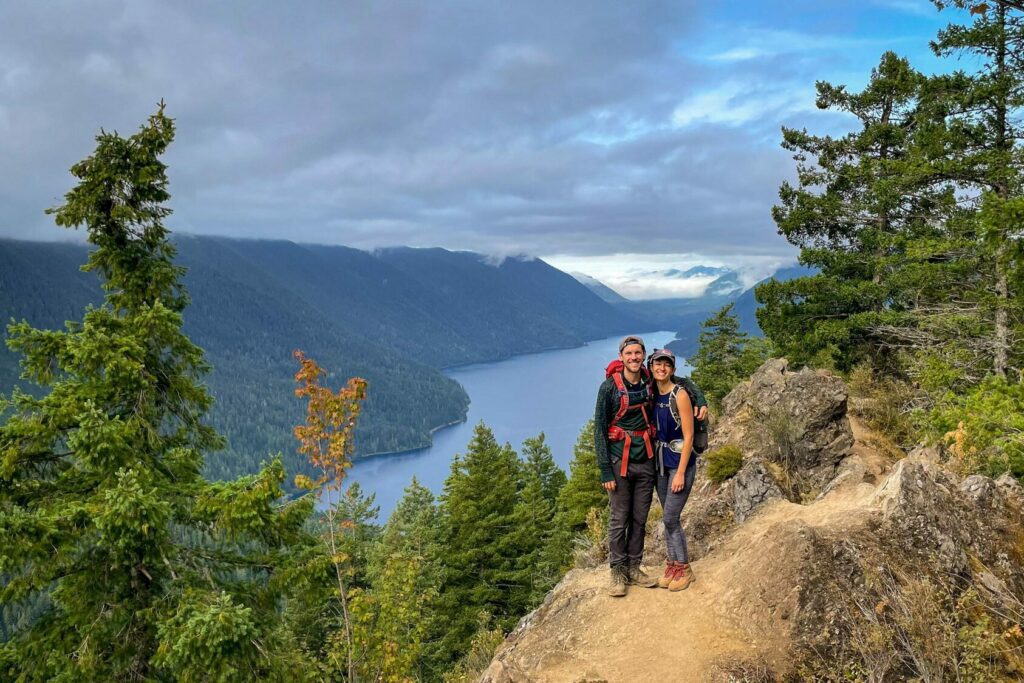
We discovered it because every PNW influencer has done an amazing sunrise or sunset photoshoot at the top, and the hike fell short of our expectations.
We’d opt for one of the two longer hikes near Hurricane Ridge before this one (and it’s not close).
It’s a relatively short and steep climb, and to get to the summit you’ll have to climb some cables and do some scrambling that might be a little much for people afraid of heights.
I suggest only doing this one if the weather is good because it can get pretty ugly up there when it’s not.
This hike is 4 miles roundtrip with an elevation gain of 2,065 feet, and leaves from the same trailhead as Marymere Falls.
It’s a slog, and there are many better hiking options in the park (here’s our guide to the best hikes in Olympic National Park).
The second place we like here is the Lake Crescent Lodge.

While we wouldn’t necessarily recommend staying here (high prices, rooms that need some TLC), it’s a nice place to visit right on Lake Crescent.
The historic lodge was built way back in 1915, and is one of the oldest national park lodges in the country.
You can grab a drink or a meal at the bar/restaurant onsite, rent a canoe or kayak and do some exploring on the water, or just grab one of the adirondack chairs on the rocky lakefront beach and relax.
Sol Duc Falls
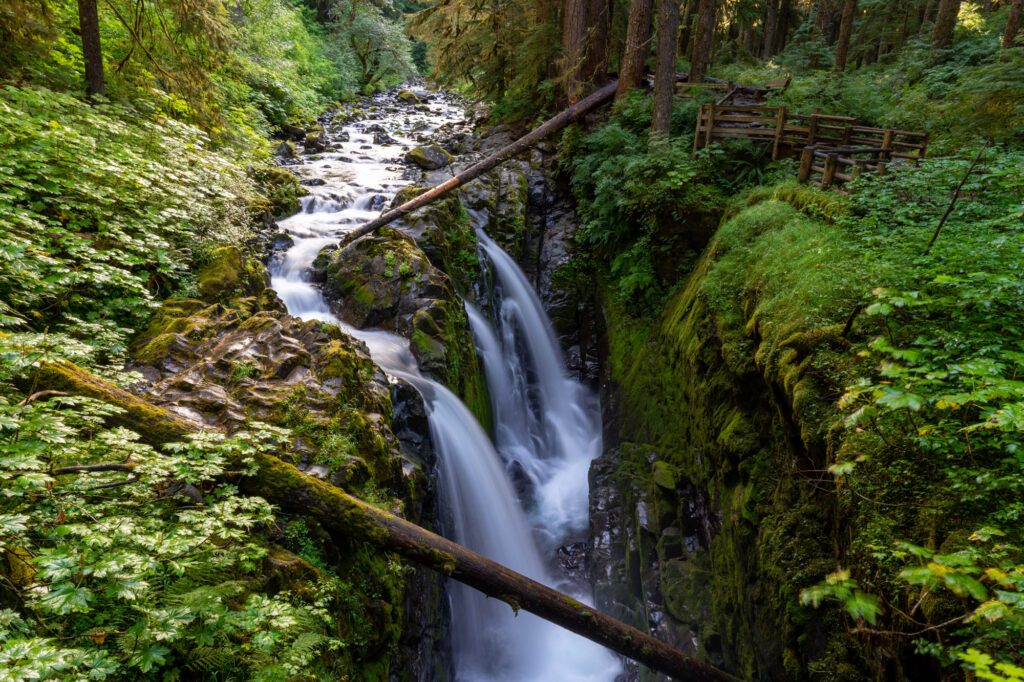
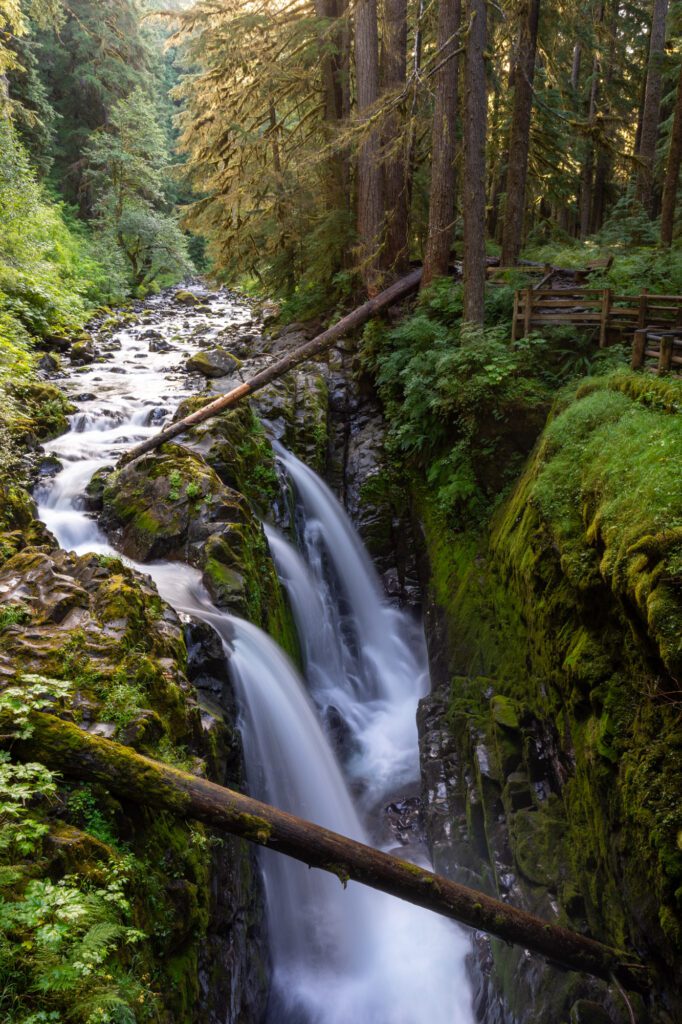
After you’re done hanging out around Lake Crescent, close out your first day in the park by heading to our favorite waterfall in the park, Sol Duc Falls.
To get there, you’ll drive up Sol Duc Hot Springs Road, which heads south from a junction just west of the far end of Lake Crescent.
It’s a long-ish drive out to the trailhead, where you’ll pass Sol Duc Hot Springs Resort (yes there are hot springs to soak in if you’re into that, but it’s a little gross to us because it’s packed with people) and continue to the end of the road.
From the trailhead, it’s a short, mostly flat walk to get out to Sol Duc Falls, our favorite waterfall in the park.
The hike through the forest will be 1.6 miles and have an elevation gain of just 200 feet, so just about everyone can do it.
You end up on a wooden footbridge standing over the falls looking up the gorge where the Sol Duc River flows.
It’s a nice walk through the forest that is every bit as charming and beautiful as the much more visited rainforests in the park.
This is also the trailhead for the High Divide / Seven Lakes Basin trail, which we backpacked a few summers ago and is one of our favorite hikes in Washington State (though it’s best as an overnight trip with 2-3 nights spent along the trail).
Day 2: The Northern Pacific Coast (Shi Shi + Cape Flattery)
On your second day, you’ll head west towards the coast to take in the sights on the remote northern Pacific Coast.
Part of the reason we’ve organized your time in this specific way is to have you going to Cape Flattery – the northwestern corner of the contiguous United States – from Port Angeles instead of Forks.
The drive along the Strait of Juan de Fuca Highway (Highway 112) from Port Angeles to Neah Bay is beautiful, with multiple stops that are worth getting out of the car to see and stretch your legs a bit (Crescent Bay and Twin Beach are two good stops).
The day will start with that drive, explore the sights on the northern Pacific Coast (Cape Flattery, Neah Bay, and Hobuck Beach), and then continue south to Shi Shi Beach and, eventually, end in Forks, which you’ll use as a home base for the rest of your trip.
It’s a lot of driving, but we’ve set it up this way to make the drive as scenic as possible (the drive from Forks or along 101 past Lake Crescent isn’t nearly as beautiful).
An important note here: Many of the sights today are on the land of the Makah Tribe, and you need a specific recreation pass from the tribe to access them.
You can get one at the Makah Cultural & Research Center Museum (here on Google Maps), which is on the way from Port Angeles, or at the other places mentioned in the page we linked above.
Cape Flattery & Hobuck Beach
Start your day with the drive up to Cape Flattery, which is the northwestern corner of the continental, mainland United States (technically the San Juan Islands are further north).
There’s a 1.5 mile hike (roundtrip) out to a viewpoint, where you’ll have a nice view of the place where the Strait of Juan de Fuca meets the Pacific Ocean. There’s a lighthouse just offshore.
It’s an easy hike along a boardwalk for most of the way, and you’ll find yourself in a towering forest of sitka spruce trees, which is peak coastal Pacific Northwest for us.
Because it’s a short hike, it’s going to be a busy one. But not early in the morning! That’s why we have this first on the itinerary.
On the way back towards Neah Bay, it’s worth stopping by Hobuck Beach (here on Google Maps), which is a nice, wide, sandy beach with a resort on the southern end.
Shi Shi Beach
From Hobuck Beach, it’s a relatively quick drive south to the trailhead for the hike out to Shi Shi Beach.
The trail stats might scare you off, but you should know that it’s a relatively easy two mile walk out to the beach itself.
The longer part of the hike is the flat stroll along the beach out to the south end of the beach, which is where you’ll find Point of Arches.
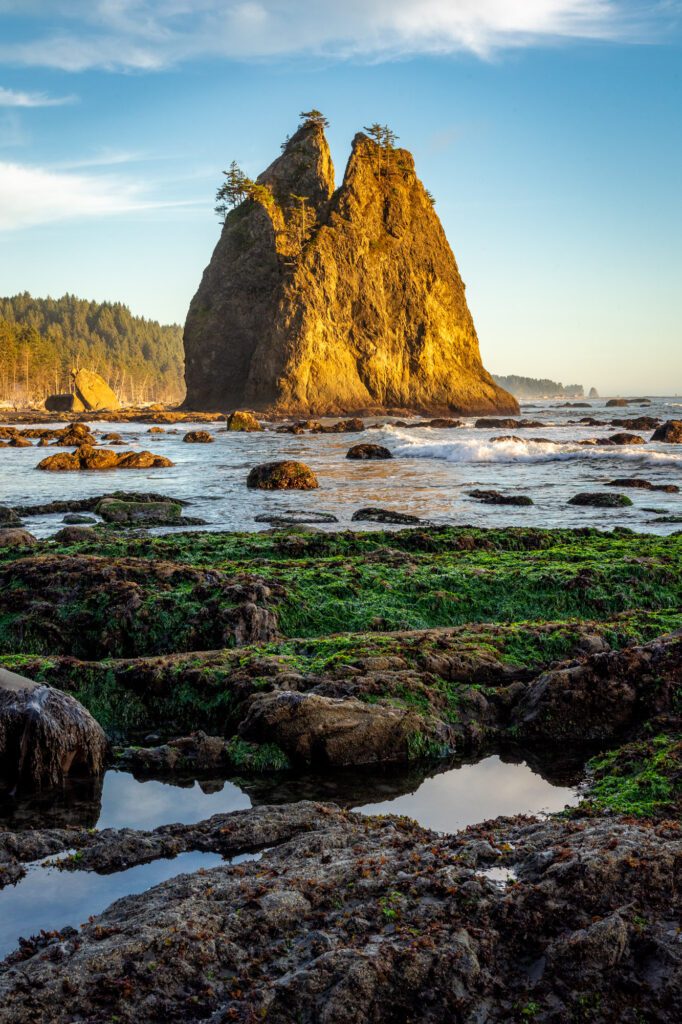
Point of Arches is a collection of sea stacks – probably the best in the park – that take a little extra effort to get to, but are well worth the journey.
It’s a full 8.5 miles (ish) to get out there (and back). Make sure to bring plenty of water, snacks, and rain gear.
Point of Arches is best at low tide, when the tide pools are visible. Check tides here.
You can camp overnight on Shi-Shi beach, which is one of the coolest things to do in the park, we think.
You’ll need both a Makah permit and a park wilderness permit, along with a bear canister to store your food. More information here.
Lunch in Neah Bay & the Makah Cultural & Research Center
After your long drive and busy morning, head back into Neah Bay for a well-earned lunch and some learning about the Makah Tribe, whose land you’ve spent the morning exploring.
If you have a packed lunch, we’d recommend enjoying it on one of the beach stops earlier in the day.
If you’re looking to grab lunch in Neah Bay, there are only a handful of places to eat in Neah Bay, but the place we’d go is BIGGINZ for fish and chips. When in Rome, right? FYI – it’s cash only.
It’s also worth stopping by Take Home Fish Company across the street for freshly caught smoked salmon that is quite literally smoked in front of you.
After lunch, head to the Makah Cultural & Research Center which has exhibits that cover the history and culture of the Makah, including a replica longhouse and a bunch of artifacts from the archaeological site at Ozette Lake (just a bit south of Neah Bay).
Day 3: The Hoh Rainforest and La Push Beaches
On your last day in the park, start your day bright and early in the Hoh Rainforest, which is the busiest part of the park, and then finish your trip by exploring the beaches lining the central Pacific Coast, ending at Rialto Beach to do a sunset beach walk.
The Hoh Rainforest Bright & Early
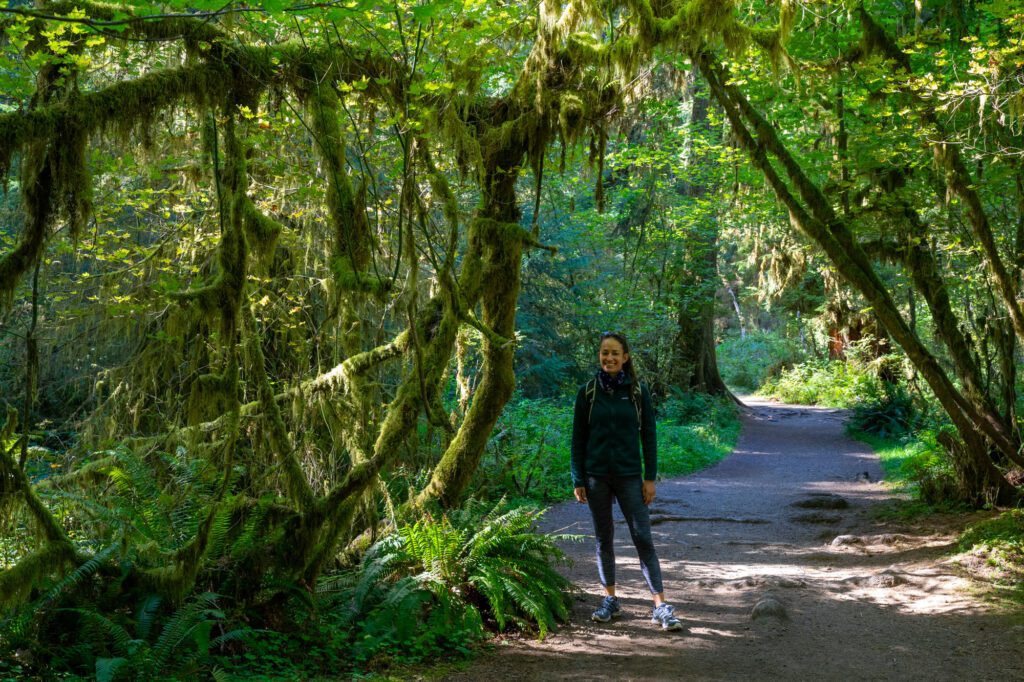
Head STRAIGHT to the magical Hoh Rainforest. I suggest you get there as early as humanly possible.
That way, you will get to experience the sublime ambiance of the rays of sunlight streaming in through the dense forest canopy. You may even get to spot some Roosevelt Elk!
Olympic National Park was put on the path to becoming a National Park in part to protect the calving grounds of these elk at the base of Mt. Olympus.
Teddy Roosevelt made it a National Monument in 1909, and it became a National Park in 1938 thanks to FDR.
The parking situation at the Hoh Rainforest is extremely limited, which means they’ve started limiting capacity at the entrance station during peak times with a one car in, one car out policy.
Between 10:00 am and 5:00 pm, there will be a line on a summer weekend.
We know, because we accidentally got a late start last time and got caught in an hour wait to park.
Do yourself a favor and get there by 9:00 am at the latest, both for the best experience in the rainforest, and so that you don’t have to wait for parking.
Also, the early morning is the best time to visit because there won’t be that many people around, making it more of a solitary experience with the rainforest.
The ambiance is much more pleasant without hundreds of people talking and kids screaming. Believe us.
Once midday rolls around, there’s tons of people, given how accessible it is to explore. Keep that in mind, so you get to enjoy it to its fullest.
There are a couple of short hikes to do here, and a longer option that is customizable to what you’re up for.
Hall of Mosses: The Hall of Mosses is a short 0.8 mile loop through lush rainforests where you will see moss-covered trees, banana slugs, elk, and more. There’s also plenty of signage with helpful information about everything you’ll be seeing.
Spruce Nature Trail: The Spruce Nature Trail is a 1.2 mile roundtrip stroll through the Hoh Rain Forest that takes you through ancient groves and relaxing areas of this exceptional rainforest.
The Hoh River Trail: If these Hoh Rain Forest hikes are too short for your liking, you can also hike part of the Hoh River Trail.
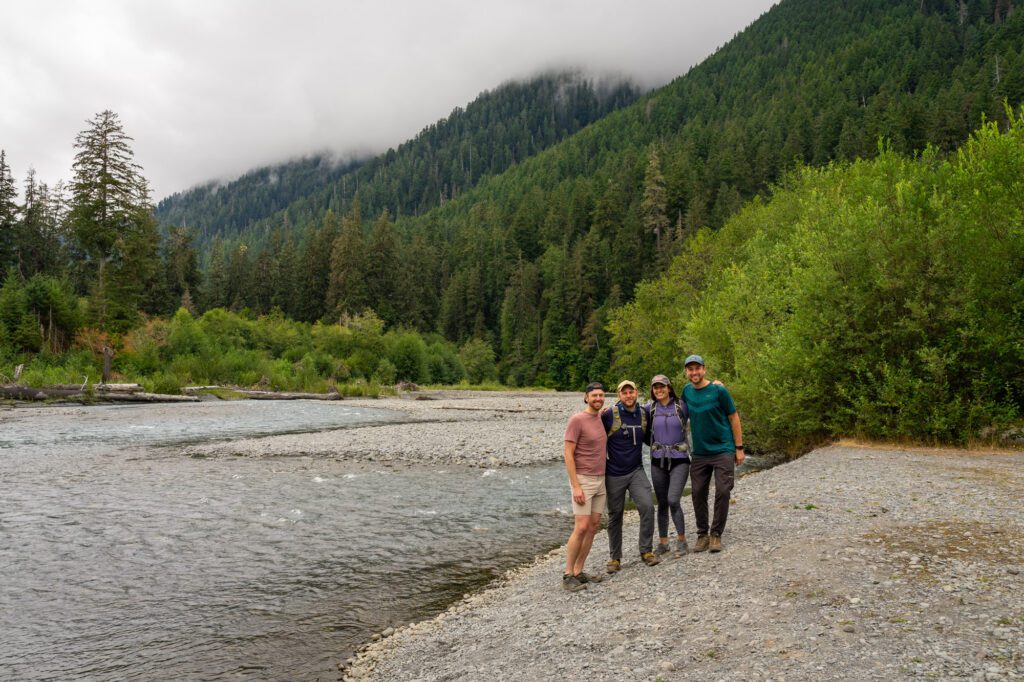
This is a 37-mile (59.5 km) backpacking trail that takes you all the way out to the base of Mount Olympus, so if you’re following this itinerary you’ll just want to hike a few miles along the river before heading back to make it to the beaches.
We’ve done the hike out to Mineral Creek Falls, and it’s a lovely hike that’s basically flat the entire way.
Ruby Beach
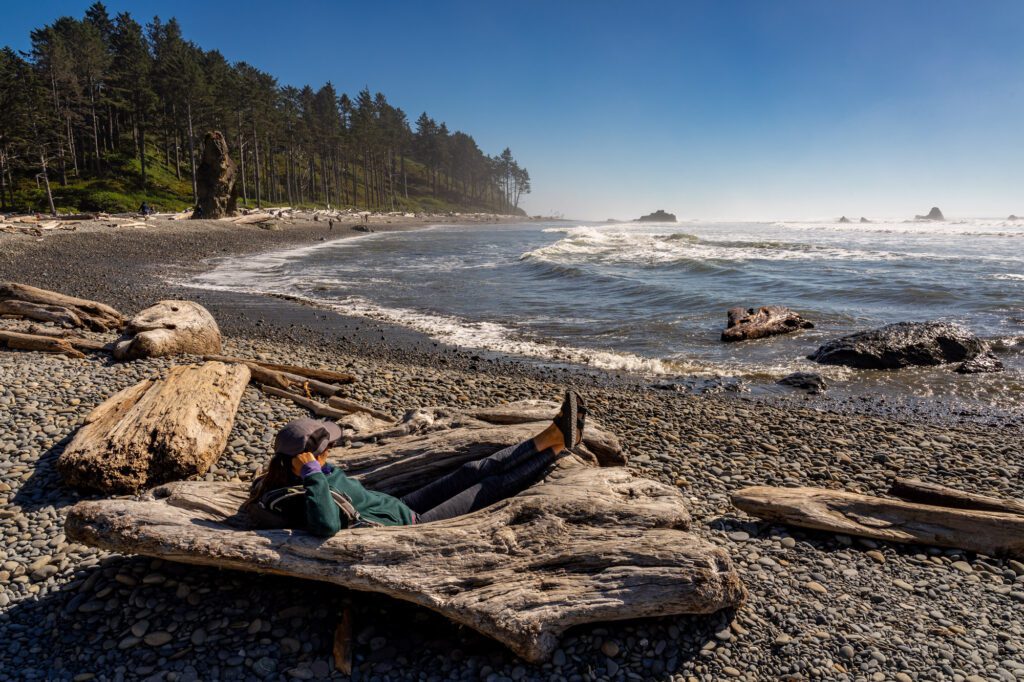
Ruby Beach is a little bit of a detour from the Hoh Rainforest, but we think it’s worth it.
From the turnoff to the Hoh Rainforest, you’ll take a left and head south on 101 for 15 minutes to reach the parking lot.
Ruby Beach is probably our second favorite of the Pacific Coast beaches (after Rialto, which you’ll hit later in the evening).
The driftwood on the beach and the sea stacks just off the coast are gorgeous, and impress us every time we’re here.
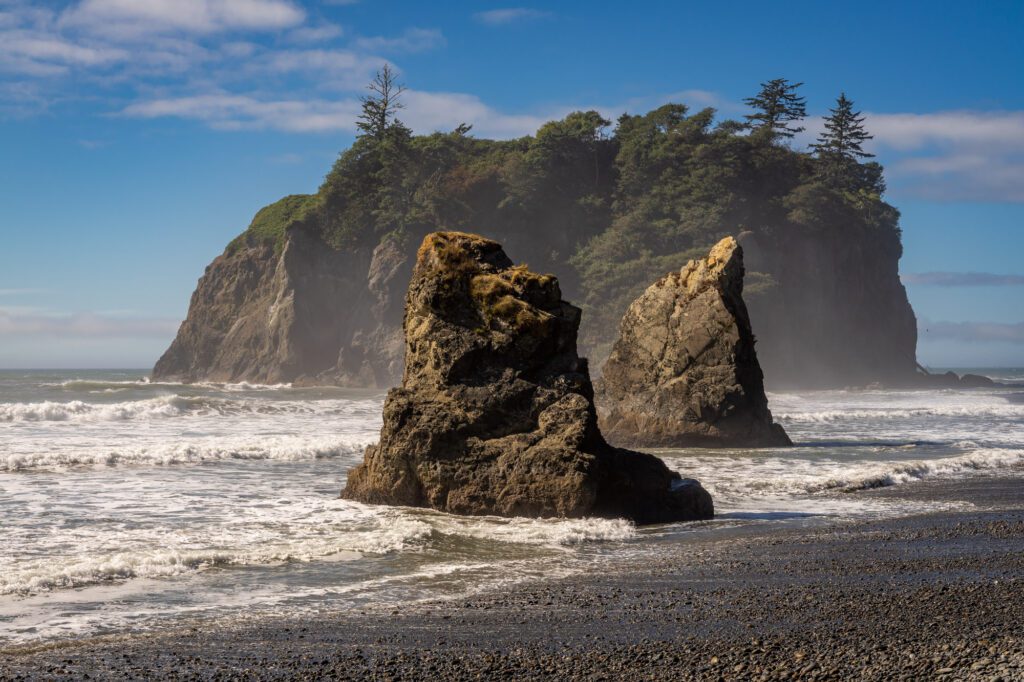
If you’re up for another beach walk, do at least a part of the 6 mile round trip hike that looks out onto sea stacks and Abbey Island.
If you happen to be here at low tide, you may even see some starfish and other sea life while you’re at it.
The La Push Beaches (First, Second, and Third)
Give yourself the rest of the afternoon to enjoy all of the beaches near La Push!
These are going to be easy-going and mellow hikes. Actually, they’re more like strolls and long walks on the beach, which I have been known to love.
Before you Google it, yes, the names are actually First, Second, and Third Beach. Second is the best of the bunch, but they’re all worthwhile.
First Beach: The small coastal village of La Push is your entryway to First Beach. Stroll along a mile-long sandy beach that has views onto sea stack islets and large waves.
There is plenty of driftwood to look through and potentially find a souvenir.
Second Beach: This beach is an unsung jewel of wild beaches. There’s two miles of a sprawling sandy beach here, as well as a lagoon, sea stack islets, tide pools, driftwood, and tons of sea life.
There aren’t that many people here, which makes it a very peaceful place. It’s a short hike from the parking lot – nothing too crazy at all for families with kids.
Third Beach: Third Beach is significantly less visited because of the 2.8 mile hike (round trip) that you’ll need to do to access the beach.
The trail takes you through towering trees until it reaches a creek that flows into the Pacific Ocean. The sunsets at this, and the other beaches, are postcard-perfect!
Sunset on Rialto Beach
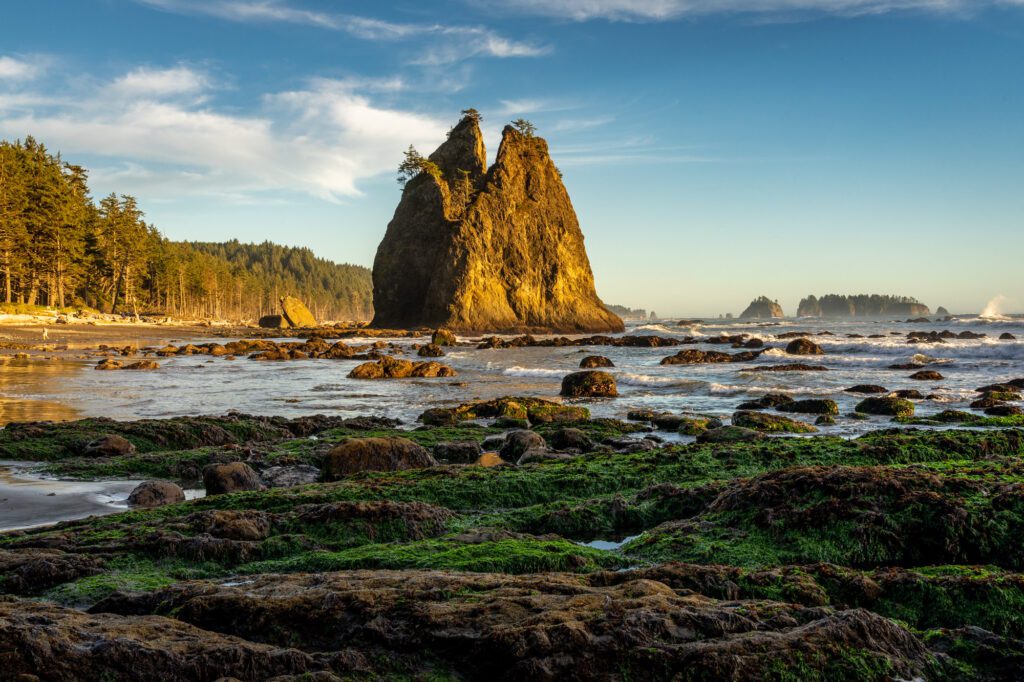
The evening is the perfect time to catch that glorious Pacific Ocean sunset that you have to see in person to truly believe.
The sunset at Rialto Beach is one of the top memories of our two year US road trip.

The picturesque sea stacks emerging from the ocean add to the breathtaking backdrop of the daily sunset. Plus, we saw multiple bald eagles hanging out in the trees.
You should know going in that it’s coastal, so there’s a pretty high chance that you won’t be able to see a sunset at all because of the fog or clouds that enshroud this part of the world for most of the year.
However, if it’s a clear day, you’re in for a treat.
If you want to have the best chance of seeing a sunset here, you should come during the summer months.
However, it will stay chilly year-round, so bring something warm to wear.
You definitely shouldn’t miss the stroll down Rialto Beach to an incredibly gorgeous spot called the Hole-in-the-Wall. Which is pretty much exactly what it sounds like, only prettier.
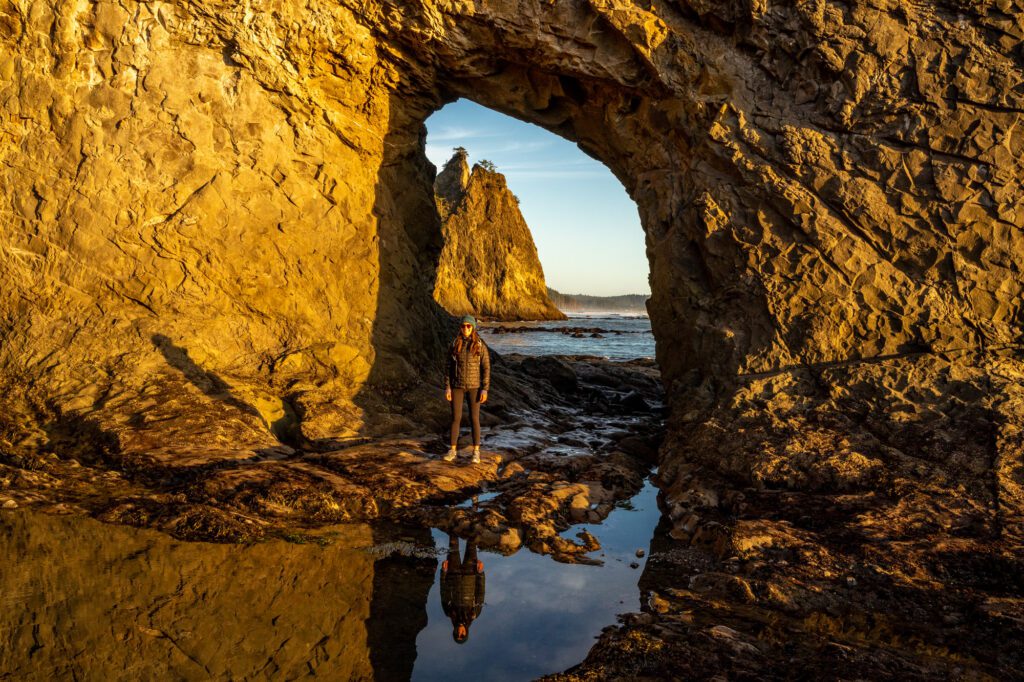
To get there, you’ll walk for about an hour down the beach, passing by a couple of incredible sea stacks that tower above you.
Eventually, you’ll reach a point where a natural arch has formed in the wall thanks to countless years of erosion.
There are some pretty cool tidepools on either side of Hole in the wall to explore – remember not to touch or disturb the sea life!
Make sure to check the tides – you need to do this walk at low tide, otherwise you’ll either not be able to get there, or you’ll get stuck out there and have to do some rock climbing to get back. We used this site to check tides.
What to Do with More Time in Olympic National Park
If you’re lucky to have more time in the park, here are a few things we’d add, along with the amount of time you’ll need.
With an extra day, the first thing we’d add is the journey south to Kalaloch and Lake Quinault for more great beaches and rainforest action.
The Kalaloch Beaches (+2-3 Hours)
Just south of Ruby Beach is Kalaloch Lodge and the many sandy beaches surrounding it.
There’s a nice campground here, and it’s also where you’ll find the Tree of Life, a tree whose roots have been exposed after years and years of erosion.
There are four wide beaches to explore here. You can find more information on the area here.
You can stay at the Kalaloch Lodge in one of their lodge rooms (hotel-style), or one of the oceanfront cabins.
For the price, the facilities are a little rundown (as they tend to be in national park lodges, which are almost always at full capacity), but the location and ambiance can’t be beat.
Book well in advance – it’s completely full during the summer.
Like we mentioned, you can combine this area with Lake Quinault for a fourth day on this itinerary. Plus, if you do that, you can follow 101 south to loop back to Seattle or Portland.
Lake Quinault & the Quinault Rainforest (+2-3 Hours)
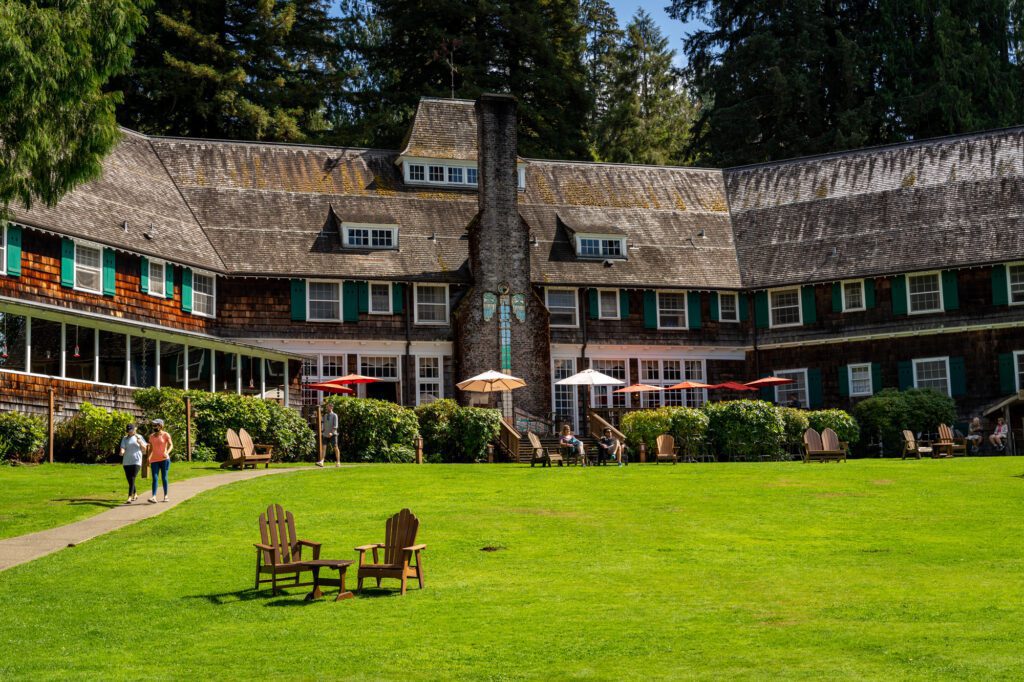
On the southern Pacific Coast, you’ll find another lake and another fern-laden rainforest waiting for you.
Just like with the Hoh Rain Forest, the Quinault Rainforest gets packed.
I’d actually recommend heading here later in the day when the crowds start to thin.
The Quinault Rainforest Nature Loop is a quick milelong trail that takes you through an incredibly mossy forest with a dizzying array of fungi and animals.
Lake Quinault is a massive glacier-fed lake that is surrounded by mossy old-growth rainforest.
It is around this lake that you will find some of the most massive Sitka Spruce trees in the entire world! It’s no wonder it’s called the Valley of the Giants.
There is a 31 mile road that circles the entire lake that is a great place to do some wildlife spotting.
Head out around sunset and you might see some elk, black-tail deer, bald eagles, bobcats, and the occasional black bear.
Add Another Hike at Hurricane Ridge (+½ Day)
If you’re into hiking, the first place we’d add time is Hurricane Ridge, where you can do one of the other hikes we mentioned in that section like Grand Lake or Klahhane Ridge.
Add a Backpacking Trip (+1-3 Days)
Over the past few years, we’ve had the privilege of tackling two amazing backpacking trails in Olympic National Park, and loved them both.
Keep in mind that you’ll need a bear canister for any overnight camping – including on the beach – in Olympic National Park.
We have this one, and highly recommend it. Other friends have one of the clear, screw top ones, and prefer using ours.
If you’re planning to do any overnight backpacking, make sure to stop at the ranger station in Port Angeles to get your backcountry permits, bear canisters (for rent if you need them), and information about the park.
If you’re 16 years old or older, it will cost you $8 per night (plus a nonrefundable service fee).
Any overnight stay in the wilderness will carry this fee, so make sure you get your wilderness permit ahead of time. You can also print them at home ahead of time.
More information on backpacking in the park here.
The High Divide / Seven Lakes Basin
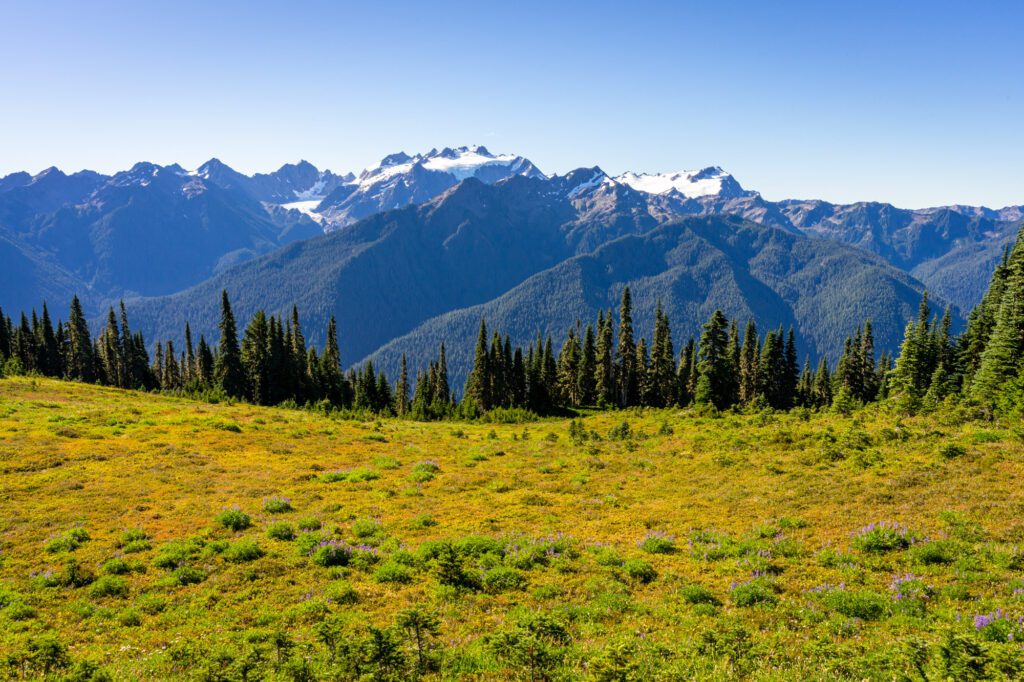
The first we did was the High Divide / Seven Lakes Basin, which is about as spectacular a backpacking trip as we’ve ever done.
You’ll start from the Sol Duc Falls parking lot, and make a big 19 mile loop that takes you up to the High Divide, a rocky ridge with spectacular views of the Olympics and the Seven Lakes Basin below.
Along the way, you’ll pass several spectacular alpine lakes, including our favorites Heart Lake and Lunch Lake. You’ll need to snag permits as early as possible – they routinely sell out, especially in recent years.
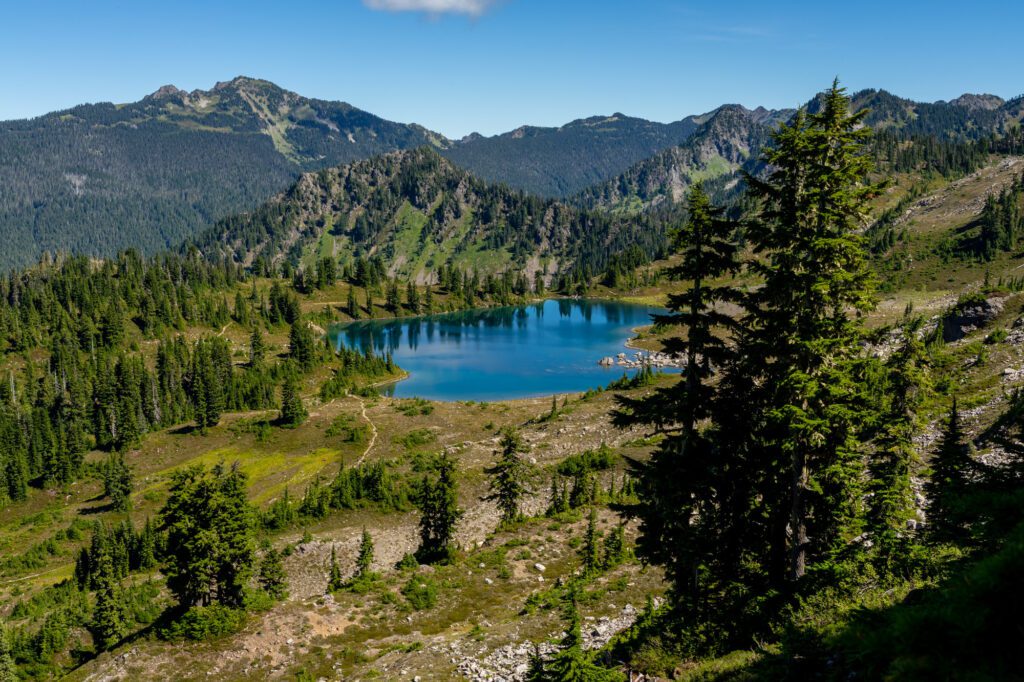
Do it in three days / two nights, spending one night up on the High Divide (at Lunch Lake!), and one night at Deer Lake or Sol Duc Park (depending on which direction you want to hike).
We liked doing it clockwise, which is a more gradual climb up and an easier climb down, but you could easily do it in the other direction.
The Enchanted Valley
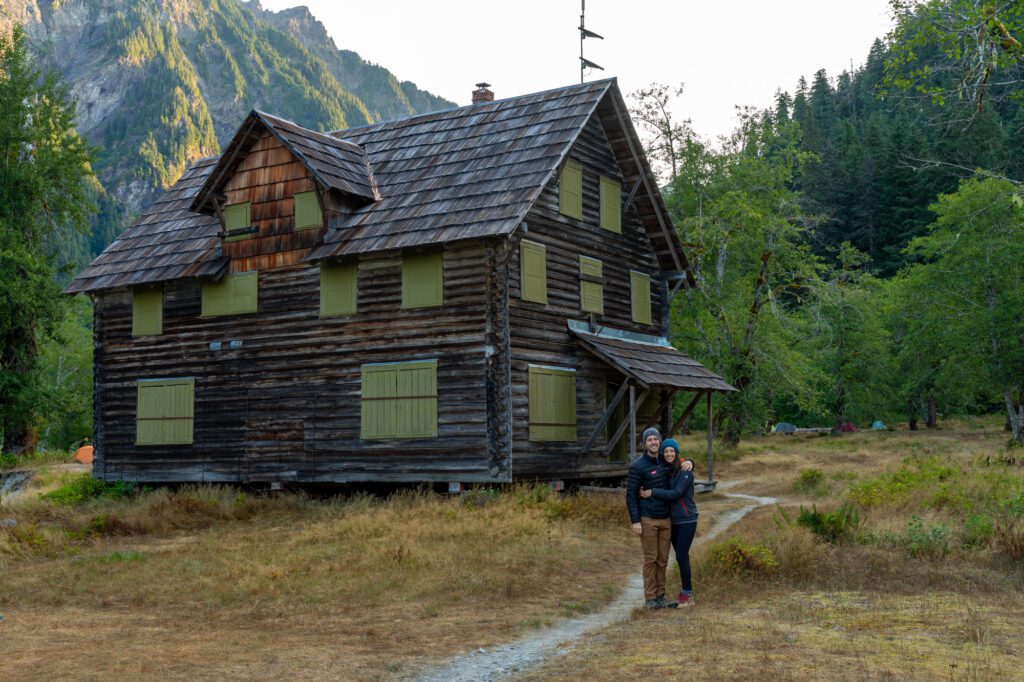
The second backpacking trip we did was the Enchanted Valley, which we tackled midweek a few summers ago.
This one is less about the spectacular mountain views, and more about hiking into a beautiful, secluded valley only accessible to people willing to hike the 13 miles in.
We did three days / two nights here, but would recommend an extra night if you can swing it because hiking the entire 13 miles in one go was a little much.
Better to spend a night on the trail there and back to break up the long days.
Definitely make sure to spend a night in the valley itself, which is where you’ll find the picturesque chalet that’s in all the pictures (it’s not actually being used at the moment).
We loved this hike, though the valley isn’t so secluded these days (there are routinely 100 people camping in the valley on summer weekends).
We have an entire guide to hiking the Enchanted Valley Trail which you should read for more details, like the best trip length, campsites, and how to get permits.
What to Do with Less Time in Olympic National Park
As we mentioned above, the first thing we’d cut with less time is the northern Pacific Coast, which is just a long way from everything else in the park.
With two days or less, focus on Hurricane Ridge, Lake Crescent, the Hoh Rainforest, and the central Pacific coast beaches.
Olympic National Park in 2 Days
If you have two days in Olympic National Park, we’d devote one day to each area (the two areas being Hurricane Ridge/Lake Crescent and Pacific Beaches/Hoh Rainforest).
Spend your first morning at Lake Crescent, doing the hike to Marymere Falls and adding the climb up to Mount Storm King if you’re feeling adventurous before heading to the Lake Crescent Lodge afterwards.
Then, take a slight detour out to Sol Doc Falls, and head up to Hurricane Ridge for the afternoon and sunset. Hike Hurricane Hill around sunset for an unforgettable experience.
On your second day, head out towards Forks and make a beeline straight for the Hoh Rainforest.
Try to arrive as early as you can to avoid the crowds and the lineup at the gate. Hike the Hall of Mosses and part of the Hoh River Trail to see the dense, wet rainforest in all its glory.
From there head down to Ruby Beach for a picnic lunch and to admire the sea stacks just offshore.
End with a walk on Rialto Beach out to Hole in the Wall for an unforgettable sunset.
Olympic National Park in One Day
Like we mentioned above, Olympic National Park really isn’t a great day trip destination (if you’re looking for a day trip, make sure to read our guide to the best day trips from Seattle!).
However, if you have only one day and one night in the park, we’d focus on the northeastern corner around Hurricane Ridge, Lake Crescent, and the Sol Duc Valley. Which means you can follow day 1 of this itinerary as written!
Planning a Trip to Olympic National Park? You won’t want to miss our detailed guides to visiting the Olympic Peninsula that are all based on our own personal experience exploring the park.
- All of our Favorite Things to Do in Olympic National Park
- How to Plan a Perfect Olympic National Park Itinerary (3-4 Days)
- Where to Stay in Olympic National Park: A Complete Guide
- The Best Hikes in Olympic National Park: A Helpful Hiking Guide
- Hiking the Enchanted Valley Trail: A Perfect 2-3 Day Backpacking Trip in Olympic National Park

Thank you so much for this detailed Itinerary! Best one Ive found. I am planning my July Seattle/ Olympic park trip based off all your recommendations 🙂 My Bf and I are from Florida, first time in the PNW.
We are getting to Port Angeles hotel pretty late in the afternoon (6;30-7;00ish) pm and I’m wondering if the hurricane ridge hike is do-able then. I saw sunset is >8pm in Mid july.
Thanks in advance ! 🙂
It’s probably going to be too late since the drive up to Hurricane Ridge from Port Angeles takes ~45 minutes. The hike is only a mile and a half, so if you arrive on the early end of that window (closer to 6:30) you MIGHT be able to squeeze it in. It’ll be tight, though.
We are planning to hike and stay in around the Olympic Peninsula later this summer. I love all your tips for hiking. Do you have any recommendations for restaurants that have gluten free (Celiac) options in this area?
Sure do! There’s really nothing in Port Angeles or Forks, so plan on cooking your own meals. BUT, in Sequim, you’ll find Nourish Sequim, a 100% gluten free farm-to-table restaurant with chicken pot pie and amazing desserts. Definitely stop there either on the way there or back (or both). It was our post-backpacking meal last time we were out there.
Would any of these locations on this itinerary not allow dogs?
Thanks.
Since you’re in a national park for most of this, dogs are ONLY allowed in places where you can take your car (e.g. parking lots, campgrounds, etc). The only exception is the first half mile of Rialto Beach, where dogs are allowed. No dogs on hiking trails, beaches, or anywhere else, which means it might be best to leave the pup at home if you really want to do this itinerary.
Hi,
We are staying in Forks for a few nights and are looking for restuarant suggestions. They do not need to be gluten free but if you have heard of good places there we are up for ideas.
Thanks for all this info…incredibly helpful!
Beth
We always pack our own food, so I don’t have any restaurant recommendations in Forks. Sorry! In Sequim (on your way home), definitely stop by Nourish Sequim, which is 100% gluten free!
Hi,
Any advice for doing this trip in late December? I’ll be heading there from Seattle for 4 days with 6 people. Also, I was recently diagnosed with Celiac Disease and was wondering if you have any advice for traveling and eating out gluten free safely (this is first major trip since being diagnosed)? I’m aiming to book an airbnb in Port Angeles so I can cook my own food and mostly avoid eating out.
Thanks!
Hey Tyler,
Sorry for the delay on this – we’ve been on the road and missed this comment.
For the most part, I’d say plan on cooking for yourself. There’s not a whole lot of places to eat gluten free on the Olympic Peninsula.
BUT, you should stop by Nourish Sequim (https://www.nourishsequim.com/) which is a 100% gluten free restaurant / bakery on the way out to Port Angeles. Highly recommend – we stop there every time we’re going to / from Olympic National Park.
Cheers,
Matt